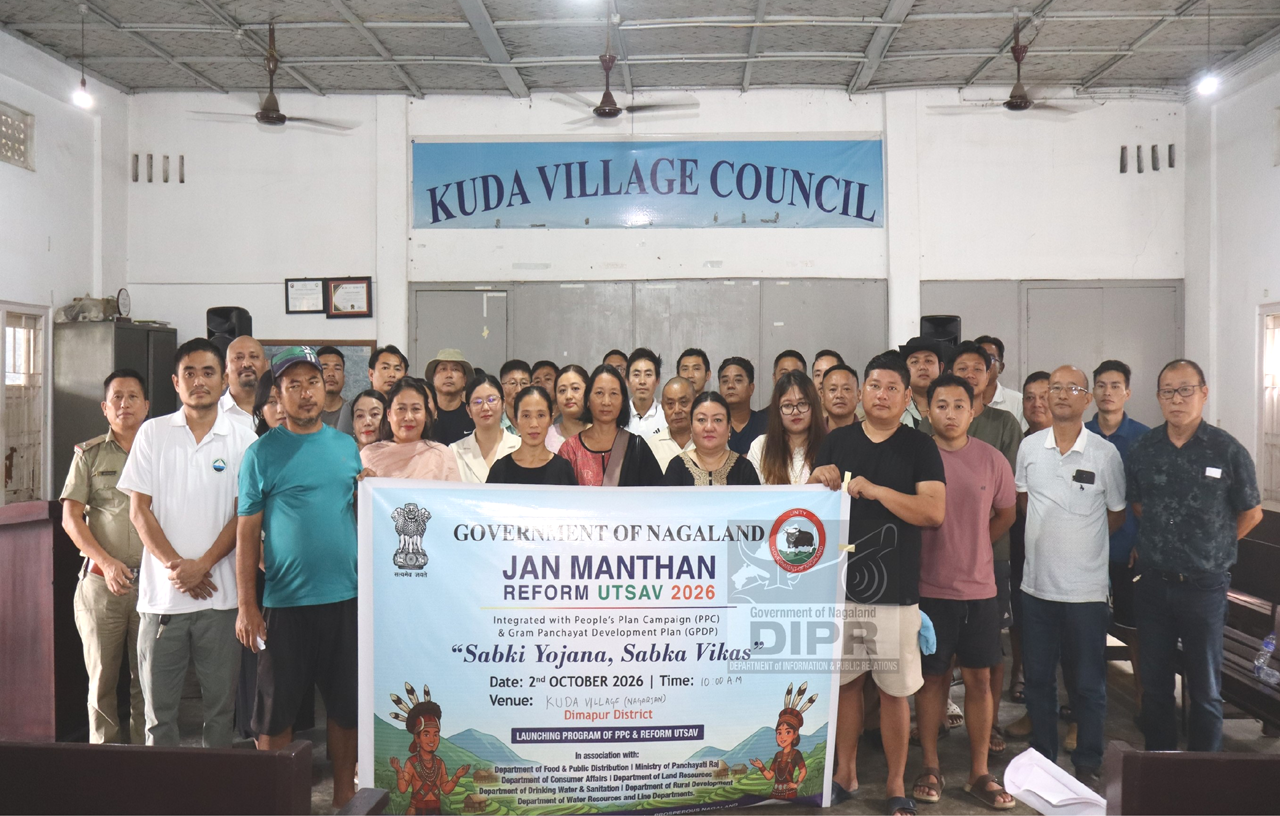
(GPDP) was launched at Kuda Village (Nagarjan) in Dimapur district on October 2, 2026.
The programme, chaired by Jacob Zeliang, Block Development Officer (BDO), RD Block West Dimapur, focused on creating awareness about citizen-centric reforms, government schemes and services.
The launch featured a brief presentation on Reform Utsav by Lalen Phom, Department of Planning and Reformation, she stated that the initiative, launched nationwide on the call of the Prime Minister, seeks to identify reform suggestions from citizens and translate them into measurable outcomes as part of the broader vision of Viksit Bharat 2047. It emphasises a bottom-up, whole-of-government approach, with reform ideas cutting across departments rather than being confined to a single ministry. She highlighted three key features of Reform Utsav—time-bound and outcome-driven implementation, bottom-up participation, and a clear decision-making mechanism. Suggestions received from citizens would be tracked from collection through deliberation and implementation.
Phom said reform suggestion under the initiative would have to be general in nature, address a systemic root cause and propose a forward-looking change in policy, process or system. Unlike a grievance, which seeks redress for an individual case, a reform suggestion is intended to benefit all citizens facing a similar issue.At the State level, a State Level Coordination Committee (SLCC) has been constituted with the Chief Secretary, Government of Nagaland, as Chairman. Administrative Heads of Departments from key sectors including Home, Planning & Transformation, Power, Industries & Commerce, Social Welfare, Rural Development, Urban Development, Education, Health Engineering and others are members of the committee.
District administrations have been assigned a key role in taking Reform Utsav to the grassroots. They are expected to constitute District Level Committees and, where required, Sub-District Level Committees, coordinate with District Nodal Officers, and sensitise DPDB members and local institutions.
She said that awareness and mobilisation would involve Village Councils, Ward Authorities, schools, colleges, churches, SHGs, CSCs, MY Bharat volunteers and local media. District administrations would also conduct Gram Sabhas and town-level consultations to identify local service-delivery gaps that could be converted into systemic reform suggestions.
Help desks would be operationalised during outreach programmes to assist citizens in submitting suggestions through the Reform Utsav portal.
The Reform Utsav roadmap includes Jan Manthan, focused on discovering citizen inputs; Vimarsh, involving departmental deliberation and classification of suggestions; and Jan Samadhan, focused on delivering and implementing reforms.
The timeline includes citizen consultations and submission of suggestions from October 2 to 31, followed by department-wise compilation and examination of suggestions. During the Vimarsh phase, departments would examine and classify suggestions as quick-win or medium-term reforms, based on feasibility and departmental ownership.
The Jan Samadhan phase would involve implementation of quick-win reforms and preparation of roadmaps for medium-term reforms. Sankalp Siddhi, scheduled from December 25 to 27, would mark the culmination and reporting of achievements, followed by monitoring and Action Taken Reports from December 28 onwards.
Phom stated that the success of Reform Utsav would depend on converting citizen participation at the grassroots into practical systemic reforms and ensuring that suggestions did not remain merely as submissions but were followed through to implementation.
Departmental presentations on various citizen-centric reforms, schemes and services were also made by the Rural Development Department on PPC-GPDP, besides the Public Health Engineering Department (PHED), Social Welfare Department, Food and Civil Supplies, Veterinary Department and other line departments.
A brief presentation by Lakhpati Didi was also held as part of the programme.
The programme began with a welcome address by the Kevitsozie Liegise, VDB Secretary of Kuda Village and concluded with a vote of thanks by Apoung, Data Entry Officer RD under RGSA.
NIULAND:
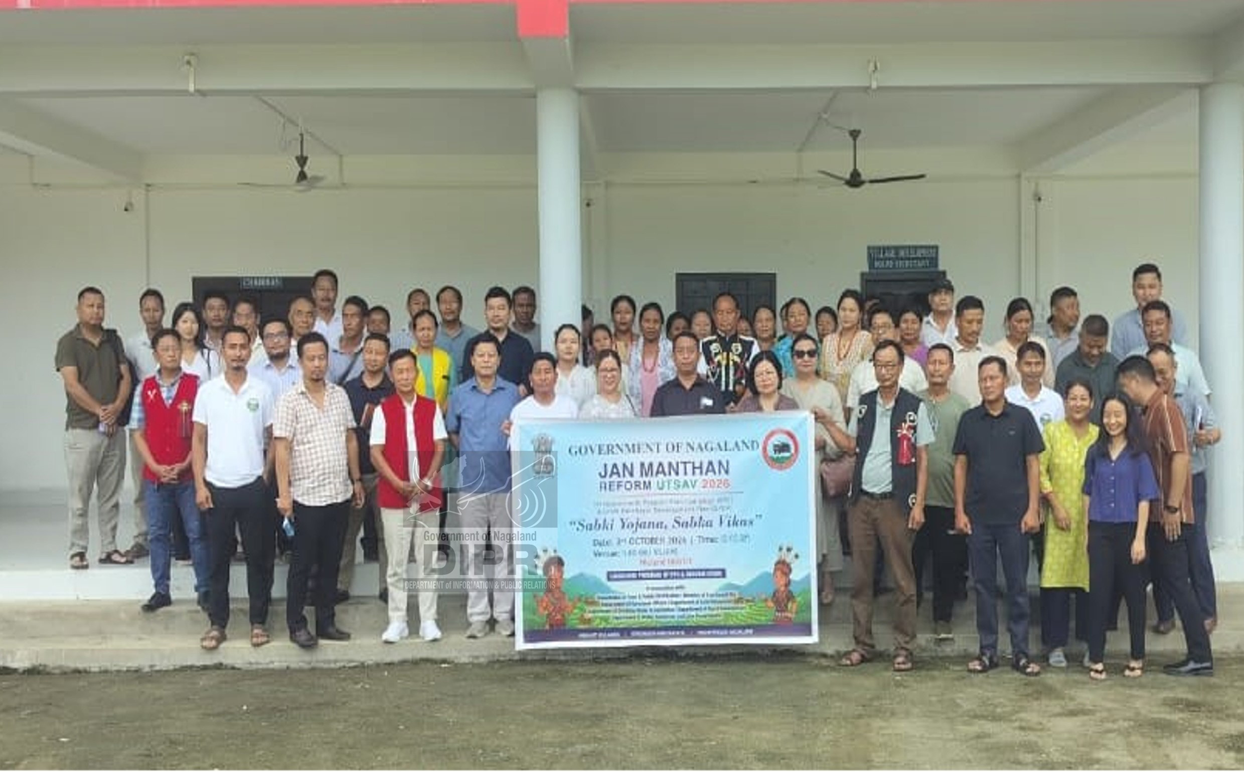
Niuland District Administration launched the Reform Utsav 2026 at Nihokhu village Niuland on October 2.
Special Guest of the program, DC Niuland, T L Kiusumong Tikhir, in his keynote address, acknowledged the hosting Village for the overall development and functioning of the village in the district.
Tikhir, while highlighting the purpose and aims of the campaign said spreading awareness about the government initiatives & its policies, focused on citizens- centric reforms said, structural reforms down to the grassroot level is vital steps towards achieving the vision of Viksit Bharat 2047.
He also explicitly narrated the distinction between reform and grievances and encouraged all the stakeholders to focus on long term reforms and development.
Download Nagaland Tribune app on Google Play


In his concluding remarks DC, strongly urged all the officials and departmental heads to work collectively as a team for a successful and impactful Reform Utsav in the district.
Reflecting on the Reform Utsav, various officers from ten departments such as Rural Development Department, Agriculture, Horticulture, Fisheries, Food & Civil Supplies, Social Welfare, School Education, PHED, Health & Family Welfare and Land Resources Department, gave their respective departmental activities, schemes and projects that are being implementing in the grassroot level.
The program also witnessed a fruitful interaction with the villagers and beneficiaries.
The program was Chaired by EAC Nihokhu.
Chumoukedima:
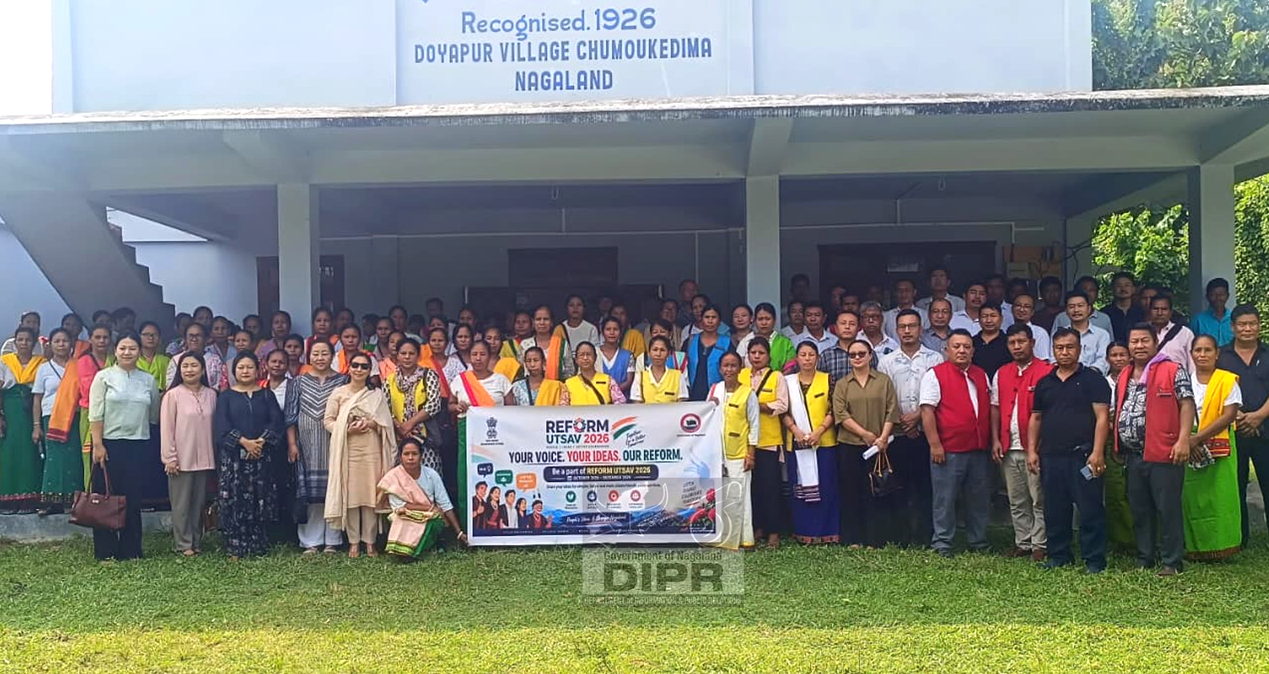
Coinciding on the occasion of Gandhi Jayanti, the Chümoukedima district launched Reform Utsav at Doyapur, which is a three-month nationwide campaign designed to turn citizen voices into actionable, real-world governance reforms.
The campaign will unfold in three vital phases: Jan Manthan (Discover); Vimarsh (Deliberate); and Samadhan & Sankalp Siddhi (Resolution & Delivery)
In her keynote address, ADC Chumoukedima remarked that Reform Utsav is a call to move from being passive recipients of policy to active co-creators of our future. Whether you are a student, a professional, a farmer, or an entrepreneur, your perspective matters. She encouraged the citizens to share their ideas for a more transparent, technology-driven, and responsive community. She called upon the citizens to celebrate the spirit of reform, not just as an official campaign, but as a Jan Andolan—a people’s movement for better governance.
MON:
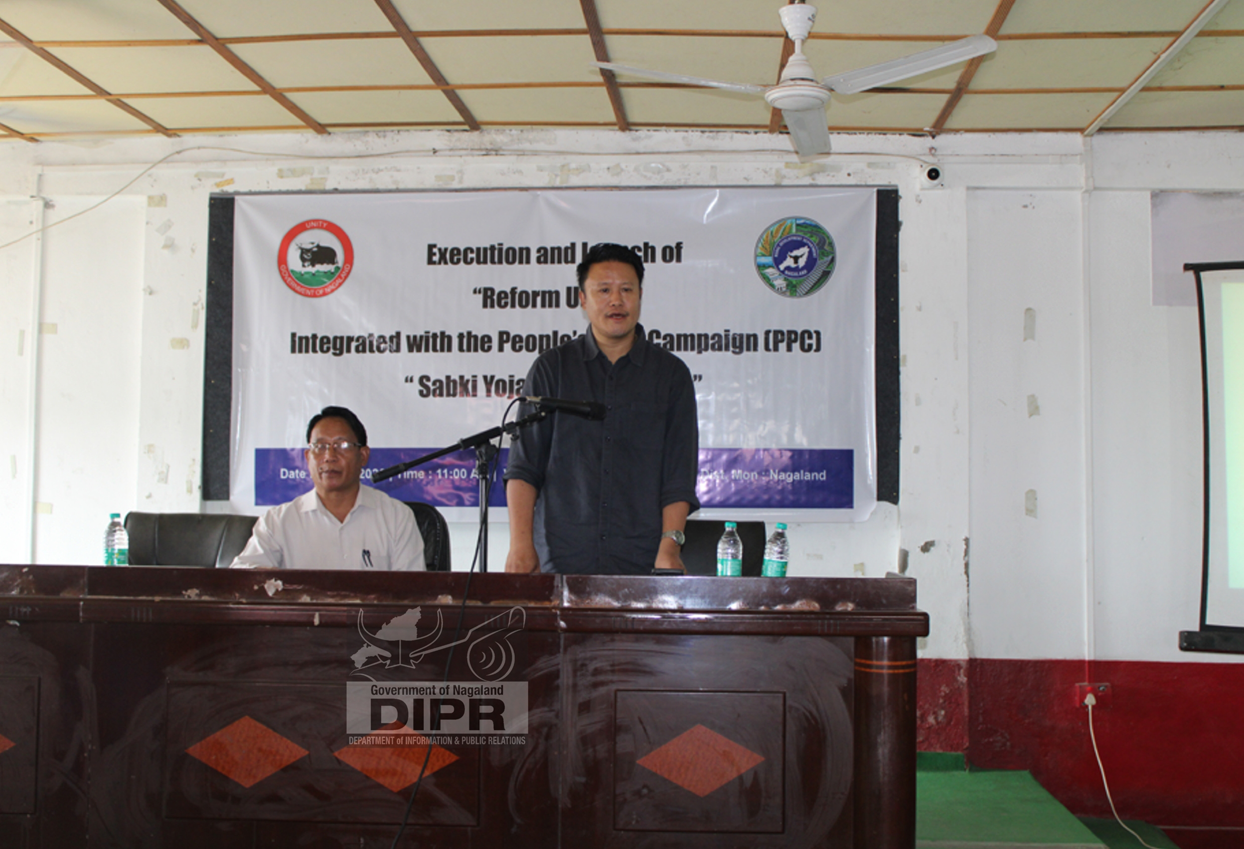
Along with the rest of the country, District Level Execution and launch of Reform Utsav Integrated with the People’s Plan (PPC) programme was held at DRDA Resource centre, Mon on October 2.
ADC Mon, Pakon Phom, NCS, briefed about the Reform Utsav, said that it is a citizen centric programme, where citizens are encouraged to give suggestions to the department and to improve its functioning with transparent accommodation of the existence scheme. He encouraged all the line departments to be more responsible for the success of the Reform Utsav programme in the district.
K Mewang, Junior Programme Co-ordinator (JPC) gave a PowerPoint Presentations on Action Plan of all the line departments under Mon District.
The programme was chaired by T Manhom Konyak, PD, DRDA, Mon, while the Invocation was pronounced by Simon, LDA, DRDA Mon. Vote of thanks was delivered by Nokton Konyak, PO, DRDA, Mon.
TUENSANG:
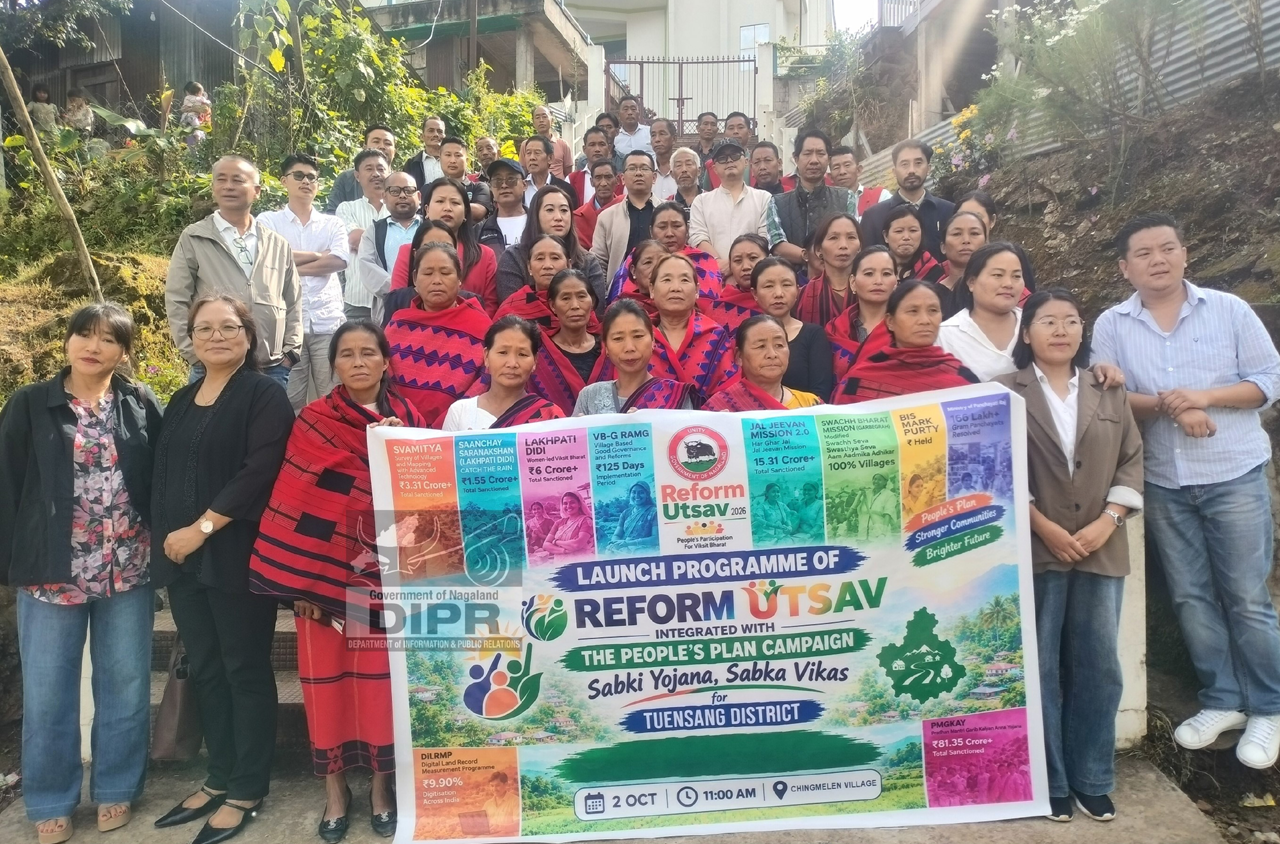
In Tuensang, Reform Utsav was launched at Chingmelen Village Council Hall, Tuensang on October 2. Reform Utsav is Integrated with The People’s Plan Campaign (PPC)- “Sabki Yojana, Sabka Vikas”.
Lithrongla Tongpi Rutsa, DC Tuensang, in her short speech highlighted that Reform Utsav is a bottom up initiative created connecting citizens voice directly to policy implementation and road maps to develop India by 2047 or Viksit Bharat@2047. It also focuses on creating awareness about Government reform and Program while also collecting feedback and suggestions for citizens. For the successful implementation Rural Development has been designated as Modal Department, she added.
In the inaugural programme, the PowerPoint Presentation were presented by Saku Chingmak SDO (C) Tuensang on Reform Utsav, Sangbou DPM, DRDA on GPDP and Hongsasonla Chang, Area Coordinator NSRLM on VPRM. Other Department Activities were also presented by District Agricultural Office, PHED and Social Welfare Tuensang. The function was attended by line Department from Tuensang, Village Council members and SHGs from Chingmelen Village.