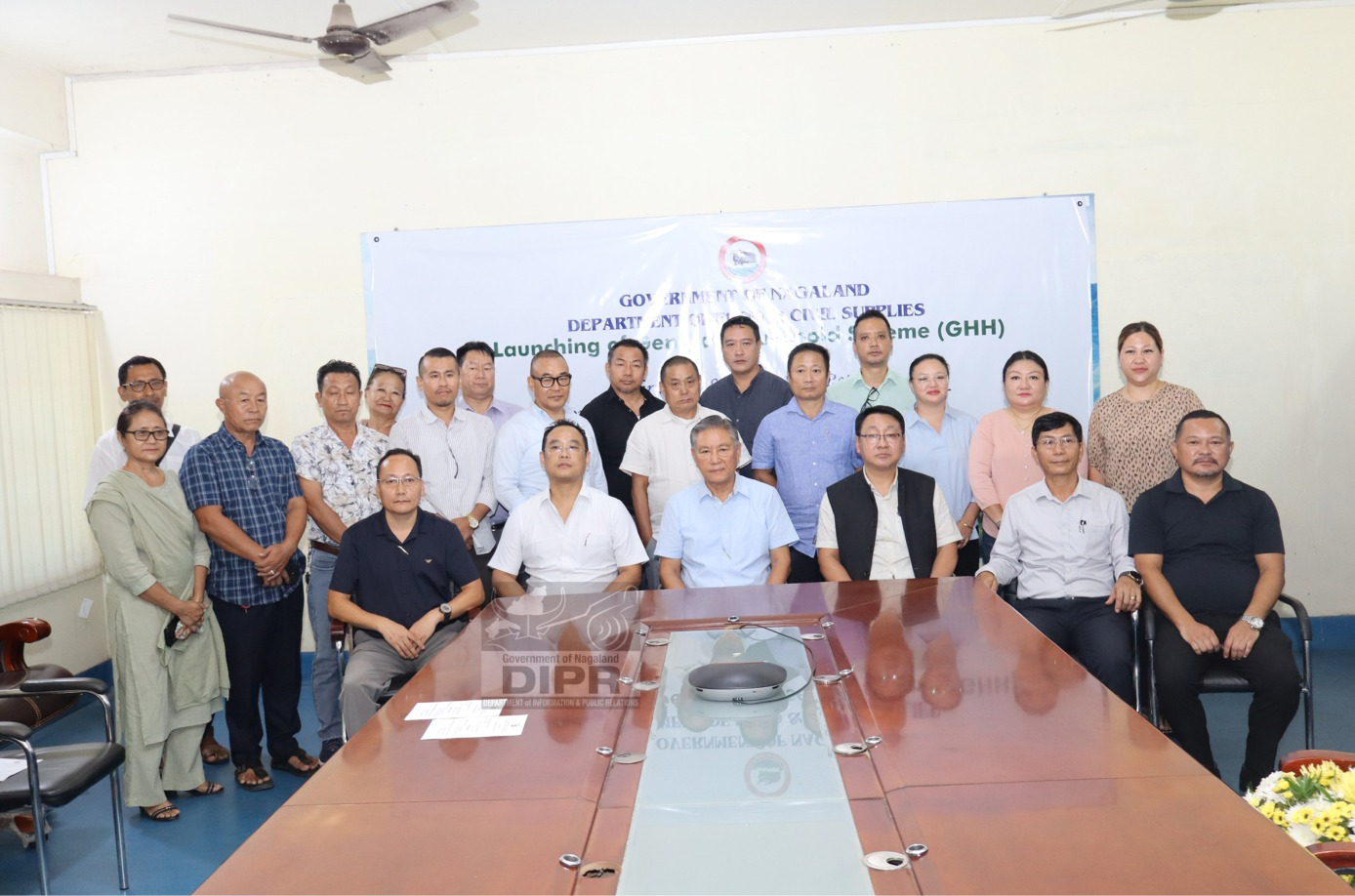
The Department of Food and Civil Supplies, Government of Nagaland launched the General Household (GHH) Scheme at the Directorate of Food and Civil Supplies, Dimapur on October 14 with the aim of extending food grain support to eligible households not covered under the National Food Security Act (NFSA), 2013.
The scheme was formally launched by Advisor, Food and Civil Supplies, K T Sukhalu, IAS (Retd.).
Addressing the programme, Sukhalu said the scheme was introduced to address the shortfall in food grain allocation following the implementation of the NFSA and to ensure that households excluded from the existing Public Distribution System (PDS) receive food security support.
He emphasised that the scheme was open to all eligible Indian citizens, including indigenous inhabitants and non-indigenous residents who fulfil the prescribed criteria. He also informed that 1,21,238 beneficiaries have been identified in the first phase, with the number expected to increase as implementation progresses.
Clarifying the functioning of the Centre’s Tide Over Rice allocation, Sukhalu stated that the provision had been in place since 2017 to address additional food grain requirements. Under the system, the state appoints stockists who lift food grains from the Food Corporation of India (FCI) at their own expense, subject to government regulations.
He said the department frequently receives requests for rice during festivals, jubilees and celebrations, as well as from old-age homes, destitute persons and various social organisations. Food grain assistance has also been extended in certain cases, including fire incidents, based on requests from district administrations and with the approval of the competent authority.
Download Nagaland Tribune app on Google Play


However, he clarified that the Tide Over allocation was not a free distribution scheme. Food grains provided for relief purposes were purchased through the concerned agencies, including disaster management authorities, wherever applicable.
Highlighting the need for a regulated system, Sukhalu said the department had undertaken the necessary groundwork to streamline distribution and address confusion surrounding the allocation mechanism. He expressed hope that the introduction of the GHH Scheme would dispel misconceptions and promote greater transparency in food grain distribution.
In his introductory remarks, Secretary, Food and Civil Supplies, Wonchio Odyuo, NCS, said the GHH Scheme was being implemented in accordance with the State Government’s guidelines under the Tide Over allocation of the National Food Security Act, 2013.
He informed that eligible households must have an annual household income of ₹2.5 lakh or above and must comprise indigenous inhabitants of Nagaland or bona fide citizens of India. Non-indigenous residents are required to submit a self-declaration certificate.
Applicants must not possess any active Antyodaya Anna Yojana (AAY), Priority Household (PHH) or other Public Distribution System ration cards, in keeping with the one-card policy.
Under the scheme, the eldest female member of the household aged 18 years or above will be designated as the Head of Family (HoF) for the ration card. In the absence of a female member, the eldest male member will be designated as the head of the family. Enrolment of beneficiaries will be Aadhaar-based.
Each eligible beneficiary will be entitled to five kilograms of rice per month at a subsidised rate on a payment basis. Distribution will be carried out through verified Fair Price Shops (FPS) in both urban and rural areas of the state, with monitoring by the respective district administrations.
Odyuo said effective implementation of the scheme is expected to improve access to food grains for identified General Household beneficiaries, strengthen last-mile delivery through FPSs and local institutions, and promote transparency in allocation and distribution. It would also enhance coordination among the Directorate, district administrations, Village Councils and FPS dealers while establishing a reliable monitoring and reporting mechanism.
Sharing the implementation status, Odyuo informed that, according to the district-wise statement, 26,982 GHH ration cards had been generated so far, covering 1,19,401 units, with a total food grain allocation of 5,97,455 kilograms.
He said the launch marked an important step towards strengthening food security and improving public service delivery in Nagaland.
The GHH Scheme aims to protect eligible households against food inflation and seasonal grain shortages while extending food grain assistance to those not covered under the NFSA, 2013.
The programme was chaired by Warren Holohón Yepthomi, NCS, Director of Food and Civil Supplies, and was attended by departmental officials & staffs