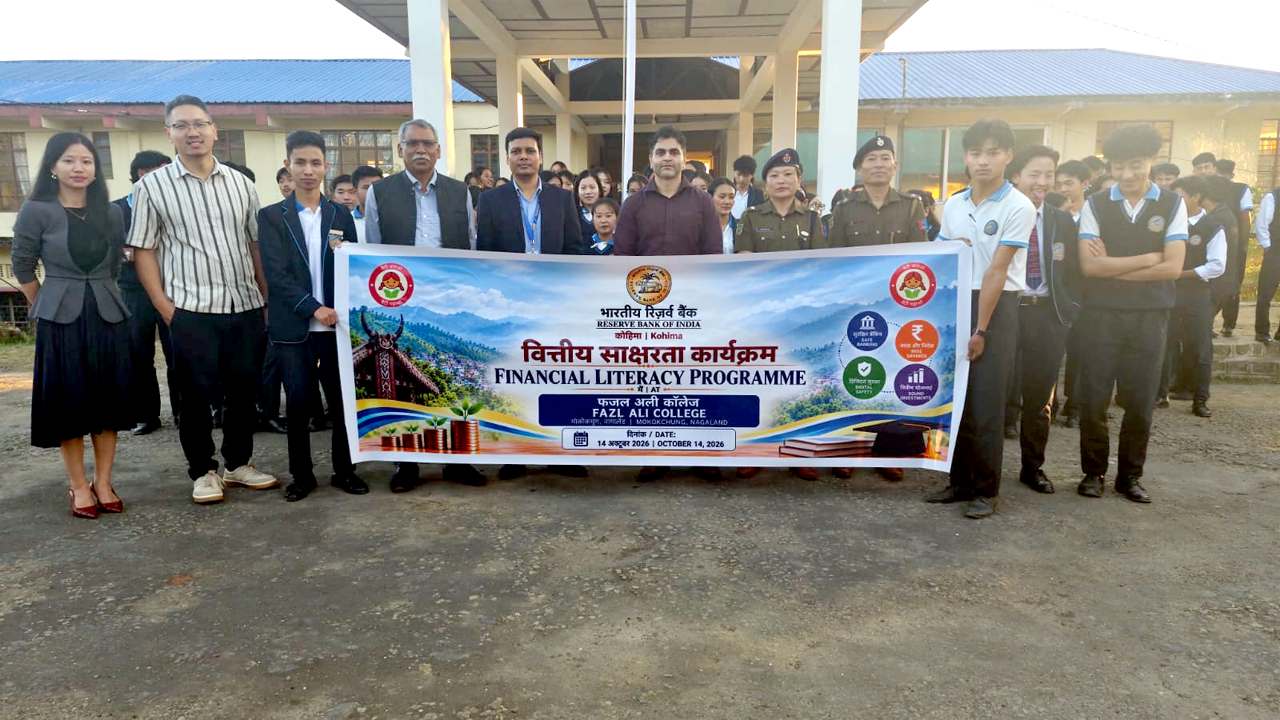
Fazl Ali College (FAC) organised a financial literacy programme in collaboration with the Reserve Bank of India (RBI) and the Securities and Exchange Board of India (SEBI) for Honours students of its Departments of Economics and Commerce on October 14, focusing on financial planning, investment awareness, banking services and the prevention of cyber fraud.
The programme was chaired by Lushian H, while Vice Principal of FAC, LS Vinod Kumar, delivered the welcome address.
The first session was conducted by Aniruddha S Patil, Assistant General Manager, SEBI, who spoke on financial literacy, budgeting, savings and investment awareness. He explained the 50-30-20 budgeting rule, the importance of maintaining emergency funds and having health insurance, and the benefits of investing in mutual funds.
Patil also highlighted the roles of financial sector regulators, the need for informed investment decisions, SEBI’s Investor Charter and the SEBI Saathi app.
The second session was delivered by UBI Achila Pongen, Officer-in-Charge of the Women Police Station, Mokokchung, who focused on cybersecurity and the prevention of financial fraud. She highlighted common forms of cybercrime, including UPI and QR code scams, online marketplace fraud, investment and job scams, and impersonation fraud.
She advised students never to disclose their one-time passwords (OTPs) or UPI PINs, to verify transactions carefully, and to avoid suspicious links and unauthorised applications. She also urged them to report financial cyber fraud promptly through the national helpline 1930.
Download Nagaland Tribune app on Google Play


The third session was conducted by Arnav Kumar, Manager, RBI, Kohima, who explained the functions of the RBI, banking services, regulated financial institutions and responsible financial practices.
Kumar discussed deposit insurance under the Deposit Insurance and Credit Guarantee Corporation (DICGC), credit scores, responsible borrowing and digital banking safety. He also explained the security features of Indian banknotes, the Clean Note Policy, the RBI Integrated Ombudsman Scheme for grievance redressal and the Sachet portal for reporting unauthorised financial schemes.
An interactive quiz was organised for the students, with prizes awarded to participants. The programme concluded with a vote of thanks by Kethosilhu, Head of the Department of Economics.
Faculty members and students from the Departments of Economics and Commerce attended the programme, which aimed to promote informed financial choices and responsible financial behaviour among young people.