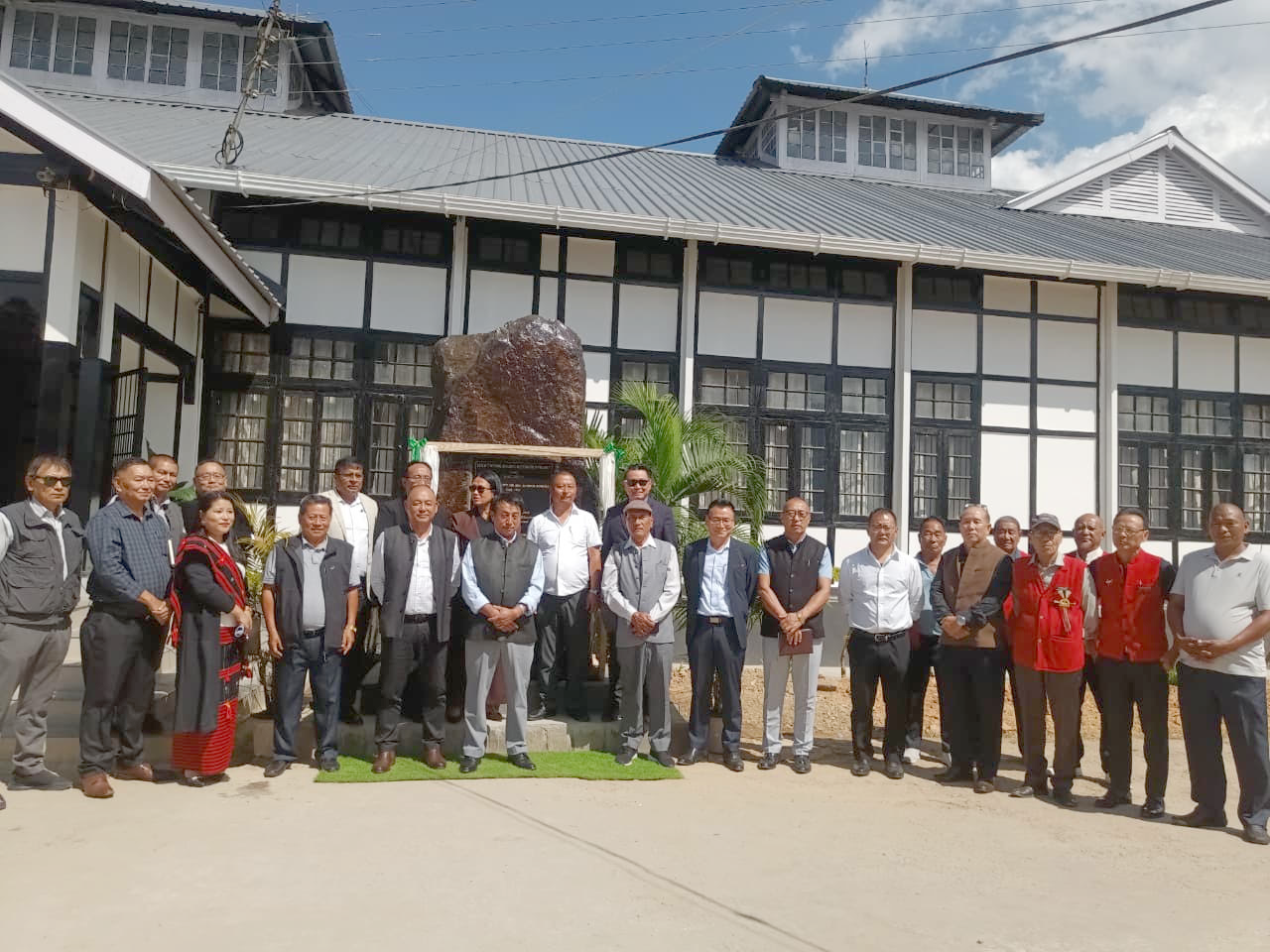
The renovated heritage building of Rüzühkrie Government Higher Secondary School (GHSS), Kohima, was inaugurated and dedicated on Friday, marking a significant milestone in the preservation of the institution’s legacy and the ongoing efforts to strengthen government school education in Nagaland.
Addressing the gathering, MLA and Advisor for School Education, Dr Kekhrielhoulie Yhome highlighted the importance of preserving educational heritage, recognising pioneers who contributed to Naga society, and improving the quality of government schools through modern infrastructure and innovative learning systems.
Emphasising the role of community participation in education, Yhome said the active involvement of local leaders was essential in protecting and developing educational institutions. He described the school premises as sacred ground, stressing that the responsibility of safeguarding the institution extended beyond the present generation.
Recalling Naga history, Yhome referred to the gathering of around 9,000 Naga warriors in 1878, who assembled in opposition to the growing presence of British colonial forces. He also traced the development of formal education in the Naga Hills, referring to the arrival of American Baptist missionaries in the region in 1885 and their subsequent role in establishing schools.
He noted that some schools in the Chakhesang area were established earlier than those in Kohima, underscoring the need to understand and preserve the history of educational development across different Naga communities.
Yhome also highlighted the contributions of early Naga educational pioneers, recalling that Dr Neilhouzhü Kire became the first Naga matriculate in 1918, followed by A Kevichüsa, the first Naga graduate in 1924. He also spoke of Lhoulienyu Suokhrie and Mayang Nokcha, who, despite having opportunities to pursue other careers, chose to dedicate their lives to teaching and serving the Naga people.
While Mayang Nokcha went on to receive the Padma Shri, Yhome observed that the contributions of several other pioneers deserved greater recognition. He stressed that remembering such individuals was important for a society whose history had largely been transmitted through oral traditions.
“We are building a new foundation of history, and it is important that we celebrate pioneers who have done great things for us, through whose vision and leadership we are what we are today,” he said.
Speaking from personal experience, Yhome shared how his parents, despite facing severe financial hardship, made considerable sacrifices to educate their eight children. He recalled that they had borrowed money and sold ancestral land and family property to meet school expenses, illustrating the value Naga families place on education despite economic challenges.
He said government schools must play a central role in ensuring that quality education remains accessible to all, particularly children from economically disadvantaged families. Citing countries such as Australia and New Zealand, he pointed out that government schools continue to play a major role in delivering quality education in developed countries.
Yhome expressed concern over the poor condition of several government school buildings in Nagaland, particularly in the eastern areas, where some large school facilities remained underutilised. He said the government was committed to addressing such challenges and improving educational infrastructure.
He observed that government schools in Kohima were gradually attracting greater interest, with entrance examinations introduced this year to improve student selection and admissions. Kohima has eight government higher secondary schools and 27 private higher secondary schools, he said, adding that the objective was not to compete with private institutions but to raise the overall standard of government education.
Highlighting the state’s educational progress, Yhome said Nagaland had moved from having one of the lowest literacy rates when it attained statehood to ranking third in literacy nationally. He acknowledged the sacrifices made by parents across the state, many of whom continue to invest heavily in their children’s education despite financial difficulties and debt.
Download Nagaland Tribune app on Google Play


Looking ahead, he said the School Education Department was working to introduce future-ready skills and global competencies into classrooms. The department was also formulating an artificial intelligence (AI) curriculum and exploring ways to strengthen digital infrastructure through engagement with philanthropists and other resource partners.
Referring specifically to Rüzühkrie GHSS, Yhome said he had included the school’s boundary fencing under his Local Area Development Fund (LADF) iconic project for the year. As the School Education Department faced resource constraints, the L Khel Council and L Khel youth leaders would supervise the fencing work.
He urged students to take responsibility for maintaining the school premises, keeping the campus clean and protecting the institution for future generations. He said the proposed boundary fencing would help safeguard the school grounds and regulate access to the premises.
Concluding his address, Yhome congratulated the school leadership and expressed confidence that the renovated heritage building would continue to serve as an important centre of learning for the community.
Presenting the technical report Er G Vikhepu Yeptho, Executive Engineer, PWD Housing Education Division, said the project focused on strengthening and modernising the building’s internal framework while retaining the original architectural profile of the 1941 heritage block.
He said the renovation was undertaken to provide a safer, more functional and conducive learning environment for students, in line with the state government’s initiatives to preserve Nagaland’s educational heritage.
The project, titled Upgradation of Rüzühkrie GHSS, Kohima, was funded under the Special Assistance to States for Capital Investment (SASCI) scheme of the Ministry of Finance, Government of India, with a total financial outlay of Rs. 593 lakh. The executing agency was Kahie Kesiezie of M/S SPN Enterprises.
Work commenced on October 14, 2025, and the renovated building was handed over and dedicated on October 16, 2026.
Outlining the major technical interventions, Yeptho said the work included retrofitting and reinforcement of structural columns to improve stability and safety, replacement of the existing heritage roofing with coloured roofing sheets, and extensive renovation of structural woodwork, including framed doors and windows.
The renovation also involved installing vitrified tiles in classrooms and administrative corridors to facilitate easier maintenance, replacing interior partition walls with fire-retardant cement fibre boards, and carrying out comprehensive replastering and finishing of internal and external wall surfaces.
In addition, the internal electrification network was upgraded as part of the overall effort to improve the building’s functionality and provide a better learning environment.
Yeptho emphasised that the project sought to balance structural renewal with heritage preservation, ensuring that the historic building could continue serving future generations while retaining its distinctive identity.
Concluding his report, he said the renewed building was being handed over with confidence that it would continue to protect and shape the brightest minds of the state for generations to come.
The programme also featured a monolith dedicatory prayer led by Rev. Dr. Rachülie Vihienuo, Executive Director of the ABCC, followed by the unveiling of the monolith by Dr. Kekhrielhoulie Yhome, MLA and Advisor for School Education, Government of Nagaland.
The ceremony began with an invocation and the school anthem presented by the school choir. A welcome address was delivered by A. Mughali Sema, Senior Principal of Rüzühkrie GHSS, while Ilopeni of Class 10 A presented a special song. The programme was compered by Yekatoli Chisho and Moatemsu Jamir, with Kote-ü Sekhamo, Vice Principal of the school, delivering the vote of thanks.