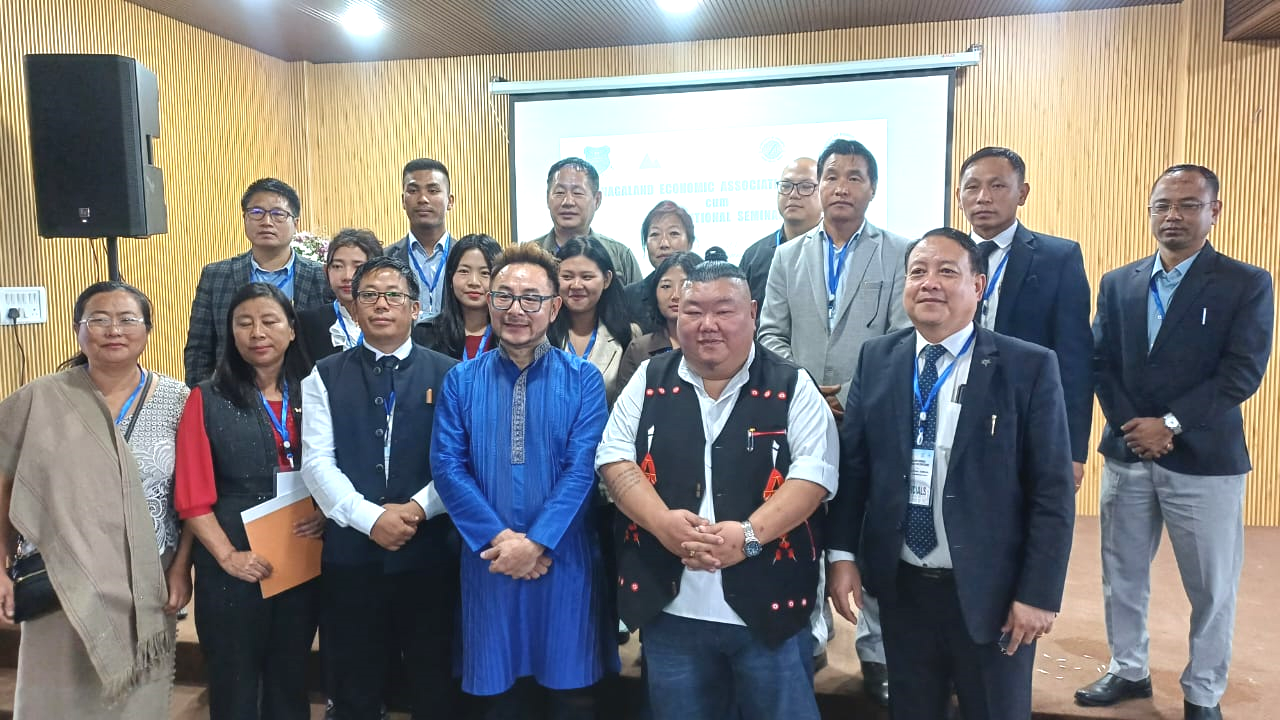
Nagaland must move beyond producing degree holders and create an environment where young people can apply their knowledge, develop practical skills and become opportunity creators, Minister for Higher Education and Tourism Temjen Imna Along said at the 3rd Nagaland Economic Association (NEA) Conference-cum-International Seminar held at Kohima College on October 16.
The conference, themed “Refocusing Human Capital Development: Challenges and Opportunities,” was organised by the Department of Economics, Kohima College, in collaboration with the NEA, with support from the Department of Higher Education and the Internal Quality Assurance Cell (IQAC), Kohima College.
Addressing the gathering as special guest, Along said Nagaland’s economic transformation must begin with improving the quality of its human resources. He stressed that literacy, modern infrastructure and improved amenities alone could not ensure sustainable development without hard work, humility, inclusiveness and a willingness to learn.
Along observed that modern technology had expanded access to knowledge and opportunities, but emphasised that people must learn to apply their knowledge practically and contribute to society rather than focusing solely on personal and family advancement.
Acknowledging the importance of infrastructure, roads, good housing and modern amenities, he said these would have limited value unless human resources were strengthened. He cautioned that negative attitudes, blame games, backbiting and divisive tribalism were hindering social progress.
Calling for resilience and inclusiveness, Along said civilisation should not be measured solely by material achievements but also by sustainability and the ability of people to support and uplift one another. He urged students to learn beyond classrooms, work hard and contribute meaningfully to their families and communities.
Highlighting the paradox of Nagaland being among the country’s most literate states while facing high unemployment, he pointed out that graduates and postgraduates continued to compete for limited government jobs. He stressed that education must extend beyond academic qualifications to equip young people with practical skills and the ability to apply their knowledge productively.
Along further described education as a lifelong process, stating that educated individuals must remain willing to learn and contribute at every stage of life. He challenged teachers, professors and other professionals to assess whether their work and community engagement were genuinely strengthening the state’s human resources.
He urged academics and professionals across disciplines to engage directly with communities, particularly young people, women and rural residents, to share knowledge and build local capacity. He also called for greater mentorship and practical support for aspiring entrepreneurs, including partnerships to help transform ideas into viable businesses.
Emphasising women’s contributions, Along described them as a resilient force behind Nagaland’s progress and called for greater recognition of their growing role in education, professional fields and public life.
He also called for greater responsibility, cooperation and practical engagement among citizens, stating that Nagaland’s future could not be built through agitations and divisive rhetoric alone.
“There is no shortcut to success,” he said, stressing that acquiring knowledge, applying it practically and helping others succeed were essential to building a stronger state.
Along expressed hope that discussions on economic development would extend beyond academic institutions to communities across Nagaland, encouraging citizens to work collectively towards a more sustainable and inclusive economy.
Delivering a presentation, Prof. Zuchamo Yanthan of the Discipline of Library and Information Science, School of Social Sciences, Indira Gandhi National Open University (IGNOU), New Delhi, said Nagaland’s greatest resource was its people, adding that the state’s future would depend not only on what it possessed but also on what its people could become and create.
He called for a shift from producing degree holders to developing capable individuals, from job seekers to opportunity creators, and from viewing people merely as human capital to recognising their wider potential.
Yanthan observed that human capital was often measured through education, skills and knowledge, but stressed that every individual possessed dreams, talents, ideas and the ability to contribute to society. He said farmers, artists, teachers and young people should be recognised for their broader contributions rather than being defined solely by their occupations or employment prospects.
Identifying educated yet unemployed or underutilised youth as one of Nagaland’s major challenges, he said opportunities had not expanded at the same pace as educational attainment. While acknowledging that seeking employment was legitimate, he pointed out that the government could not provide jobs for everyone.
He urged young people to move beyond asking where jobs could be found and begin exploring what opportunities they could create. Education, he said, must equip students with the skills to establish enterprises, generate livelihoods and contribute to development.
Yanthan also called for educational reforms to ensure that learning responded to real-world needs amid rapid changes driven by artificial intelligence, automation and climate change. Schools and colleges, he said, must nurture critical thinkers, innovators, problem-solvers and responsible citizens.
Emphasising practical learning, he advocated internships, live projects and hands-on experiences to connect classroom theory with real-life applications. Educational institutions, he said, should become centres of ideas, innovation and meaningful discussion, empowering young people to return to their communities, create opportunities and contribute to local development.
He further stressed that entrepreneurship should not be limited to starting businesses or establishing companies but should encompass recognising opportunities, solving problems, creating value and turning ideas into action.
Download Nagaland Tribune app on Google Play


Calling for development rooted in Nagaland’s strengths, Yanthan identified the state’s land, culture, food, forests, crafts, music, biodiversity and indigenous knowledge as potential sources of sustainable livelihoods. By combining these resources with modern skills, technology, design, branding and marketing, he said, local products and services could reach wider markets.
He encouraged greater processing, packaging and marketing of local products instead of selling only raw materials. Tourism, he added, should benefit local communities by creating opportunities for farmers, artisans, musicians, guides and homestay owners.
While welcoming outside investment and technology, Yanthan stressed that local youth should become creators, owners and value builders. He also called for ways to harness the knowledge, skills, networks, investments and ideas of Nagas living outside the state, describing the goal as a shift from the migration of talent to the circulation of talent.
Yanthan said the government should function not only as a provider of jobs but also as an enabler of opportunities through better policies, simpler procedures, stronger infrastructure, digital connectivity, skills development, market access, mentorship and entrepreneurship support. He emphasised the need to extend such opportunities to young people in remote villages and provide first-generation entrepreneurs with guidance and encouragement.
He also underlined the importance of placing women at the centre of development, noting their contributions as farmers, entrepreneurs, artisans, professionals, teachers and leaders. However, he said many women continued to face barriers to finance, markets, technology, training and decision-making.
Calling for a broader understanding of success, Yanthan said people who built businesses, developed local products, solved community problems, taught young minds or generated employment deserved recognition. He stressed that every honest form of work deserved dignity and that people should be recognised for the value they created and the problems they solved rather than merely their job titles.
He concluded by urging schools and colleges to encourage critical thinking, independent thought, debate and the exchange of ideas, stating that students who developed problem-solving abilities could become opportunity creators rather than merely job seekers.
“Our greatest resource is not merely our land or natural wealth. It is our people,” he said, calling on educational institutions to nurture innovators and on the government to create an environment where people could experiment, innovate and succeed.
Yanthan said Nagaland’s future would depend on the potential of its people, the courage of its youth and the actions taken today.
The programme also featured a folk song performance by Javino Lhousa and Neikhotsono Vikhrie, while NEA president Dr. Vitsosie Vupru delivered the welcome address.
The conference sought to examine the challenges and opportunities surrounding human capital development in Nagaland, particularly the gap between the state’s growing pool of educated youth and the limited employment opportunities available to them.
Nagaland’s young population possesses diverse talents in areas such as arts, sports, music, entrepreneurship and innovation. However, limited employment opportunities have contributed to frustration, migration, underemployment and economic dependency, raising concerns about how the state’s human potential can be better harnessed for sustainable development.
Despite its natural resources, including forests, biodiversity, minerals and favourable conditions for agriculture and tourism, Nagaland’s economy continues to face challenges associated with low industrialisation, weak private-sector growth and dependence on government employment.
The conference highlighted the need to move beyond traditional employment pathways and promote entrepreneurship, innovation and enterprise development, supported by skills enhancement, institutional assistance and access to finance.
Particular attention was directed towards sectors such as eco-tourism, agricultural processing, handicrafts, digital services and technology start-ups, which offer opportunities to mobilise local talent and resources.
Bringing together college and university students, researchers, academicians, policymakers, entrepreneurs and development practitioners, the conference aimed to create a platform for dialogue on unlocking Nagaland’s demographic dividend and enabling young people to become active contributors to economic growth.
Scholars from universities and research institutions across India, policymakers, industry leaders, development agencies and entrepreneurs were expected to deliberate on innovative practices, inclusive policies and emerging technologies that could broaden opportunities for enterprise development in the state.
Parallel technical sessions were also organised to facilitate detailed discussions, research presentations and interaction among participants.
The conference aimed to develop practical recommendations for strengthening human capital development and fostering an entrepreneurial ecosystem that could help transform Nagaland’s youth from job seekers into job creators.