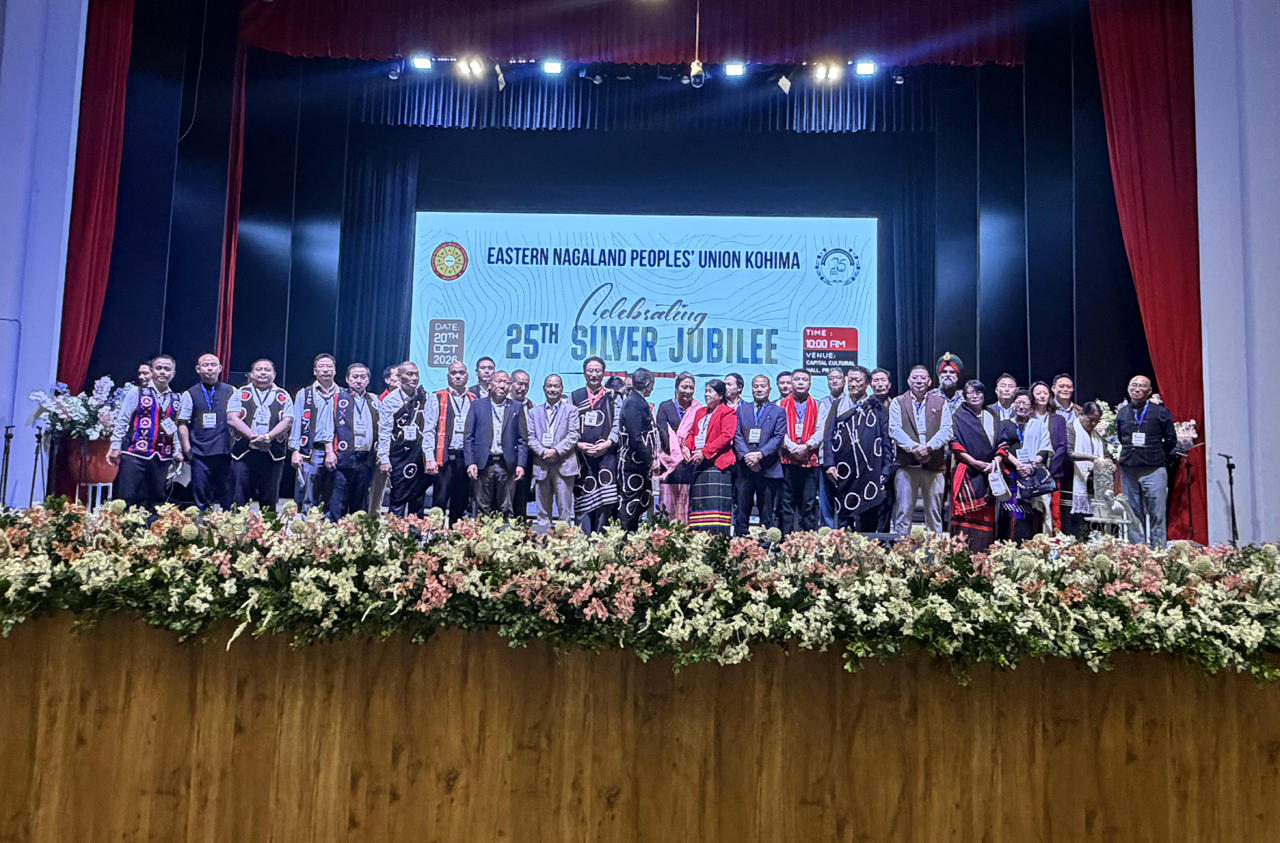
Minister of Parliamentary Affairs, Government of Nagaland, KG Kenye, has urged the people of Eastern Nagaland to use the opportunity presented by the proposed Frontier Nagaland Territorial Authority (FNTA) to promote responsible development, create employment opportunities and strengthen unity among the Naga people.
Addressing the 25th Silver Jubilee celebration of the Eastern Nagaland Peoples’ Union Kohima (ENPUK), held at the Capital Cultural Hall, PR Hill, Kohima, on October 20, on the theme “Honouring Our Past, Forging the Future,” Kenye extended his heartiest congratulations to the organisation on behalf of the Chief Minister of Nagaland Dr Rio and the Cabinet colleagues.
Reflecting on the historical connection between his family and the people of Eastern Nagaland dating back to 1956, Kenye said he was familiar with their history and acknowledged their contribution to the social and political journey of Nagaland. He described the Eastern Nagas as cultured and hardworking people and stressed the need for special attention to their aspirations and development.
Kenye said the demand for greater autonomy should be understood in the context of the region’s history and experiences. He expressed the view that the people should be given the opportunity to manage their own affairs and use the proposed autonomy to address their specific needs and priorities.
Describing the occasion as a significant coincidence, he said the EPUK Silver Jubilee was being celebrated at a time when the FNTA framework presented an important opportunity for the people of Eastern Nagaland to shape their future. He urged them to make the most of this opportunity by drawing lessons from the past rather than relying solely on historical experiences.
Recalling Nagaland’s journey since statehood in 1963, Kenye said the earlier generations had worked together despite differences in their approaches and roles. He noted that various sections of Naga society, including public leaders and national workers, had contributed to the collective journey in their own ways.
However, he expressed concern that the advent of development funds and financial opportunities had gradually affected the traditional values, character and virtues of Naga society. He observed that the growing pursuit of money had weakened community values and encouraged practices such as corruption, misappropriation and extortion.
“The society we have today is becoming dangerous because we are running after money,” he cautioned, lamenting that the values upheld by earlier generations had been gradually eroded. He said the older generation had lived by different principles and called for a renewed commitment to honesty and integrity.
Kenye acknowledged that many honest and responsible people continued to serve their communities, particularly in villages, and said their values should form the foundation for rebuilding society.
He urged the people of Eastern Nagaland to treat the FNTA opportunity as a fresh beginning and ensure that development funds were utilised judiciously. Stressing the importance of purposeful investment, he said resources should be directed towards employment generation, sustainable industries and opportunities that would benefit future generations.
Referring to the failure of several industrial ventures in Nagaland, including sugar mills, cement factories and paper mills, Kenye said development initiatives had often failed to establish sustainable industrial infrastructure and generate lasting employment. He emphasised that future investments under the FNTA framework must be guided by clear objectives and long-term benefits rather than profit alone.
“The seed should be sown, but not eaten,” he said, underscoring the need to preserve resources and invest them for the future. He clarified that his observations were not intended to criticise previous generations, but to draw lessons from their experiences and prevent similar mistakes from being repeated.
Kenye further stressed that the people of Eastern Nagaland would remain an integral part of the Naga community, describing them as an important pillar in the collective future of the Nagas. He also expressed the view that Eastern Nagaland should continue to play a significant leadership role in guiding the Naga people.
Calling for unity within the Eastern Nagaland community, he said differences must not be allowed to undermine the opportunities ahead. He identified division, factionalism and the absence of unity as major challenges facing the Naga people, cautioning that the failure of any initiative could be attributed to a lack of collective commitment.
Kenye urged the Eastern Nagaland Peoples’ Organisation (ENPO) and the people of the region to remain united and approach the future with a shared sense of purpose.
He concluded by emphasising that the success of the FNTA opportunity would depend not only on the authority and resources made available, but also on the wisdom, integrity and unity with which the people choose to use them.
Chief Host CL John, Minister of Forest, Environment & Climate Change and Village Guards, expressed gratitude to all those who contributed to the journey of the Eastern Nagaland Peoples’ Union Kohima (EPUK). He described EPUK as one of the youngest organisations and encouraged its members to continue working hard for the organisation and the community.
He also remembered the members who had been part of the organisation over the years, noting that some were still alive while others had passed away. He said prayers were offered for all, acknowledging their contributions and remembering those who had helped shape the organisation’s journey.
Download Nagaland Tribune app on Google Play


Addressing the gathering, ENPO Vice President, Andrew Tikhir said the ENPUK was growing by the grace of God and the blessings of its founding members. Acknowledging issues within Eastern Nagaland, he expressed hope that the situation had subsided and been settled, urging members not to be discouraged and to remain committed to the organisation’s principles.
Referring to the peace monolith established at the ENPO office in Tuensang on December 18, 2019, Tikhir called for internal differences to be resolved amicably. He stressed that disagreements among frontal organisations should be settled within their own ranks through mutual understanding and dialogue.
He also expressed gratitude to the Government of Nagaland for the Frontier Nagaland Territorial Authority (FNTA), describing it as a dream come true. He thanked ENLU members, national workers, supporting organisations and the Naga tribes for their support and solidarity.
Y Lima Onen Chang, Member of the Nagaland Legislative Assembly, urged the people of Eastern Nagaland to work harder and take responsibility for their own progress rather than blaming others. He observed that Nagaland remained fragmented along tribal lines, with multiple languages and divisions affecting unity.
Pointing to divisions within Eastern Nagaland itself, Chang said that although the people appeared united, internal differences continued to weaken their collective strength. He called for peaceful coexistence and greater understanding among communities, stressing the need to overcome divisions and work towards a common future.
Thejao Vihienuo, President of the Angami Public Organisation (APO), described the silver jubilee as both a celebration and an opportunity to reflect on the organisation’s history, acknowledging the difficult journey and sacrifices made by earlier leaders.
He urged ENPUK to look beyond the present celebration and develop a clear vision for the next 25 years. Raising concerns over the influx of illegal immigrants into the state and the growing presence of people whose nationality he said was questionable in commercial establishments in Kohima, Vihienuo stressed that addressing such concerns required a collective effort.
He maintained that the Angamis could not tackle these challenges alone and called for the support of all Nagas. He also emphasised the importance of preserving culture, traditions and identity, warning that the younger generation would increasingly acquire knowledge through the internet as Generation Z and subsequent generations assumed greater responsibility.
Vihienuo said the present generation had only a limited time to pass on traditional knowledge and cultural values to the youth, making it essential to take deliberate steps to preserve and transmit the community’s heritage.
Kekongchim Yim, former president of ENPUK, said the silver jubilee should be more than a celebration, urging the organisation to become a guiding force and mentor for the Eastern Nagaland Peoples’ Organisation (ENPO).
Reflecting on the past, Yim acknowledged that Eastern Nagaland had experienced discrimination but cautioned against making it the sole explanation for the region’s challenges. He urged the people to examine whether they had adequately fulfilled their own responsibilities and whether past hardships had been transformed into opportunities for progress.
He said the people of Eastern Nagaland had not become backward by choice, but had been shaped by circumstances. However, he called on them to take greater responsibility for their future rather than depend entirely on others.
Yim further stressed that a positive outlook and collective determination were necessary to move forward. Referring to the FNTA, he underscored that the future of Eastern Nagaland would continue to be linked to its relationship with fellow Nagas, emphasising the importance of peaceful coexistence and unity.
The programme was compered by Runshito and Dr Tovikali Yepthomi and began with a two-minute silent tribute, followed by an invocation by Rev S Noksa Chiu, Secretary, Finance and Property, Nagaland Baptist Church Council (NBCC). The welcome address was delivered by N Toshi Chang, President of ENPUK and Convenor of the Planning Committee.
A jubilee prayer was led by Rev. Thsadongse, SBLK, on behalf of ENPO Pastors, Kohima, followed by the release of the jubilee souvenir by the special guest and a felicitation programme organised by the Planning Committee. Special performances were presented by the Konyak Baptist Bumeinok Kohima Choir and Elate Fusion. The vote of thanks was delivered by Shahsha L Menhahu, General Secretary, ENPUK, while the benediction was led by Atsüla, Women Pastor, TBCK, on behalf of ENPO Women Pastors, Kohima.