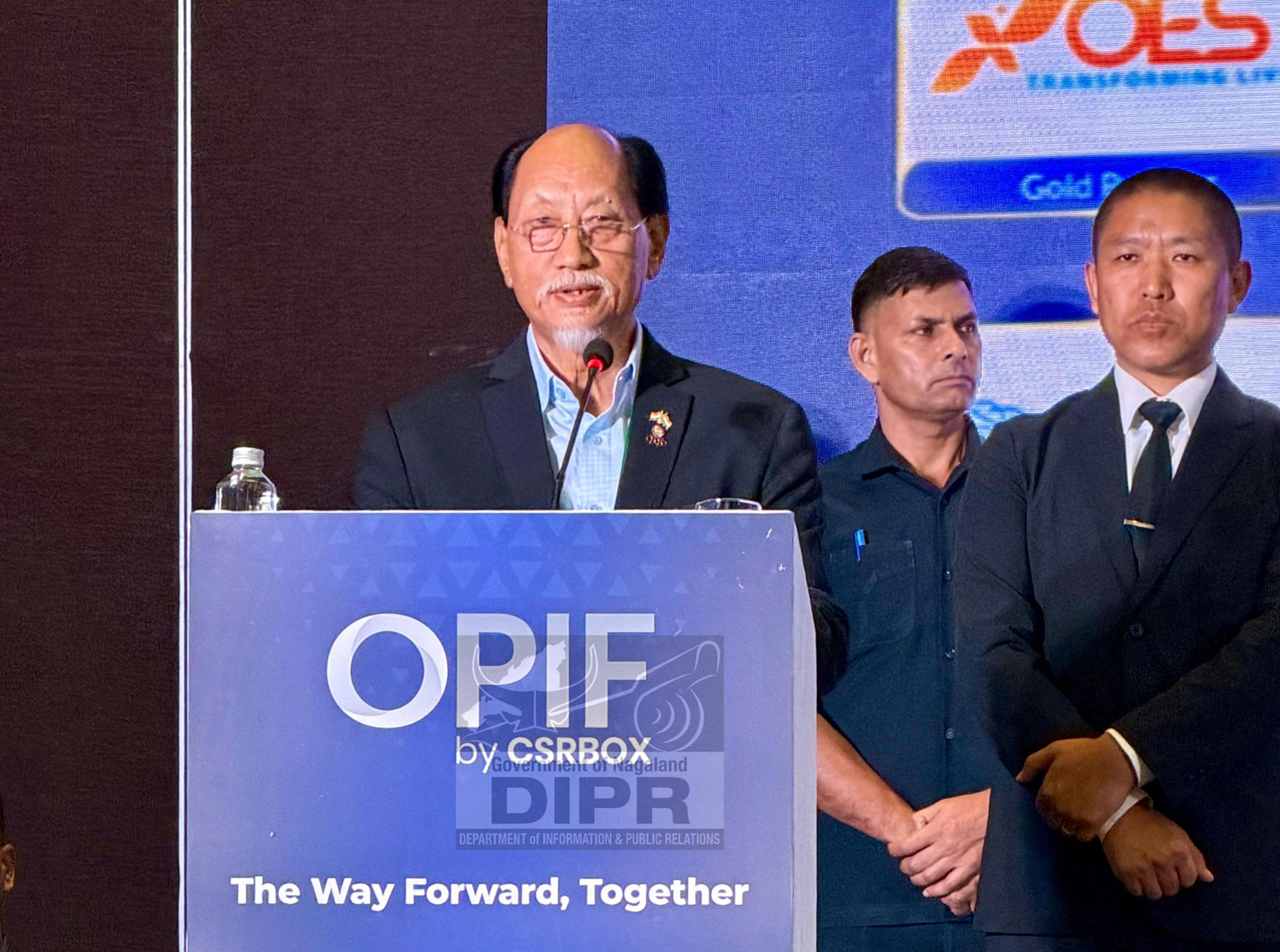
CM highlights opportunities in education, healthcare, entrepreneurship, tourism and creative economy at One Purpose India Forum 2026
Nagaland Chief Minister Dr. Neiphiu Rio has called for stronger partnerships between governments, businesses, civil society and communities to address development challenges and contribute to the national vision of Viksit Bharat.
Delivering the keynote address at the inaugural ceremony of the 13th edition of the One Purpose India Forum (OPIF) 2026 at Hotel Pullman, New Delhi Aerocity, on October 26, Rio invited corporate India and philanthropic institutions to explore Nagaland’s development priorities and establish partnerships that would create sustainable opportunities for local communities, according to a DIPR report
Organised by CSRBOX, the three-day forum is being held from October 26 to 28, bringing together policymakers, corporate leaders, philanthropists and development practitioners.
Congratulating CSRBOX and its partners for organising the forum, Rio said the evolution of the India CSR and ESG Summit into the One Purpose India Forum reflected growing recognition that development required collective effort and shared responsibility.
He emphasised that the true measure of development lay not merely in the resources mobilised or projects undertaken, but in the lasting difference made in people’s lives. Corporate Social Responsibility (CSR), philanthropy and sustainable development, he said, must ultimately translate into better opportunities, stronger communities and an improved quality of life.
Rio observed that CSR had evolved into an important instrument for social investment and community development, with corporate and philanthropic institutions contributing not only financial resources but also technological expertise, innovation, research and professional capabilities to strengthen public initiatives.
He stressed the need for stronger partnerships, credible institutions, transparent processes and clear accountability. While governments must identify development priorities and create an enabling environment, corporate and philanthropic partners should complement these efforts with expertise, resources and sustained commitment.
He also underlined the importance of documenting successful initiatives, measuring outcomes and replicating good practices, noting that meaningful and lasting change required long-term partnerships and sustained efforts.
Nagaland’s cultural and creative potential
Highlighting Nagaland’s rich biodiversity, diverse cultures, living traditions and vibrant communities, Rio described the State as an emerging hub for innovation, entrepreneurship, music, arts and the creative economy.
He said the annual Hornbill Festival had become an internationally recognised celebration of Nagaland’s cultural identity, bringing together traditional heritage and contemporary creativity while connecting the State with the wider world.
Reflecting on the State’s history, the Chief Minister spoke about Naga resistance during British colonial expansion and the ongoing efforts to repatriate Naga ancestral human remains held abroad.
He said the Government of Nagaland, in collaboration with the Pitt Rivers Museum at the University of Oxford in the United Kingdom, was undertaking an exercise in repatriation and decolonisation.
The repatriated remains are expected to arrive in India later in November, he informed.
Rio also recalled the historic Battle of Kohima during the Second World War, describing it as a decisive chapter that halted the Japanese advance towards the Indian subcontinent and underscored the resilience and strategic importance of the region.
Download Nagaland Tribune app on Google Play


Despite geographical challenges, infrastructure gaps, limited resources and an uncertain political environment, he said the people of Nagaland, particularly its youth, had continued to make significant contributions to nation-building.
He cited Dr Talimeren Ao, who captained India’s first Olympic football team at the 1948 London Olympics; filmmaker Theja Rio and his film Angh; para-athlete Hokato Hotozhe Sema; and the Nagaland Madrigal Singers as examples of individuals and groups who had brought recognition to the State and the country through their achievements.
These accomplishments, he said, demonstrated the immense potential of the people of Nagaland across fields such as the creative economy, innovation and start-up entrepreneurship.
“If our people can achieve so much despite tremendous hurdles, imagine how much more they can contribute with the right support, encouragement and opportunities, especially through the goodwill and partnership of corporate India,” Rio said, urging businesses to forge collaborative partnerships towards the shared aspiration of building a developed India.
IDAN to facilitate corporate partnerships
Highlighting the role of the Investment and Development Authority of Nagaland (IDAN), Rio said the State was working to connect its development priorities with corporates, investors and development partners capable of providing expertise, resources and innovative solutions.
He emphasised that the government alone could not address every development challenge and that private-sector participation and philanthropic institutions had an important role in accelerating progress.
He identified education, skill development, sports, entrepreneurship, healthcare, sustainable livelihoods, women-led enterprises, environmental conservation, water security, climate-resilient agriculture and community-based development as key areas offering significant scope for collaboration.
Rio also stressed the need to strengthen local enterprises and harness traditional knowledge and cultural heritage by combining them with modern technology, professional expertise and access to wider markets. Such an approach, he said, could create sustainable livelihood opportunities while preserving the State’s distinct identity.
Northeast as gateway to Southeast Asia
Positioning Nagaland and the wider Northeast as an emerging gateway to the East, particularly the ASEAN region, Rio highlighted the region’s strategic geographical location, connectivity potential and longstanding cultural ties with neighbouring Asian societies.
He pointed to the Trans-Asian Highway as an important connectivity link between the Indian subcontinent and Southeast Asia, saying these geographical and cultural advantages offered significant opportunities for economic growth.
The Chief Minister urged corporate India to look beyond CSR initiatives and explore investment opportunities in logistics, infrastructure, manufacturing hubs and economic zones across the region.
He also highlighted the vision of Nagaki, envisaged as a future global city in the foothills of Nagaland, alongside emerging opportunities in natural resources, tourism, the creative economy and sports.
Such partnerships, he said, could align nation-building objectives with business growth and investment while creating new opportunities for local communities in a region with considerable untapped potential.
Call for concrete outcomes
Rio said the One Purpose India Forum provided an important platform by bringing CSR, environmental, social and governance (ESG) initiatives, philanthropy, sustainability and innovation under one umbrella.
He expressed hope that the three-day deliberations would move beyond discussions and lead to concrete partnerships, stronger institutional relationships and practical outcomes that made a tangible difference on the ground.
On behalf of the Government and people of Nagaland, he invited the corporate and philanthropic community to visit the State, explore its development priorities and establish collaborations that were locally relevant, professionally implemented and mutually beneficial. He assured prospective partners of the State Government’s full cooperation and support for initiatives contributing to the progress and well-being of its people.
Concluding his address, Rio said the vision of Viksit Bharat must ensure that opportunities were not constrained by geography and that every State, district and village had the opportunity to progress.
He emphasised that economic growth must go hand in hand with social inclusion, environmental sustainability and community empowerment, adding that the success of collective development efforts would ultimately be measured by the lives improved, opportunities created and lasting value delivered for future generations.