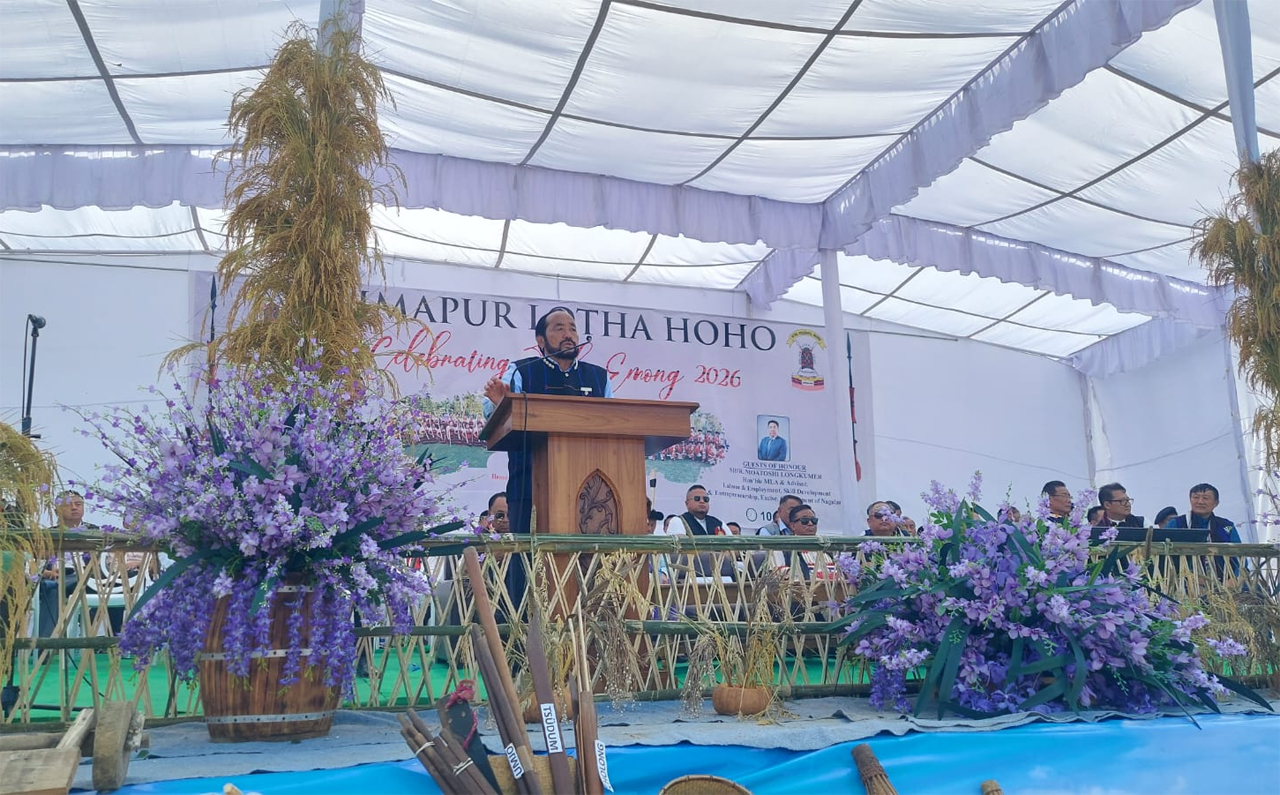
Deputy Chief Minister and incharge of Home and Border Affairs, Y Patton on Saturday called upon the Lotha community to strengthen unity, preserve its cultural identity and work collectively towards a better future while observing Tokhu Emong, the traditional post-harvest festival of the Lotha Nagas. He said that just as they had prayed the previous year to reach the present year, they should remain grateful for God’s blessings.
He described Tokhu as an occasion for reconciliation, forgiveness and reflection, urging the community to resolve misunderstandings and work together towards a better future.
Recalling his early association with Dimapur, Patton said he studied at Holy Cross School Dimapur in the 1960’s and was among its first students. He observed that festivals were not celebrated on such a grand scale in earlier years, but circumstances had improved over time through God’s blessings.
He suggested that instead of celebrating the festival separately every year, the community could consider organising a collective celebration once every three or four years to bring people together, strengthen relationships and provide an opportunity to know one another better. He also urged the Lotha community to reciprocate the cooperation and participation extended by other communities during their programmes and celebrations.
On the Naga political issue, Patton stressed the need for unity among the different Naga groups, stating that the Government of India would not provide separate solutions to 36 or 37 factions. He called upon all groups to unite and coordinate with one another, asserting that a collective approach was necessary to move forward on the political issue.
He also expressed concern over the growing problem of donations and extortion in Dimapur, Niuland and Chümoukedima, stating that the highest levels of extortion were linked to demands for donations. He said the public had also been voicing the need for all groups to come together and work towards unity.
Speaking on education, Patton encouraged students not to pursue studies merely for the sake of obtaining qualifications but to aim higher and work hard to achieve their ambitions. He also cautioned them against misusing mobile phones and urged responsible use of technology.
Emphasising the importance of preserving Lotha language and cultural identity, Patton expressed concern that many members of the community, particularly the younger generation in Dimapur, were unable to speak their mother tongue. He urged parents to take responsibility for teaching their indigenous language to their children at home and encouraged the younger generation to uphold traditional attire, customs and cultural practices.
Patton further stated that the Chief Minister, Neiphiu Rio had taken serious note of the need to preserve and promote indigenous culture, adding that cultural preservation should not be limited to the Hornbill Festival but should also be encouraged through initiatives such as the Mini Hornbill Festival.
On development, he referred to Article 371 and observed that development-related matters continued to face challenges, adding that the chief minister had been consistently emphasising the need to address them.
Referring to his 44 years in politics, he also shared his experiences and urged the people to move forward with unity, mutual understanding and a collective commitment towards the future.
Tovihoto urges Nagas to balance tribal identity with collective Naga unity
In his address, MLA and Advisor, Tribal Affairs and Election, H Tovihoto Ayemi described Tokhü Emong as the traditional post-harvest festival of the Lotha Nagas, marked by thanksgiving for the harvest, renewal of friendships, sharing of happiness and setting aside grievances. He said the festival’s traditional theme, ‘Englan-tso’, meaning reconciliation and unity, carried a meaningful message for society.
He said Nagaland was passing through a period of profound transition, caught between its traditional roots and the changing demands of the modern world. Pointing to two areas requiring attention, he stressed the need to strike a balance between clan, tribe and the shared Naga identity, and to embrace modernisation without losing cultural identity.
He observed that village, khel, clan and tribe remained important foundations of Naga society, providing security, support networks and a sense of belonging. However, he cautioned that tribal and clan loyalties should not overshadow the larger identity of the Naga people.
“When tribalism dictates our politics, our employment opportunities and our social circles, we fracture our own strength,” he said, adding that individual tribes were branches of the same tree and that the collective Naga identity must remain strong.
Download Nagaland Tribune app on Google Play


He emphasised that the need to preserve tribal heritage did not mean encouraging divisions, but maintaining pride in individual traditions while remaining united as one Naga people.
On modernisation, Tovihoto said education, urbanisation, technology and global standards were necessary for progress, but warned against adopting outside influences at the cost of indigenous traditions. He expressed concern over the declining use of native dialects among younger generations and the fading importance of traditional institutions, community spirit, discipline and oral history once nurtured through the morung system.
He said the challenge was not modernisation itself, but the danger of becoming culturally detached from the land and traditions of one’s ancestors.
“Our unique dialects, all language are being replaced entirely by different Nagamese or any other English right among the younger generation. The profound value of our traditional institutions like the community spirit, discipline, and oral history once taught in the morung system are fast disappearing,” he lamented.
Suggesting ways to restore the balance, he called for stronger inter-tribal social, cultural and political platforms, with youth organisations, student bodies and civil society groups taking a proactive role in promoting cooperation. He also urged parents to speak to their children in their native dialects at home to ensure the survival of indigenous languages.
Tovihoto further called for critical evaluation of customary practices, stating that while Article 371A protected the special identity and customary practices of Nagaland, regressive practices that restricted social equality or denied women fair participation in decision-making needed to be addressed.
“Being modern does not mean we must stop being Naga. Having pride in our tribes does not mean we must look down on another,” he said, urging the people to choose unity over division and deliberate cultural preservation over passive loss.
Moatoshi acknowledges Lotha community’s contribution to Dimapur
While extending Tokhü Emong greetings to the Lotha community, MLA and Advisor, Labour & Employment, Skill Development and Entrepreneurship, and Excise, Moatoshi Longkumer acknowledged its contribution to the growth and development of Dimapur.
He said Dimapur had been built through the hard work, enterprise and determination of people from different parts of Nagaland, adding that the Lotha community had earned its place in the city through its entrepreneurial spirit, businesses and efforts to create opportunities for the next generation.
He said the harvest celebrated during Tokhü Emong represented not only what the land produced but also what a community built through years of hard work, sacrifice and determination.
Describing the Lothas as an enterprising community, Moatoshi particularly acknowledged the courage and initiative of its young people who had moved away from home in search of employment, career opportunities and better prospects.
“The prosperity that you celebrate today is not a gift. It is the result of your hard labour, your sacrifices and your determination,” he said, adding that the community had every reason to celebrate its achievements with pride.
He said the achievements of the Lothas were a source of pride for the wider Naga society. He acknowledged their contribution to Dimapur’s progress and said the future of Naga communities remained closely connected despite their different histories and traditions.
Moatoshi said public representatives had a responsibility to work towards a Nagaland where young people could find opportunities, businesses could grow and the hard work of communities could translate into lasting progress.
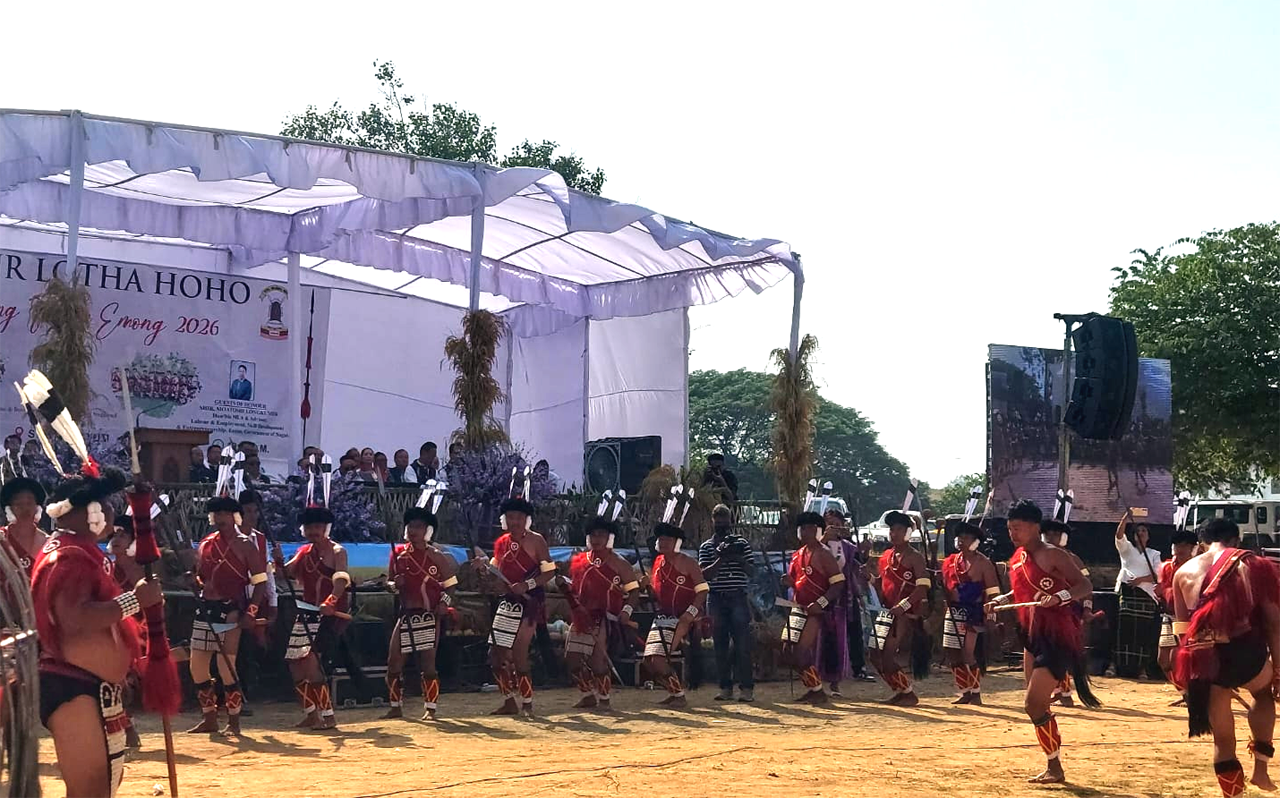
The celebration was organised by Dimapur Lotha Hoho (DLH) and hosted by Y Patton and family at Multi Disciplinary Complex Stadium, Dimapur.