Nagaland has recorded a considerably lower prevalence of anaemia among women of reproductive age than Assam, Tripura and Meghalaya, according to the latest findings of the Indian Council of Medical Research–National Institute of Nutrition (ICMR-NIN) Survey for Assessment of Markers of Population Health, Activity, Diet and Anthropometry (SAMPADA), conducted during 2023–2025.
The survey puts anaemia prevalence among women aged 15–49 years at 36.6% in Nagaland, compared with the national average of 55.9%. Mizoram, at 37%, and Sikkim, at 38.3%, have also recorded relatively lower figures.
The situation is considerably worse in neighbouring states. Assam reports 71.9% anaemia among women in this age group, followed by Tripura at 70% and Meghalaya at 61.8%. All three figures are substantially above the national average.
The differences are striking, particularly among states located within the same geographical region. While Nagaland, Mizoram and Sikkim have comparatively lower prevalence, Assam and Tripura continue to face a much heavier burden.
However, Nagaland’s relatively better position does not mean that anaemia is no longer a serious concern. The survey shows that young children and older people in the state remain vulnerable, pointing to gaps in nutritional and healthcare interventions.
Nagaland’s better figures conceal vulnerabilities
At 36.6%, Nagaland has one of the lower anaemia prevalence rates among women of reproductive age. The figure is also reflected among adolescent girls, with prevalence standing at 22.8%, compared with 24.8% in Mizoram.
The picture changes among other population groups. In Nagaland, 25.7% of children aged 12–59 months are anaemic, meaning approximately one in four young children is affected. Among people aged 60 years and above, prevalence stands at 43.2% among women and 40.2% among men.
These figures show that the relatively favourable position of women and adolescent girls does not extend uniformly across the population.
Anaemia among older people also requires a different approach to diagnosis. Iron deficiency may be one contributing factor, but chronic kidney disease, inflammation, infections, other nutritional deficiencies and age-related disorders can also lower haemoglobin levels.
For Nagaland, maintaining the gains among younger women while improving screening and treatment for children and older people should be an important part of its public health agenda.
Assam and Tripura face a serious public health challenge
The figures for Assam and Tripura are particularly concerning.
Assam records 71.9% anaemia among women aged 15–49 years, 40.6% among children aged 12–59 months and 58.8% among adolescent girls.
Tripura reports 70% among women, 25.7% among young children and 59.5% among adolescent girls.
The high prevalence among adolescent girls in both states deserves particular attention. With more than half of this population affected, the problem is already widespread before many enter their reproductive years.
Meghalaya also reports a high prevalence of 61.8% among women, 37.2% among young children and 47.1% among adolescent girls. Its estimates, however, need to be interpreted with caution because the state has a relatively wide confidence interval.
Assam’s figures among adult men and older people further indicate that the problem extends beyond women and children. The survey records 46.8% prevalence among men aged 20–59 years and 74% among older men.
This calls for investigation into factors beyond pregnancy-related nutritional requirements and menstrual blood loss. Dietary inadequacy, recurrent infections, poor nutrient absorption, chronic illnesses and inherited blood disorders may contribute to the burden. However, SAMPADA measures prevalence and does not independently establish the causes behind the high figures.
The findings make a strong case for state-specific investigations in Assam and Tripura rather than depending entirely on uniform nutrition interventions.
How the Northeast’s states compare
The state-wise figures reveal considerable differences in anaemia prevalence among women, young children and adolescent girls.
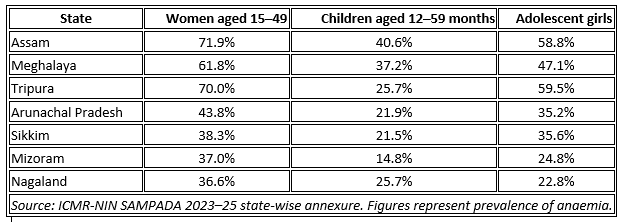
Women’s anaemia prevalence in Assam is almost twice that of Nagaland. The difference between Tripura and Mizoram is 33 percentage points. Among adolescent girls, Tripura’s prevalence is more than twice the figure recorded in Nagaland.
The figures challenge the assumption that states within the same region necessarily share similar nutritional and health outcomes.
Differences in dietary practices, household food security, access to healthcare, maternal health services, sanitation, infection patterns and socioeconomic conditions warrant closer examination. The survey, however, does not establish which of these factors account for the variations.
It would also be premature to attribute the lower figures in Nagaland, Mizoram and Sikkim to any particular food habit or cultural practice without further evidence.
Iron deficiency does not explain the entire anaemia burden
One of the important findings of SAMPADA is the gap between anaemia prevalence and measured iron deficiency. It raises questions about the continued reliance on iron supplementation as the principal response to the country’s anaemia burden.
For years, India’s anaemia-control programmes have placed considerable emphasis on iron and folic acid supplementation, particularly for children, adolescent girls and women of reproductive age.
The survey found that iron deficiency, after adjustment for inflammation, affected 34.1% of women of reproductive age and 36.3% of adolescent girls.
More significantly, the coexistence of iron deficiency and anaemia was recorded in only 26.7% of women of reproductive age and 26.9% of adolescent girls in the total population.
This indicates that measured iron deficiency alone cannot explain the entire burden of anaemia.
Other possible contributors include chronic infections, inflammation, inherited haemoglobin disorders, kidney disease and deficiencies of other essential nutrients.
This is particularly relevant to the Northeast, where inherited blood disorders, including sickle-cell disease, thalassaemia and haemoglobin variants such as HbE, also warrant attention in relevant communities.
However, a high prevalence of anaemia in a particular state or tribal population should not be taken as evidence that inherited disorders are responsible. Screening and confirmatory diagnostic tests are necessary to establish their contribution.
Iron and folic acid supplementation remains important, but individuals with persistent or moderate-to-severe anaemia may require further clinical investigation to identify the underlying cause. Treating every case as iron deficiency risks overlooking other medical conditions.
Vitamin B12 deficiency adds to the nutritional concern
SAMPADA also reports widespread vitamin B12 deficiency across different population groups in India.
The deficiency was found among 57.4% of women of reproductive age, 65.4% of adolescent girls, 66.1% of adolescent boys and 63.1% of pregnant women.
Vitamin B12 is necessary for normal red blood cell formation and neurological functioning. Its deficiency can cause megaloblastic anaemia and neurological complications.
However, the survey found that vitamin B12 deficiency was common among both anaemic and non-anaemic individuals. Its prevalence, therefore, does not establish that it accounts for a substantial proportion of the country’s overall anaemia burden.
For the Northeast, the findings underline the importance of assessing dietary diversity and micronutrient intake rather than relying on haemoglobin levels alone.
Women and adolescent girls bear a disproportionate burden
At the national level, anaemia affects 55.9% of women of reproductive age, compared with 22% of men aged 20–59 years.
The gender difference is also evident among adolescents. While 46.3% of girls are anaemic, the prevalence among boys is 22.8%.
Menstruation, increased nutritional requirements during adolescence, inadequate dietary intake and reproductive health factors contribute to the greater vulnerability of women and girls.
The figures from Assam and Tripura show why interventions must begin well before pregnancy. With anaemia affecting 58.8% of adolescent girls in Assam and 59.5% in Tripura, schools and primary healthcare institutions have an important role in screening, nutritional counselling, supplementation and menstrual health awareness.
Nagaland’s lower prevalence among adolescent girls is encouraging, but continued screening and preventive measures will be necessary to sustain the progress.
Older people remain a neglected group
Anaemia among people aged 60 years and above is another concern highlighted by the survey.
Nationally, 55.7% of older women and 44.7% of older men are affected. Yet iron deficiency was found in only 8.8% of older women and 4.8% of older men.
The difference suggests that causes other than iron deficiency need to be investigated in this age group.
For Nagaland, where 43.2% of older women and 40.2% of older men are anaemic, routine elderly healthcare should include haemoglobin testing and appropriate clinical investigations.
This is particularly important in geographically remote areas, where access to specialised diagnostic and geriatric healthcare may be limited.
Public health programmes that concentrate mainly on pregnant women, children and adolescents risk leaving older people outside the regular screening and treatment network.
Economic development does not automatically ensure better nutrition
The national findings also challenge the assumption that economic prosperity necessarily results in better nutritional health.
Punjab reports 70.5% anaemia among women of reproductive age, while Gujarat records 66.2%. Both are economically significant states, yet their prevalence is considerably higher than that of Nagaland, Mizoram and Kerala.
Economic growth, food production and infrastructure development do not automatically ensure that households have access to adequate and balanced diets.
Dietary diversity, equitable food distribution, nutrient absorption and access to healthcare also influence nutritional outcomes.
For the Northeast, improving connectivity and economic infrastructure must go hand in hand with better healthcare services and access to nutritious food, particularly in remote and underserved communities.
What the findings mean for Nagaland and the Northeast
The SAMPADA findings provide an opportunity to examine the effectiveness of existing programmes, particularly Anaemia Mukt Bharat and Poshan Abhiyaan.
The focus should not be limited to the number of iron and folic acid tablets distributed or beneficiaries covered. Screening must lead to appropriate diagnosis, treatment and follow-up.
In Nagaland, the relatively low prevalence among women and adolescent girls needs to be sustained through maternal healthcare, nutrition education and regular screening. The figures among young children and older people, meanwhile, require targeted attention.
Assam and Tripura need more intensive efforts, given the high prevalence among women and adolescent girls. Meghalaya also requires closer examination of the factors contributing to its anaemia burden.
The comparatively lower figures in Mizoram, Sikkim and Arunachal Pradesh could provide useful material for further comparative studies, although the reasons behind the differences need to be established through research.
States should strengthen local diagnostic facilities and ensure that individuals with persistent anaemia are investigated for causes other than iron deficiency. Greater attention is also needed to childhood nutrition, dietary diversity, chronic infections and healthcare access in remote areas.
Anaemia in India cannot be treated as a single-cause nutritional problem
Nagaland’s figures among women and adolescent girls are encouraging, but the prevalence among children and older people shows that the state still has considerable work to do. Assam and Tripura face a much heavier burden, particularly among women and adolescent girls, while Meghalaya also requires focused attention.
For the Northeast, nutritional health must receive the same attention as infrastructure, connectivity, education and economic development. The latest findings show that progress in these areas will remain incomplete unless the region also addresses its unequal burden of anaemia.