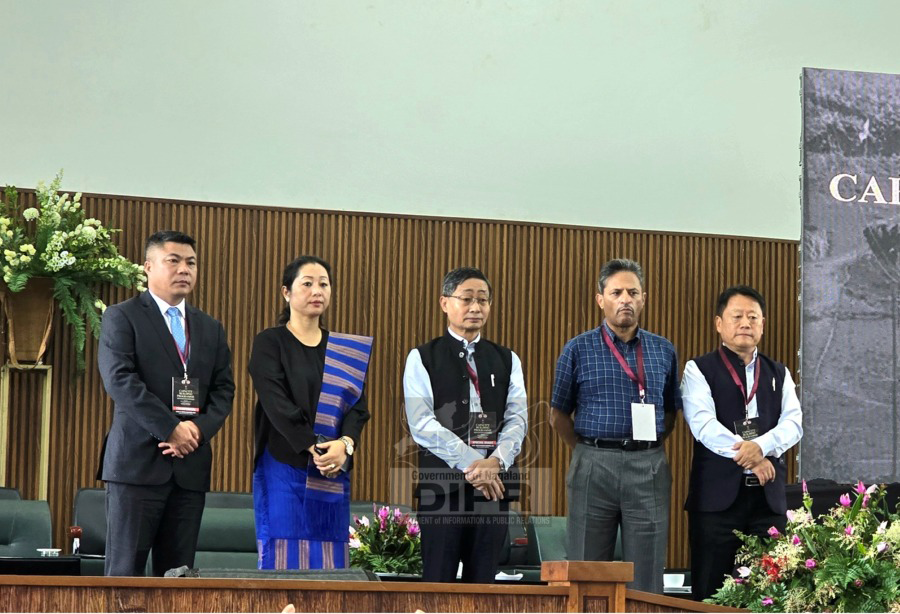
A Capacity Building Programme for Village Level Functionaries in Kohima district was held at the Kohima Village Multi-Purpose Building, Kohima on September 29, organised by the District Administration, Kohima, in collaboration with the Department of Tribal Affairs, Government of Nagaland.
Special Guest and Chief Secretary, Nagaland, Sentiyanger Imchen, IAS, called upon village councils, Gaon Burahs and village-level functionaries to uphold transparency, accountability, fairness and public interest in the discharge of their responsibilities. Imchen said the bedrock of good governance lies at the village level.
He said governance is experienced by people through basic services and development relating to water, sanitation, roads, livelihoods, healthcare, education, social welfare and law and order. He stressed that village institutions must exercise their powers responsibly and ensure that development is just and equitable.
Emphasising the importance of financial management, the Chief Secretary said every rupee entrusted to village institutions is public money and called for proper record-keeping, documentation, accounting and timely audits.
He noted that the absence of audited accounts of rural local bodies had resulted in the State forfeiting funds under the Finance Commission and said audited accounts are mandatory under the 16th Finance Commission for 2026-31.
Imchen also urged village authorities to act as a bridge between the government and the people by disseminating information and facilitating access to welfare schemes, including CMHIS, Ayushman Bharat-PMJAY and other initiatives.
On certification and verification, he stressed that documents such as Scheduled Tribe, Indigenous Inhabitant and Permanent Residential Certificates must be issued only after proper verification and due procedure, without influence or pressure.
Referring to land-related matters, he said the special protections under Article 371(A) must be respected while also balancing customary rights with the requirements of development and infrastructure. He called for village councils to play a proactive and responsible role in such matters.
The Chief Secretary further called for stronger action at the village level against waste, plastic pollution, open dumping and burning, noting that the success of the Swachh Bharat Mission (Grameen) and Solid Waste Management Rules would depend largely on local implementation.
He also reminded village authorities to understand the limits of their powers and follow due processes in addressing grievances rather than issuing ultimatums to government officials or departments.
Imchen commended the District Administration, Kohima, and Department of Tribal Affairs for organising the programme and urged the Commissioner, Nagaland, to encourage similar capacity-building programmes in other districts.
DGP Nagaland Rupin Sharma, IPS said village councils are important and empowered institutions at the grassroots, but the absence of structured induction and training can sometimes lead to functionaries exceeding their prescribed powers. He stressed the need to understand where village councils can act independently and where they must seek assistance from the police, district administration or other authorities.
Speaking from the perspective of law and order, Sharma said serious offences and important criminal matters must be reported to the police. He emphasised that village councils do not have the authority to arrest people for offences and cautioned against taking the law into their own hands.
Referring to the amended provisions governing village councils and administration of justice, he said the jurisdiction of village councils is limited to their respective areas and urged functionaries to operate strictly within the legal framework.
Download Nagaland Tribune app on Google Play


The DGP also cautioned against imposing inappropriate punishments for serious offences, citing an instance where a village-level body had reportedly dealt with a rape case by imposing a fine. He said such practices were unacceptable and underscored the importance of referring serious criminal matters to the police.
Commissioner Nagaland Gregory Thejawelie, IAS, referring to the Nagaland Village and Area Councils Act, 1978, said village councils have an established legal framework and urged functionaries to familiarise themselves with the relevant dos and don’ts and work towards decentralising governance.
He stressed the need for a clear understanding of government funding, particularly funds provided through the Village Development Board (VDB), and their proper utilization. He also highlighted the role of village institutions in areas such as communitization, school management, electricity metering and healthcare.
On certification, Thejawelie emphasized the importance of properly understanding the rules governing Indigenous Inhabitant Certificates and cautioned village authorities against issuing certificates beyond their legal mandate. He also referred to the responsibilities entrusted to village councils in connection with Inner Line Permit (ILP) requirements.
Chairing the programme, Deputy Commissioner Kohima B Henok Buchem, NCS said the programme was organized following the recent constitution of new Village Councils across the district, with the objective of familiarizing village functionaries with important laws, rules, schemes and guidelines relevant to their responsibilities.
Describing Kohima as the first district of Nagaland, he urged village leaders to lead by example through responsible leadership, good community governance and effective implementation of development programmes.
Buchem also informed that presentations by the resource persons had been compiled into a book for distribution to each village, while important Acts, rules and guidelines in Tenyidie were also being provided to the participants.
The programme covered the Nagaland Village Council Act, 1978 and Rules, 1979; Rules for the Administration of Justice and Police, 1937; regulations and code of ethics for Gaon Buras; verification of ST, Indigenous Inhabitant and Permanent Residential Certificates; and illegal immigration and enforcement of ILP under the BEFR, 1873.
Other topics included the Nagaland VDB Model Rules, 1980; Communitization Act, 2005 covering village schools, health and power utilities; financial management and statutory audits; Chief Minister’s Micro Finance Initiative, CMHIS, Ayushman Bharat-PMJAY and CMLIS; digitization of birth and death certificates and infant Aadhaar enrolment.
The programme also covered Solid Waste Management Rules, 2026, Swachh Bharat Mission (Grameen), liquid waste and plastic recovery facilities, and land holding systems under Article 371A vis-à-vis land acquisition and government land.
Earlier, the programme commenced with the prayer of blessings delivered by Rev. Keviyiekielie Linyü, Special presentation by Methanilie Jütakhrie, and concluded with a closing remarks and vote of thanks by ADC Kohima, Ruopfükuotuo Noudi, NCS.