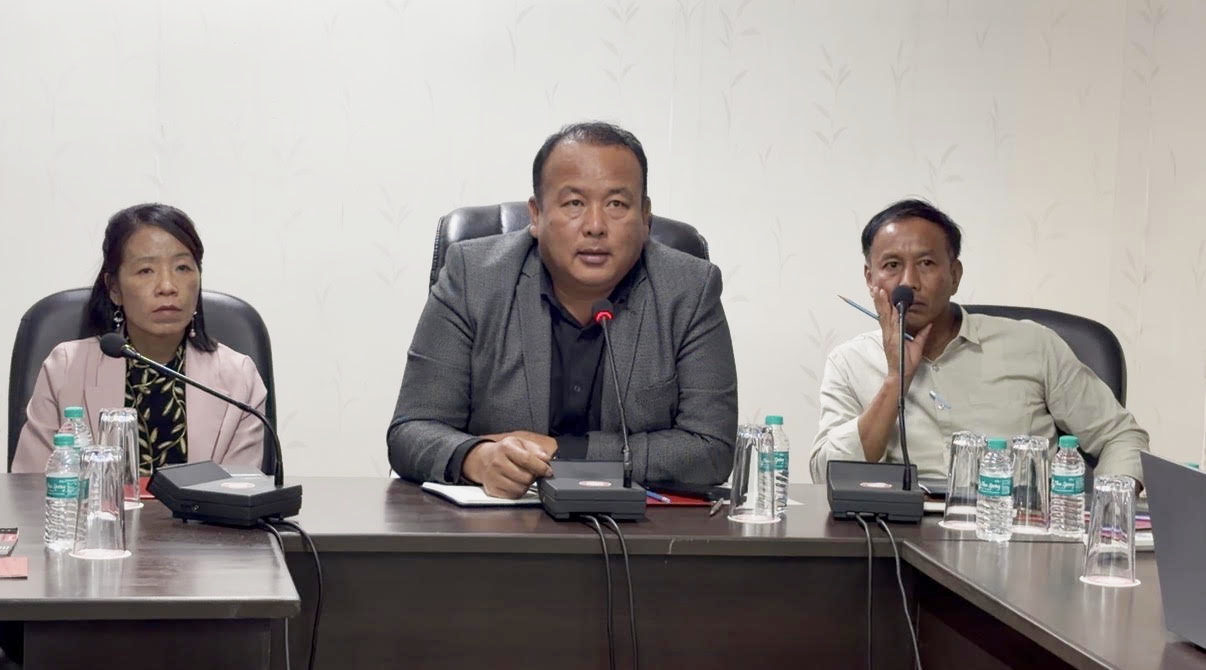
Director of Census Operations, Nagaland, Dr Kenei Miachieo has highlighted the ongoing Census operations in the state, describing Census 2027 as a major critical and statistical exercise that would rely on digital tools for data collection, monitoring and management.
Dr Miachieo was speaking during an interaction with the media fraternity organised by the Directorate of Census Operations, Nagaland, in coordination with the Kohima Press Club, at Hotel De Oriental Grande, Kohima, on Tuesday.
During the technical session on “Census of India 2027”, Dr Miachieo and Imkongnungsang Longkumer, Deputy Director, highlighted the digital systems and operational arrangements being adopted for the census.
Dr Miachieo explained that Census 2027 would mark a significant transition in India’s decennial census through the adoption of digital data collection methods.
Census 2027 would adopt digital data collection, with enumerators using mobile applications to record household information. The public would also be provided the option of self-enumeration, enabling households to submit their information independently through an online portal.
Dr Miachieo highlighted the use of mobile applications for collecting census data and a web-based portal for managing and monitoring various activities associated with the exercise. The digital system is intended to streamline field operations, improve data management and facilitate the monitoring of census activities.
He also highlighted the use of a web-mapping application for the creation of House Listing and Enumeration Blocks (HLBs), which would help organise and delineate the areas to be covered during census operations.
The Census Management and Monitoring System (CMMS), developed by the Office of the Registrar General and Census Commissioner, India, would serve as a centralised platform for coordinating and monitoring census activities, including the allocation of duties, training of census functionaries, logistics and tracking of fieldwork progress.
Dr Miachieo pointed out that census operations are conducted in two phases. The first phase, comprising the House Listing and Housing Census, involves identifying and listing buildings, census houses and households, along with information on housing conditions, household amenities and assets. The second phase, Population Enumeration, involves collecting demographic, socio-economic and other particulars of individuals.
The self-enumeration facility would supplement, rather than replace, household visits by enumerators. Information submitted through self-enumeration would be verified as part of the census process.
On data security, Dr Miachieo highlighted safeguards covering information collected through mobile devices, data transmission and storage at the server level. He also referred to secure data-protection mechanisms and security audits by reputed agencies to safeguard information collected during the exercise.
The digital infrastructure incorporates multiple layers of security to protect data throughout its lifecycle. These include encryption, controlled access, monitoring of data-related activities and safeguards against unauthorised access. The census data centres have been declared Critical Information Infrastructure (CII), underscoring the importance of protecting the digital systems supporting the nationwide exercise.
Census 2027 is being undertaken under the legal framework of the Census Act, 1948, and the Census Rules, 1990. The exercise is expected to generate essential demographic and socio-economic information for planning, policy formulation and development programmes at the national, state and local levels.
Download Nagaland Tribune app on Google Play


The interaction provided an opportunity for media representatives to engage with census officials on the ongoing operations, digital data collection and the technological and security arrangements being adopted for Census 2027.
Kohima Press Club (KPC) president Vishü Rita Krocha said the census was far more than a statistical exercise, describing it as the foundation for planning the future of the state and the country.
On behalf of KPC, she expressed gratitude to the Directorate of Census Operations for organising the timely interaction with media professionals, highlighting the importance of collaboration between the department and the media fraternity.
Krocha stressed that an accurate and comprehensive census was particularly important for Nagaland, as the data would influence resource allocation, developmental policies and the representation of communities at the grassroots level.
She cautioned that an inaccurate population count could result in missed opportunities and flawed planning for the next decade, emphasising the need to ensure that every community was properly accounted for.
Highlighting the media’s responsibility, she described journalists as a vital bridge between the government and citizens, noting that the success of the 2027 Census would depend significantly on public cooperation and awareness.
She urged media professionals to ensure that accurate information reached the public, dispel myths and apprehensions surrounding the census, and encourage citizens to participate actively and provide truthful information.
Krocha also emphasised the importance of journalists understanding the technical aspects of the census process so they could effectively educate the public on the significance of accurate participation.
Expressing hope for a productive technical session and meaningful interaction, she reiterated KPC’s commitment to working with the Directorate of Census Operations to help make the Census of India 2027 a success in Nagaland.
During the technical session on the Census of India 2027, Imkongnungsang Longkumer, Deputy Director, Directorate of Census Operations, Nagaland, highlighted key aspects of the upcoming census and its importance in ensuring accurate population data for effective planning and development.
The programme was chaired by Mhareni Kithan, Junior Executive, while Chuyalo Kath, Assistant Director, delivered the welcome note.
Kuku Livi, Junior Executive, delivered the vote of thanks.