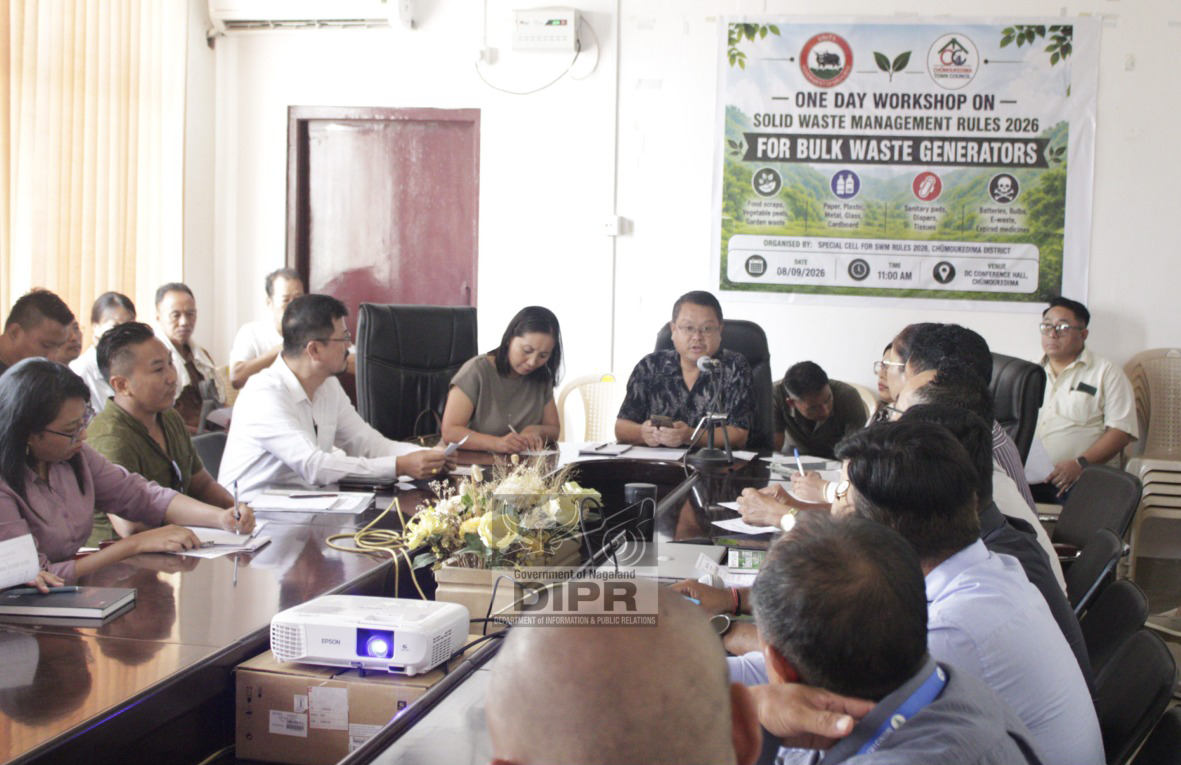
Bulk Waste Generators (BWGs) in Chumoukedima have been urged to take immediate responsibility for managing and processing waste generated on their premises, with non-compliance liable to attract penalties and other enforcement measures.
The call was made at a one-day workshop on Bulk Waste Generators held at the DC’s Office, Chumoukedima, on September 8, chaired by SDO Chumoukedima Shreyansee Jain, IAS.
Deputy Commissioner Polan John, NCS, in his welcome address, said effective solid waste management was not the responsibility of sanitary workers alone but a collective duty of individuals, households, institutions and establishments. He called upon identified BWGs and other stakeholders to comply with the Supreme Court’s time-bound directions and the Solid Waste Management Rules, 2026.
Referring to constitutional and legal obligations, the DC cited Article 51A(g), which calls upon citizens to protect the environment, and noted that the right to a clean and healthy environment is linked to the right to life guaranteed under Article 21.
He said the revised Solid Waste Management Rules, 2026 apply to both urban and rural areas and require individuals and institutions to segregate, store and hand over waste to the designated authorities in accordance with the prescribed norms.
Explaining the criteria for BWGs, John said establishments with a built-up area of approximately 20,000 square metres, daily water consumption of around 40,000 litres, or waste generation of around 100 kg per day would fall under the BWG category if they meet any one of the prescribed criteria.
Identified BWGs are required to establish appropriate waste-management infrastructure within their premises, ensure proper processing and management of waste, register online and submit compliance reports. Their premises will also be subject to inspection.
Download Nagaland Tribune app on Google Play


The DC particularly stressed the need for BWGs to manage wet waste within their own premises, including through suitable composting facilities. He said technical assistance could be provided by the concerned departments and the Nagaland Pollution Control Board.
Warning against violations, John said non-compliance could invite penalties under the “Polluter Pays” principle and other applicable enforcement provisions. Persistent violations could also lead to measures such as disconnection of electricity and water supply, in accordance with relevant directions and provisions.
Describing the initiative as a “whole-of-government, whole-of-society” approach, the DC urged all identified BWGs and stakeholders to take immediate steps to fulfil their responsibilities and meet the time-bound requirements for effective solid waste management.
A technical session was conducted by Yanathung Kithan, Environmental Scientist ‘B’ of the Nagaland Pollution Control Board, focusing on issues concerning bulk waste management. The session was followed by a group discussion on practical measures and stakeholder responsibilities.
The workshop aimed to strengthen coordination among stakeholders and promote responsible waste-management practices towards a cleaner, greener and more sustainable Chumoukedima.
