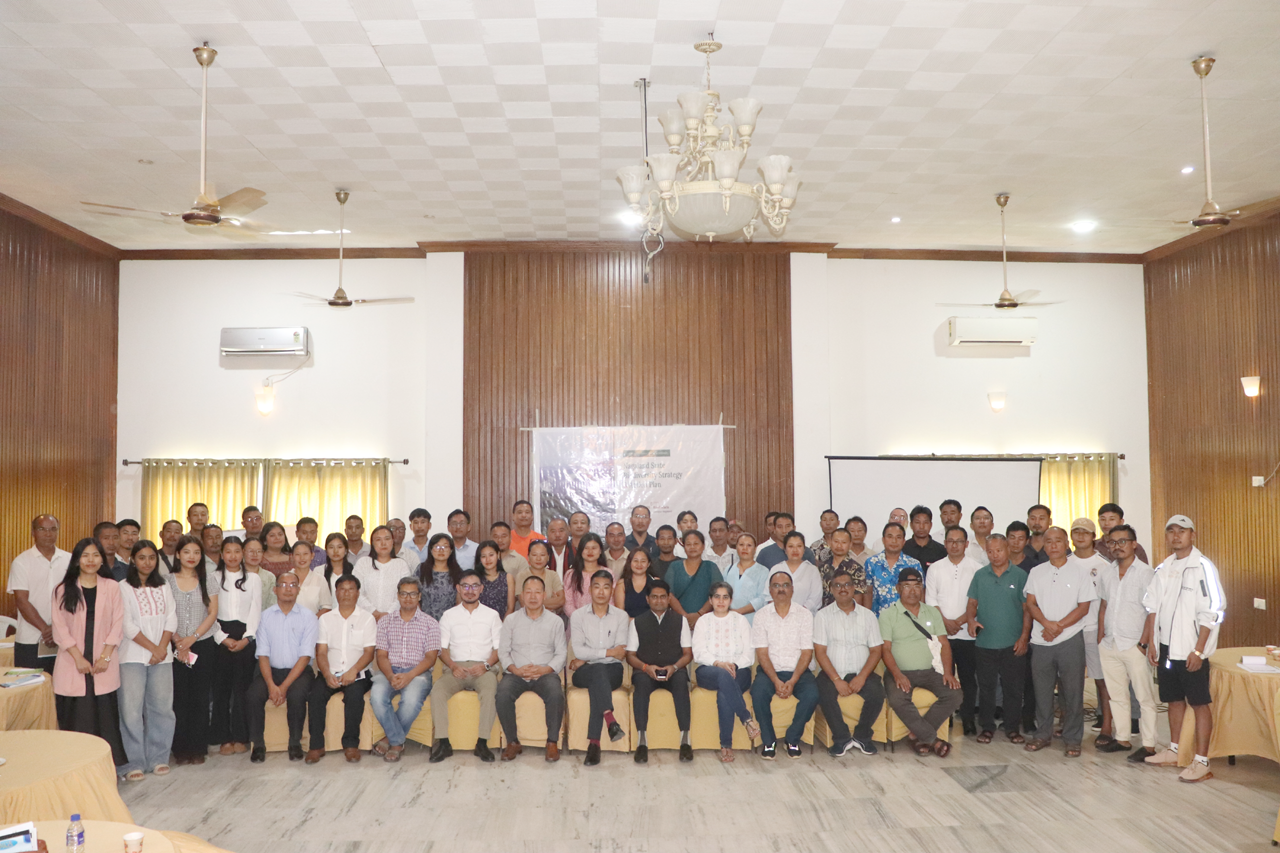
The Nagaland State Biodiversity Board (NSBB), in partnership with the Nagaland Community Conserved Areas Forum (NCCAF), The Nature Conservancy Centre (TNCC), and the Foundation for Ecological Security (FES), organised a community consultation on the Nagaland State Biodiversity Strategy and Action Plan (SBSAP) on September 3 at Hotel Acacia, Dimapur. Supongnukshi Ao (IFS), APCCF (Territorial), graced the occasion as the Chief Guest, along with Sidramappa M Chalkapure (IFS), Member Secretary, NSBB.
Led by Heirang Lungalang, Chairperson, NCCAF, the consultation brought together 59 community leaders from 15 districts of the state. Community leaders actively contributed to the discussions and shared their knowledge, experiences, priorities, and perspectives.
Nagaland is in the process of revising its State Biodiversity Strategy and Action Plan (SBSAP) to align with India’s National Biodiversity Strategy and Action Plan 2024-2030 under the Kunming-Montreal Global Biodiversity Framework.
Download Nagaland Tribune app on Google Play


Nagaland prepared its first SBSAP in 2005. It was later revised and formally launched in May 2022, incorporating twelve National Biodiversity Targets in line with the Aichi Biodiversity Targets.
The community consultation focused on hearing the voices of communities and gathering their perspectives on strategies and action points relevant to Nagaland’s biodiversity. The discussions focused on four key themes: biodiversity conservation and management; restoration of degraded land and water bodies; sustainable use and benefits from biodiversity; and participatory and inclusive decision-making.
Revising the plan using inputs received from the consultation will help align it with the local knowledge, priorities, and experiences of people dependent on the state’s biodiversity.
To support the revision process, two more consultations are planned in September 2026 with Nagaland’s Department of Environment, Forests & Climate Change, line departments, regional universities, and sectoral experts.
The Nature Conservancy and its Indian affiliate, The Nature Conservancy Centre (TNCC), and the Foundation for Ecological Security (FES), in close coordination with NSBB, have been striving to strengthen only community-led conservation efforts in the state.