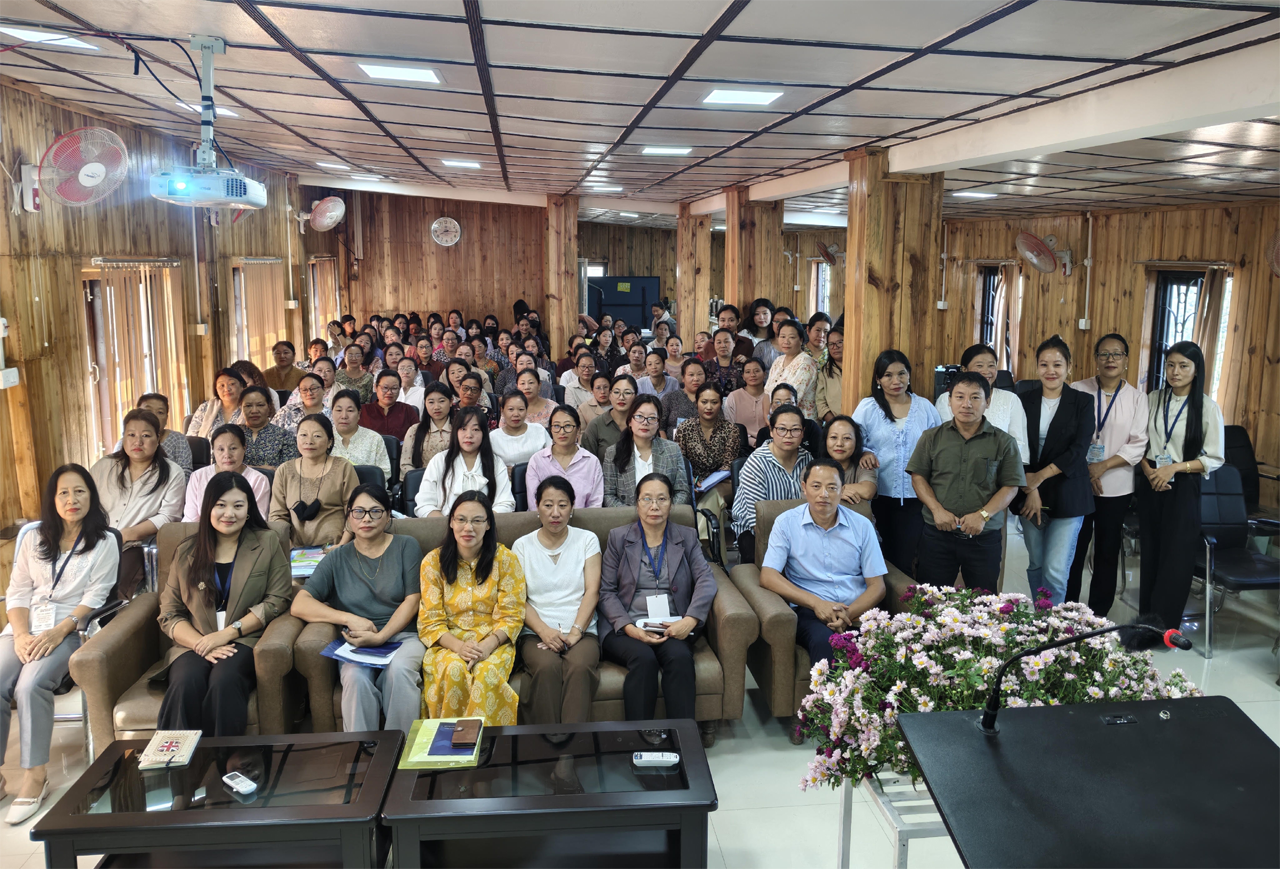
A state-level Continuing Nursing Education (CNE) seminar underway in Kohima is focusing on strengthening quality healthcare practices, with emphasis on patient safety, infection prevention, documentation, medication safety and continuous quality improvement.
Organised by the Naga Hospital Authority Kohima (NHAK), the two-day seminar is being held on September 22 and 23 at the NHAK Auditorium Hall under the theme, “Quality in Healthcare: Empowering Safe, Effective and Patient-Centred Care.” Around 100 nursing personnel from different parts of Nagaland are attending the programme.
The seminar seeks to update nursing personnel on quality healthcare practices in accordance with the National Quality Assurance Standards (NQAS), covering both institutional and nursing-specific quality areas.
Speaking at the inaugural session, NHAK Nursing Superintendent, Pinuo Nakhro said quality healthcare could not be measured only by the availability of infrastructure or advanced equipment. She said it depended on sustained efforts, proper implementation, regular assessment and a commitment to continuous improvement.
Introducing the NQAS framework, Nakhro described it as a national mechanism for improving, monitoring and certifying the quality of care in public healthcare facilities. She highlighted internal quality assessment and other quality improvement tools as important mechanisms for identifying gaps and improving performance.
She said quality improvement should be treated as a continuous cycle of observing, assessing, correcting and improving rather than as a one-time activity.
Infection prevention and control also featured prominently in her address. Referring to hospital-acquired infections and environmental hygiene, Nakhro stressed the importance of maintaining a clean healthcare environment and following standard precautions. She said infection control was a collective responsibility involving healthcare workers across departments.
Another area covered during the seminar is corrective and preventive action (CAPA), which enables healthcare facilities to identify the causes of problems, address them and put measures in place to prevent recurrence.
Nakhro also stressed proper biomedical waste management, noting that healthcare waste, if improperly segregated, handled or disposed of, could create risks for patients, healthcare workers, communities and the environment.
On occupational and patient safety, she said the two were closely interconnected and that healthcare institutions must ensure that their workforce was also protected from preventable occupational hazards.
Emphasising the role of nurses, Nakhro said nursing personnel remained involved at every stage of a patient’s healthcare journey, including admission, treatment, monitoring, education and discharge. She said strengthening nursing practices was therefore essential to improving the overall quality of healthcare.
Download Nagaland Tribune app on Google Play


The technical sessions are covering standard precautions, records and documentation, quality indicators, key performance indicator (KPI) monitoring, patient rights, communication and patient-centred care. Medication safety, high-alert medications, prevention of medication errors and early recognition of clinical deterioration are also being addressed.
Nakhro said proper documentation was particularly important for ensuring continuity of care, as incomplete records could lead to critical information being missed during patient handovers.
Organising Secretary, Vezhodulu Swiho said the seminar was intended to go beyond providing CNE credit points and instead strengthen the capacity of nursing personnel to implement quality-care practices at their respective workplaces.
She noted that quality assessment was increasingly important not only in hospitals but also in sub-centres and healthcare facilities in rural areas.
A pre-test was conducted to assess participants’ existing knowledge of quality healthcare before the technical sessions.
The programme was led by Pezalhouwheno, a member of the organising committee, while Kashito S Sumi, Chaplain of NHAK, offered the invocation prayer.
The seminar will conclude on September 23 following further sessions on healthcare quality and patient safety in line with NQAS.