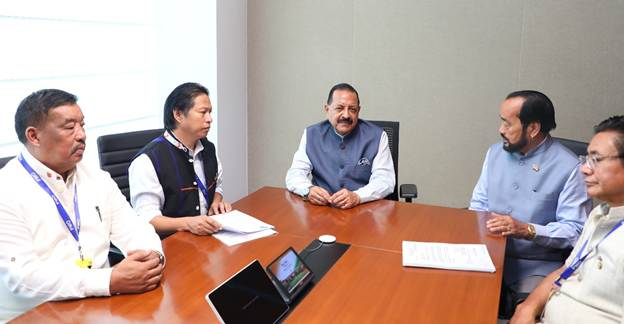
Union Minister of State (Independent Charge) for Science & Technology and Earth Sciences and Minister of State in the Prime Minister’s Office, Personnel, Public Grievances & Pensions, Atomic Energy and Space, Dr Jitendra Singh, has described the transformation of the Northeast over the past 12 years as a significant outcome of the development-oriented approach of the Narendra Modi-led government.
Dr Singh made the remarks when Nagaland Deputy Chief Minister, in-charge of Home and Border Affairs, Yanthungo Patton, led a delegation of public representatives from Wokha district to meet him and discuss a range of developmental issues concerning the district and the State.
The delegation included Mhathung Yanthan, MLA from 39 Sanis Assembly Constituency and Advisor, Agriculture; Y Mhonbemo Humtsoe, MLA from 38 Wokha Assembly Constituency; and Achumbemo Kikon, MLA and Chairman, SPDB Bhandari, representing 40 Bhandari Assembly Constituency.
During the interaction, the delegation raised issues relating to road and transport connectivity, infrastructure, livelihoods and human-wildlife conflict, besides discussing the broader development trajectory of Nagaland and the Northeast, a PIB release stated.
Dr Singh said the Northeast has moved into a new phase of development, with improved roads, railways, airports, waterways and digital connectivity bringing the region closer to the rest of the country and opening new opportunities for economic growth.
Expressing gratitude to Prime Minister Narendra Modi for placing the Northeast high on the national development agenda, the Union Minister said the region today is witnessing a new phase of connectivity, infrastructure development and economic opportunity.
Dr Singh said that the development of the Northeast is no longer being viewed in isolation from the country’s overall growth journey. He said improved connectivity was creating conditions for the Northeast to emerge as an important contributor to the national economy and as a natural gateway to India’s Act East policy.
He said that the progress achieved in the region over the last twelve years reflects a sustained policy focus on overcoming geographical challenges and ensuring that distance does not become a barrier to development.
The Union Minister said that connectivity has been at the heart of this transformation. Roads and highways have expanded access to markets and essential services, railway connectivity has steadily moved towards the State capitals and remote areas, while air connectivity has opened new possibilities for tourism, trade, healthcare and emergency response. Inland waterways are also gaining importance as an alternative and sustainable mode of transport, further strengthening the region’s links with the rest of India and neighbouring countries, he said.
Air connectivity expands across Northeast
Highlighting the progress in aviation infrastructure, Dr Singh said the number of operational airports in the Northeast had increased from nine in 2014 to 17 in 2026, representing a 78 per cent rise.
He said the expansion of aviation infrastructure and the development and upgradation of airports had significantly improved accessibility in the region, particularly given its difficult terrain and dispersed settlements.
The UDAN regional connectivity scheme has further strengthened air connectivity, with around 90 regional routes operationalised in the Northeast. He cited airports and facilities including Pakyong and Hollongi, as well as upgraded facilities at Tezu and Rupsi, as examples of the expanding regional aviation network.
According to the Minister, the benefits of improved connectivity extend beyond transportation, improving access to healthcare and education, strengthening tourism and local businesses, facilitating movement of agricultural produce and creating opportunities for employment and investment.
In difficult terrain such as the Northeast, he said, connectivity is directly linked to the quality of life and economic empowerment of communities.
He also pointed to the expansion of waterways and digital infrastructure, noting that the number of National Waterways in the Northeast increased from one in 2014 to 20 in 2024, while digital connectivity has expanded to thousands of Gram Panchayats.
Dr Jitendra Singh said that this development momentum is helping the Northeast move from a perception of being geographically distant to becoming a region of strategic, economic and technological importance. He said that the region’s young population, natural resources, biodiversity and strategic location provide a strong foundation for the next phase of growth, provided infrastructure development is accompanied by opportunities for entrepreneurship, innovation, tourism, agriculture and skill development.
Download Nagaland Tribune app on Google Play


Wokha’s connectivity and infrastructure issues raised
Against this broader development backdrop, the Nagaland delegation raised several specific demands concerning Wokha and adjoining areas.
Among the key issues was the proposal to declare the Wokha–Merapani road up to Golaghat as a National Highway, besides seeking upgradation of the Wokha–Bokajan road.
The delegation also highlighted infrastructure requirements at Wokha district headquarters, including a District Office Complex, Multipurpose Market Complex, Stadium and approach roads.
The representatives also drew attention to the difficult road conditions arising from erosion and landslides and the consequent impact on movement and economic activity.
Human-elephant conflict discussed
The delegation further raised the growing concern over human-elephant conflict in Wokha district, including crop destruction, property damage and threats to the safety and livelihoods of local communities.
It sought a comprehensive policy response and special assistance package for affected areas.
Dr Singh said such challenges require coordinated measures that safeguard both community livelihoods and the region’s wildlife, with appropriate intervention by the concerned agencies.
The Union Minister said the developmental concerns raised by the delegation would be examined in the broader context of strengthening connectivity and infrastructure in the Northeast.
He said that the objective is not merely to create physical infrastructure but to ensure that improved connectivity translates into better opportunities, stronger livelihoods and greater participation of the region in India’s growth story.
The Union Minister said that the transformation visible across the Northeast over the past twelve years has created a strong foundation for the next phase of development. He said that the Government’s approach under Prime Minister Narendra Modi has been to bring the region closer to the national mainstream while preserving its distinctive cultural, ecological and social strengths.
Dr Singh expressed confidence that the continuing partnership between the Centre and the States of the Northeast would further accelerate the region’s development. He said that with improved connectivity, expanding infrastructure and growing economic opportunities, the North-East is well placed to emerge as an important engine of Viksit Bharat, contributing its full potential to India’s growth and development.