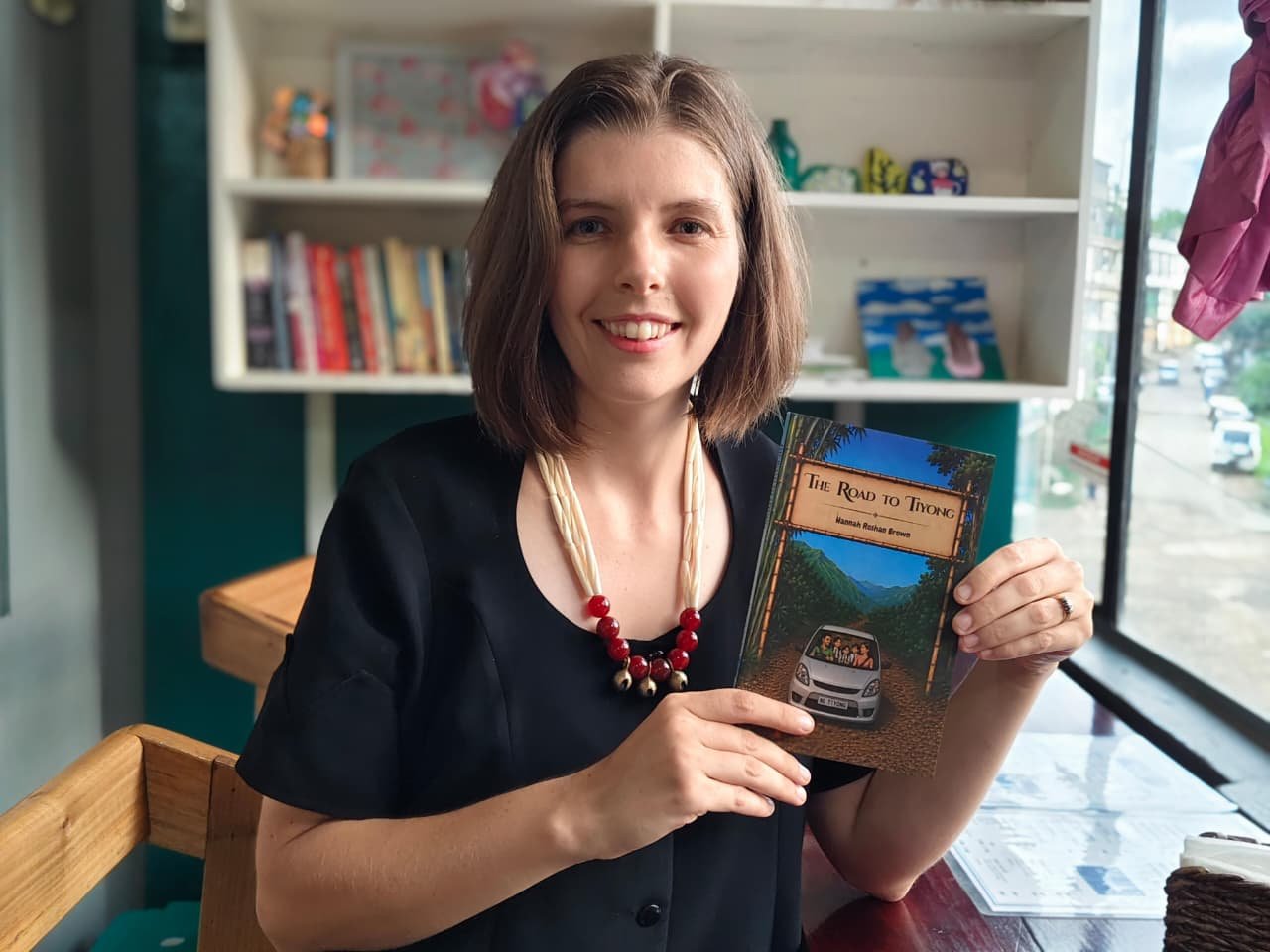
Author Hannah Roshan Brown officially launched her debut children’s book, The Road to Tiyong, during a formal program held at The Play Cafe, Indian Oil Junction, Mariani Road, Mokokchung on August 18. The book was released by her father-in-law, Lanukaba Imchen, in the presence of family, guests, and well wishers.
Originally from England, Hannah moved to Nagaland in 2015. She lives in Mokokchung with her Ao Naga husband, Limaonen Imchen, and their three children. Together, they embrace a life filled with daily adventures, family vlogging on YouTube (The Imchen Family), and community engagement as the founders of The Play Cafe in Mokokchung Town.
The newly published book, targeted at intermediate readers and priced at ₹250, draws directly from the family’s experiences at their farm in Satier, Aliba village. An initial run of 1,000 copies has been produced.
Inspiration: Choosing Screen-Free Living and Family Bonding
Addressing the gathering, author Hannah Roshan Brown shared the deeply personal motivation behind writing the book and her family’s intentional decision to eliminate screen usage for their children.
“My children, as many, many other children in the town and further afield, have had the same problem. My children got into a problem of phone addiction. And we got into this habit of just giving it because it was easiest… then I realized after a while that my children were missing out on such key parts of childhood.”
“When we were children, we went out, we played on the roads, we visited our neighbour’s houses, we did all the silly mischievous things and we got dirty… And I thought, my kids are missing out. They’re missing out on such a key part of childhood where they can use their imaginations.”
“So 8 months ago we cut them out and since then we have seen such a big change in our children’s behaviour and in their social skills. They’ve started going out and playing with other children which means that the other neighbours are also coming out and playing now… Technology has really taken over and it’s so easy to get sucked into it. I wanted to do something to inspire other parents to make the bold step to spend time with their children without technology, without screens.”
“Our children aren’t going to remember sitting at home and watching the phone all the time. They’re going to remember the times when they’ve laughed with their friends. They’ve done funny, silly things with their dad.”
Story Setting, Context, and Mongsen Language Preservation
The Road to Tiyong centers on a family with three children who spend weekends at their grandparents’ farm. While inspired by real events, Hannah explained that fictional names were used, including the setting name “Tiyong” is a Mongsen word meaning “Centre,” which also honors her husband’s late grandfather, Tiyong.
The story was initially conceived during the 2021 lockdown, when the family spent three months at the farm in Satier. Hannah expressed hope that if readers enjoy the book, it could develop into a sequel or ongoing series. She also emphasized her desire to write a story grounded in a local Naga context rather than Western settings, enabling local children to see themselves reflected in the narrative.
A central highlight of the book is its emphasis on the local Mongsen language and a native language of her in-law’s village – Aliba. Words throughout the narrative are italicized in English and linked to a glossary and key at the back. Readers can view the corresponding Aliba Mongsen phonetic translations and find dedicated blank spaces to write equivalent words in their own native languages or dialects.
“The language is slowly being lost. Schools are taught, everything’s taught in English… and I really don’t want the language to be lost and I really wish that my children also will learn their mother tongue, their father tongue actually, let’s say.”
“I really want to delve into the roots and become a part of the culture and I feel like language is such a big part of that.”
Dedication to the Children of Nagaland
The book’s dedication page reflects Hannah’s core message to local young readers:
“To the children of Nagaland:
You don’t need to travel far to find a world of wonder. Look around-beauty is everywhere you step!
May these pages inspire you to explore your home, learn more about your roots, and celebrate the land that is yours to enjoy.”
Download Nagaland Tribune app on Google Play


Dr Bendangrenla S Longkumer, Assistant Professor in the Department of English at Fazl Ali College, delivered introductory remarks commending the author for addressing critical gaps in local literature and language preservation.
“If we look at the literature market currently, we have an abundance of children’s literature in the market. But at the same time, I think that there are not even a handful of books that resonate with the experiences that we have here at home and experiences that our children go through.”
“The loss of language is also the loss of culture.”
“Language, I feel, will survive only if you learn to take pride and see value in it. And this effort by Hannah is a wonderful effort to get children interested in learning their mother tongue early on in life.”
“This is a book that celebrates values that we would love for our children to hold on to in a world that is becoming increasingly individualistic… This is truly a gift that you have given to your community, especially to the children of Aliba.”
Hannah’s father-in-law, Lanukaba Imchen, who formally released the book, reflected warmly on her integration into the family and local culture, noting that the concept of a “global village” truly exists through their family’s experience.
“We were having a very doubtful, how to make adjustments… She was a wonderful girl, my daughter-in-law. She came and adjusted with our culture.”
“When we are in the farm during summer… she started working in the field and the story continues, our family love and creating memories.”
The Road to Tiyong is available for purchase at The Play Cafe and Nata Company (agri shop next to FAC bus stand near police point) in Mokokchung town for ₹250. Home delivery options are also available across Mokokchung and throughout Nagaland.