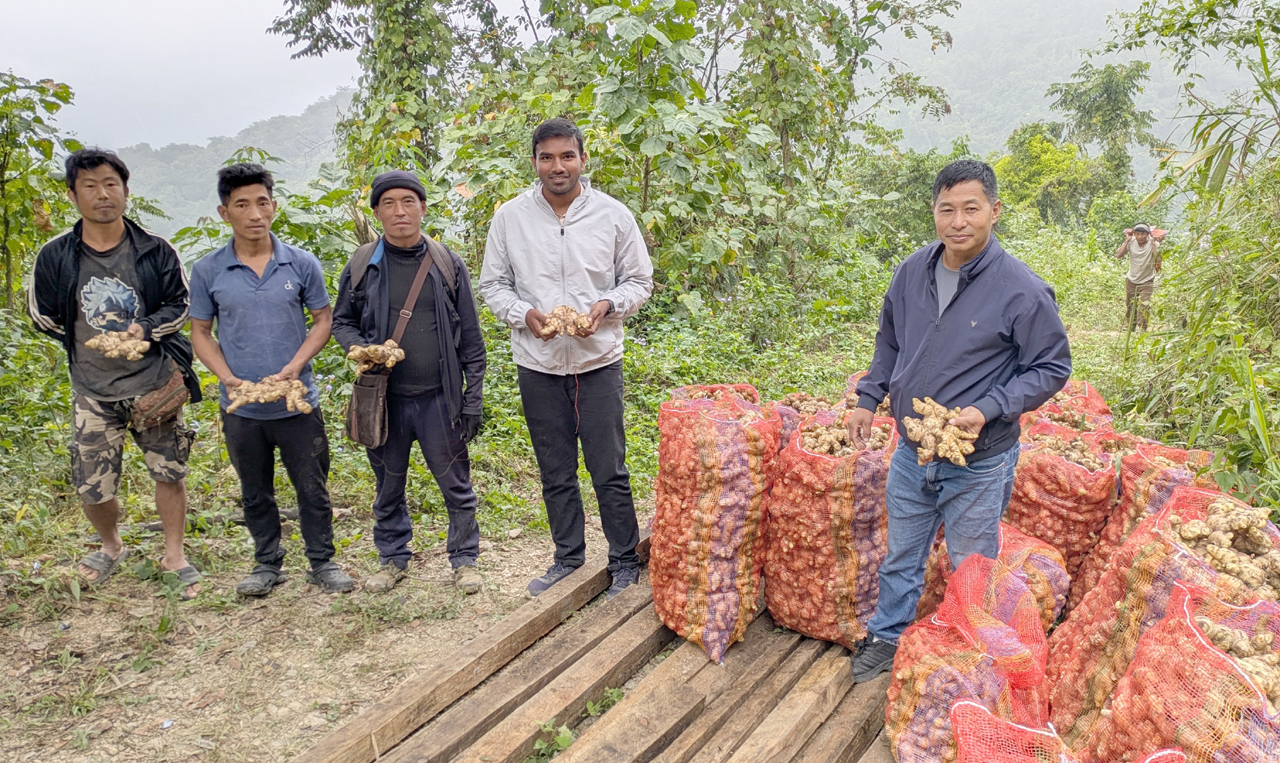
ICAR–Krishi Vigyan Kendra (KVK), Phek, under ICAR–National Research Centre on Mithun, Medziphema (ICAR–ATARI, Zone VII, Umiam), in collaboration with ICAR–Central Institute of Temperate Horticulture (CITH), Srinagar, organised a six-day training programme on “Improved Ginger Production Technologies, Post-Harvest Management and Value Addition for Enhancing Farmers’ Income” on November 16 and 21 across six villages in the Tizu area of Phek district, namely Sohomi, Tehephu, Suthotsu, Kutsapo, Khuza and Khutsokhono. A total of 150 farmers, with 25 participants from each village, actively participated in the programme.
The programme was organised under the leadership and guidance of Dr Sanjeev Kumar Singh, Senior
Scientist and Head, with the objective of enhancing farmers’ knowledge and skills in scientific ginger cultivation, improved crop management, post-harvest handling and value addition for better income generation.
During the programme, Manjunath KS, Subject Matter Specialist (Horticulture), delivered detailed technical lectures on scientific ginger cultivation, covering important aspects such as suitable varieties, quality seed rhizome selection, seed treatment, optimum planting time, recommended spacing, mulching, nutrient management, weed management, earthing-up operations, crop protection and harvesting techniques.
He also highlighted the importance of post-harvest management and value addition through the preparation of ginger powder, dried ginger flakes and ginger candy to minimize post-harvest losses and improve market opportunities.
Special emphasis was given to the Nadia ginger variety, which is widely cultivated in the Tizu area and has good potential for income generation. Farmers were encouraged to adopt improved production practices and maintain quality planting materials to enhance productivity and profitability.
Download Nagaland Tribune app on Google Play


Practical demonstrations were also conducted in farmers’ fields, particularly on the scientific treatment of ginger seed rhizomes to minimise fungal diseases, especially rhizome rot.
Demonstrations on proper harvesting techniques were undertaken, highlighting the importance of carefully lifting ginger rhizomes without causing mechanical injuries, as November is an important harvesting period in the region. Farmers were also sensitised to proper cleaning, sorting, grading, drying and storage practices to maintain rhizome quality and reduce post-harvest losses.
An interactive farmer–scientist interaction session was organised during the programme, wherein farmers actively discussed field-level problems, production constraints, disease management and marketing challenges. The importance of collective marketing, proper grading, packaging and exploring value-addition opportunities was also highlighted.
The programme provided an important platform for strengthening farmers’ technical knowledge and practical skills in improved ginger production and post-harvest management. It is expected to contribute towards enhancing ginger productivity, reducing post-harvest losses, promoting value addition and improving the livelihood and income of ginger-growing farmers in the Tizu area of Phek district.