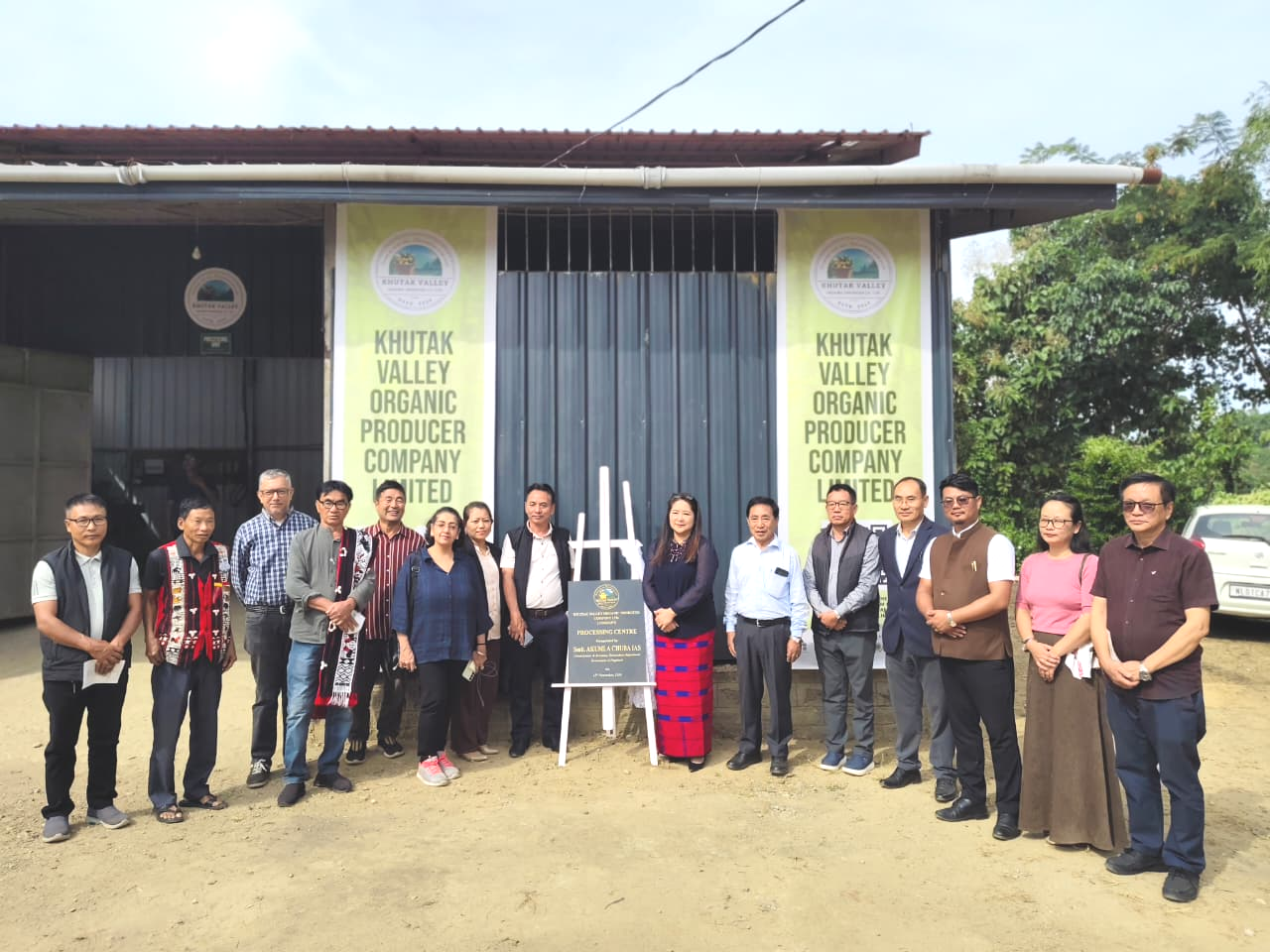
The Khutak Valley Organic Producer Company Limited (KVOPCLL) inaugurated its organic processing unit at Khanimu Longjang village, Mokokchung district, on November 11. Alongside the commissioning of its citrus juice and oil extraction facilities, the company explores the processing activities of Sichuan pepper, roselle, dried star fruit and honey-lime products, while also pursuing potential market collaborations with Guwahati-based Fundas and Nimo Pane of Jorhat for its lime juice products. The programme was attended by Commissioner and Secretary, Horticulture Department, Government of Nagaland, Akumla Chuba, IAS, as the special guest.
The Khutak Valley Organic Processing Plant (KVOPP) is a project under the Department of Horticulture, Government of Nagaland, with the Entrepreneur Associates, Nagaland, as the supporting partner. The initiative is being implemented under the Mission Organic Value Chain Development for North Eastern Region (MOVCDNER), a central sector scheme aimed at promoting organic farming, value addition and market linkages in the northeastern states.
Commissioner and Secretary, Horticulture Department, Government of Nagaland, Akumla Chuba, IAS, said the commissioning of the processing unit would provide an opportunity for farmers to move beyond the sale of raw produce towards processing and value addition, thereby improving their income and creating greater economic opportunities.
She observed that individual farmers often receive limited returns when selling their produce in raw form, and said the new facility could bring a change by enabling post-harvest processing and value addition. She expressed hope that the initiative would open further opportunities for farmers and youth in Longjang and surrounding areas.
Highlighting the importance of agriculture and horticulture in Nagaland, Chuba said a large section of the population depended on agriculture for their livelihood, while horticulture remained one of the important growing sectors of the state’s economy. She said the sector had the potential to improve farmers’ income, generate employment and contribute to nutritional security.
Referring to horticultural developments across the state, she cited the production of kiwi, persimmon, potato and cabbage in Phek district, along with pineapple production at Molvom and king chilli cultivation. She also referred to the potential of different crops across several districts, stating that such initiatives could contribute to the development of farmer-based enterprises and production activities.
Speaking on the potential of kiwifruit cultivation in Nagaland, Chuba highlighted the growing horticultural cooperation between India and New Zealand, particularly in the area of kiwi production. She noted that Nagaland’s production season coincides with New Zealand’s off-season, presenting an opportunity for the state to strengthen its position in the kiwifruit sector.
She referred to the cooperation between the two countries in horticulture, which includes the sharing of technical knowledge, scientific cultivation practices, improved planting materials and post-harvest management. She also highlighted the need for scientific intervention and greater engagement with experts to improve production and quality.
The cooperation has gained momentum through the India–New Zealand horticulture partnership, with kiwifruit identified as a priority area. A Kiwifruit Action Plan has also been taken forward, focusing on improved orchard management, farmer training, research and the establishment of Centres of Excellence. Nagaland is part of this initiative, with a Centre of Excellence for kiwifruit cultivation proposed at Pfütsero in Phek district.
Chuba expressed hope that with scientific support, improved cultivation practices and continued efforts, Nagaland’s kiwifruit production could gain wider recognition and access broader markets in the coming years. She also referred to the potential of Phek district, citing an estimated kiwi production of around 1,500 metric tonnes.
She said such developments could help place Nagaland’s horticultural produce on the international map and encouraged farmers to make use of the opportunities available through organised production, processing and market linkages.
Chuba also referred to success stories of Farmer Producer Organisations (FPOs) and Farmer Producer Companies (FPCs), stating that similar achievements could be developed in Nagaland. She said Longjang had the potential to establish itself as a successful centre of horticultural production and enterprise. She further highlighted the prospects of black pepper and cocoa plantations in the area, expressing optimism about their future.
Emphasising the importance of organic farming, she stressed the need to maintain organic standards and obtain organic certification. She also urged farmers and the company to protect and preserve their seeds and seedlings, maintain organic planting materials and ensure proper management of their resources. She said seed preservation was particularly important for sustaining agricultural production and maintaining the quality of produce.
Referring to the legacy of Longjang village, Chuba reminded the gathering that Nagaland’s first Chief Minister, P Shilu Ao, hailed from the village. She said the people should draw inspiration from this legacy and demonstrate leadership in agriculture and horticulture, not only for the district but also for the state.
Describing the processing unit as a good example for the district, she said the facility could help bring a structural change in the way farmers handle their produce, moving from raw cultivation and individual sales towards processing and value addition. She expressed hope that the initiative would improve the returns farmers receive from their produce and create opportunities for further agricultural activities.
Chuba stressed that community support and collective participation would be important for the success of the initiative. Calling upon the company, farmers and youth to work together, she urged them to maintain organic standards and continue their efforts towards building a sustainable agricultural enterprise.
She called for collective efforts to write a new chapter of economic and horticultural self-reliance, stating that the initiative could contribute to improving the livelihoods of local farmers and creating opportunities for the younger generation.
Dr James K Chawang, Joint Director and Nodal Officer of the Mission Organic Value Chain Development for North Eastern Region (MOVCDNER), Department of Agriculture, said the processing facility should be effectively utilised and sustainably managed to ensure its long-term success.
Representing the Director of Agriculture at the inaugural programme, Chawang said the department was satisfied with the work carried out by the company within the available resources and funds. He stated that the government had released the allocated funds to the Farmer Producer Company (FPC) as per the provisions of the scheme, with GST deductions as required, while the company had also contributed 25% towards the project.
Commending the retired government officers of Longjang for coming together to serve their village through the establishment of the Khutak Valley Organic Producer Company Limited, he said their initiative had set an example for other FPCs in the state.
He observed that the processing facility should not remain merely an infrastructure project but must be put to proper use, with effective management and sustainability in the years ahead. Referring to the department’s experience with FPCs in Mokokchung district, he noted that although several companies had been established since 2015, sustaining their activities over the years remained a challenge.
Chawang expressed hope that KVOPCLL would continue its operations and become a model FPC and processing unit for other districts. He also said the department would like to bring representatives of other FPCs for exposure visits to the facility so they could learn from its functioning and management.
He congratulated the company and wished it success in its future endeavours.
Dr Sashimeren Aier, Chairman of KVOPCLL, spoke about the company’s plans to expand beyond citrus processing and make wider use of the area’s agricultural potential. He said the warm, subtropical climate of the region was suitable for various horticultural plantations and that the company was exploring ways to integrate additional crops with the existing arecanut plantations.
Download Nagaland Tribune app on Google Play
https://play.google.com/store/apps/details?id=com.news.nagalandtribune< Hyperlink >
He said a team from the company had visited South India with support from the Department of Horticulture to study arecanut processing. During the visit, the team also observed black pepper cultivation and cocoa plantations, which encouraged the company to explore these crops for Longjang.
As an initial step, he said, 30,000 black pepper saplings were contributed by the local MLA last year and distributed among villagers for planting under arecanut trees. The company’s 10 board members had also taken up an experimental initiative to plant 5000 cocoa saplings on their farm. A few thousand additional saplings had been ordered, he added.
Aier said the company hoped that if the trials proved successful, the village could adopt the integrated plantation model on a wider scale. He acknowledged the support of the village council and expressed appreciation to officials from various departments for attending the inauguration. He also expressed hope for continued cooperation between the company and the departments in developing the initiative.
It was also outlined the company’s plans to diversify its processing activities and explore additional agricultural products. The products now incluses Sichuan pepper, dry star fruit, roselle, and a honey-and-lime combination, Lime juice. The processing facilities include an oil-pressing machine, a juice extractor and two dehydrator machines for drying fruits. It informed that cocoa cultivation was also being taken up as a pilot project, with 5,000 cocoa plants planned for distribution among selected farmers, with the possibility of expanding the initiative in the future. The company is also exploring arrangements for collaborating it’s lime juice, with discussions underway with Guwahati-based Fundas and Nimo Pane, based in Jorhat.
It was further informed that nursery plants of Cocoa plants and black pepper would be available around March and April, for farmers to take up plantation activities during the period.
Representing The Entrepreneurs Associates (EA), Chubazen Longkumer Project Coordinator congratulated the Khutak Valley Organic Producer Company Limited and its Board of Directors, led by Chairman Dr. Sashimeren Aier and secretary Limawati, for their commitment towards community development through the establishment of the processing facility.
He said the organisation had been working as a service provider under the Department of Agriculture since Phase III of the project and had supported the establishment of 40 Farmer Producer Companies across Nagaland.
Longkumer said the success of an FPC depended not only on its establishment but also on its proper utilisation, sustainability and collective participation of the Board of Directors, village councils and farmer members. He expressed confidence that the Khutak Valley FPC would work collectively towards achieving its objectives and assured continued handholding support and training from the organisation.
Commending the Longjang community for taking the initiative, he said the commitment demonstrated by the company reflected a concern for the development and betterment of the community. He also stressed that the organisation would extend its support with transparency and without partiality, irrespective of the location of the FPC.
Conveying a message from the CEO of The Entrepreneurs Associates, Longkumer said the inauguration of the citrus juice and oil extraction processing unit marked an important step towards economic development through business enterprises. The CEO observed that wealth creation among Nagas had largely been associated with government employment, contracts and supplies, and stressed the need to demonstrate that sustainable wealth could also be generated through organised business systems.
The CEO also acknowledged the leadership of Dr. Sashimeren Aier and the support of Commissioner and Secretary, Horticulture Department, Akumla Chuba, IAS, in facilitating the project. He expressed hope that the Khutak Valley FPC would serve as an example for other communities and demonstrate the potential of Nagaland’s resources.
The message further highlighted cocoa plantation as a prospective area for the organisation’s next project, with the aim of developing Nagaland’s presence in the chocolate industry. Longjang was identified as a potential hub and model for the proposed initiative, which could contribute to the development of a new economic zone.
Longkumer thanked the Departments of Agriculture and Horticulture, Government of Nagaland, for their support to the organisation and the FPCs across the state, and expressed hope for continued collaboration in future development initiatives.
MOVCDNER is a Government of India initiative designed to support farmers in adopting organic farming practices, strengthen value addition, establish market linkages and develop an organic value chain across the northeastern region.
The inauguration programme included the commissioning of the processing units, comprising the lemon juice extraction unit and oil extraction unit. A dedicatory prayer was offered by Yashii Longkumer, Pastor of Khanimu Baptist Church, while the programme also featured addresses by representatives of Longjang and Khanimu village councils, and the Departments of Horticulture and Agriculture.
The programme was chaired by Limawati Longchar, Secretary of KVOPCLL, with a welcome address by Dr Sashimeren Aier, Chairman of the company. Senti Longchar, Pastor of Longjang Baptist Church, offered the invocation.