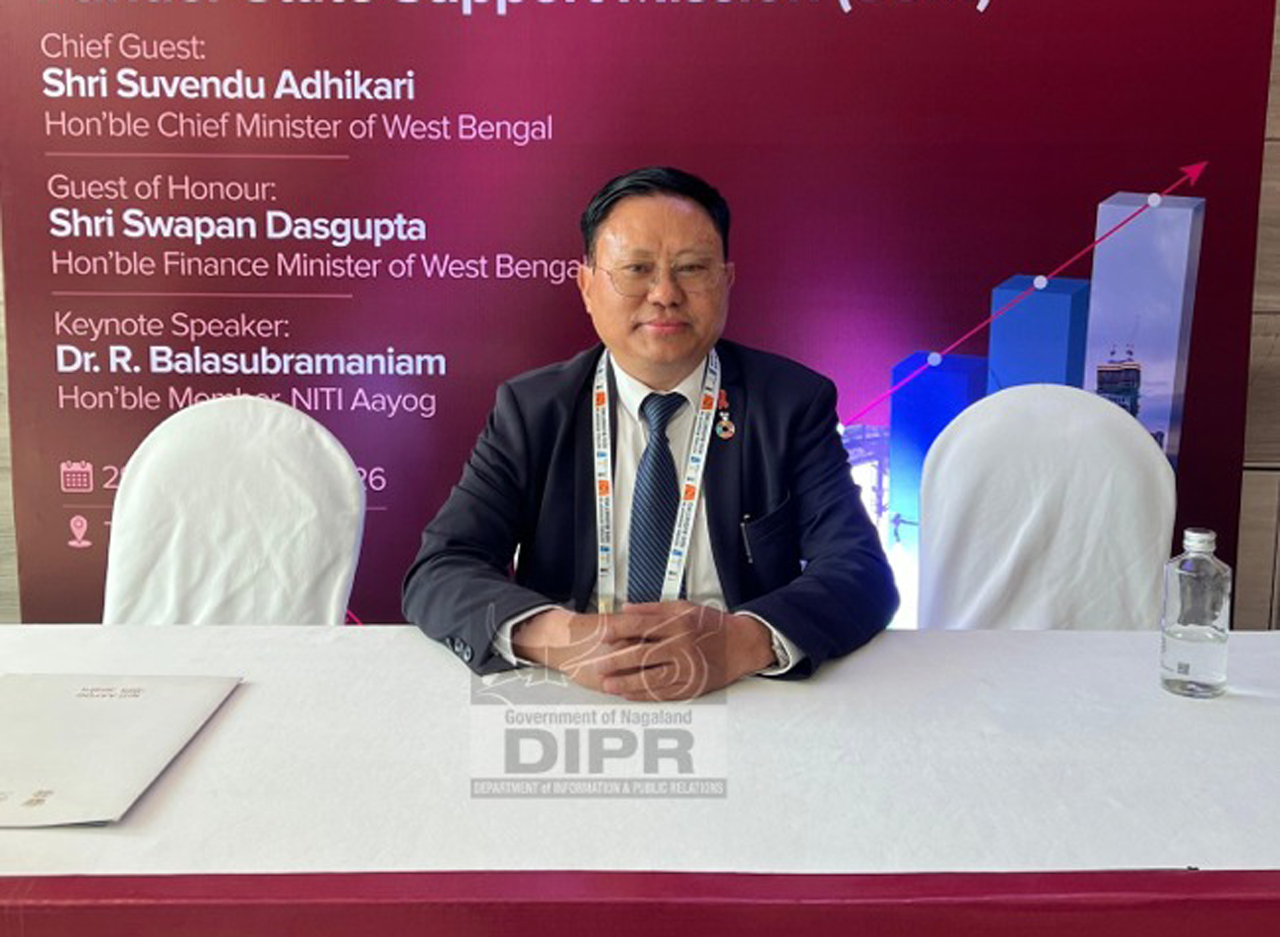
Principal Secretary and Development Commissioner, Y Kikheto Sema, IAS has called for greater flexibility and region-sensitive approaches in the implementation and assessment of Sustainable Development Goals (SDGs), highlighting the distinct geographical, agricultural, cultural and socio-economic realities of Nagaland and the North Eastern Region (NER).
Speaking at the National Workshop on SDG Budgeting organised by NITI Aayog and UNDP and hosted by the Government of West Bengal under the State Support Mission in Kolkata on September 29, Kikheto highlighted several challenges faced by Nagaland in meeting and interpreting SDG indicators.
According to a DIPR update, on financial inclusion under SDG 1 (No Poverty) and SDG 8 (Decent Work and Economic Growth), the Development Commissioner pointed out that access to banking services is essential for the effective delivery of government welfare schemes, as benefits are increasingly linked to bank accounts. However, 14 of Nagaland’s 76 blocks remain unbanked, with people in remote areas sometimes having to travel 30–40 km to access banking services.
He called upon the Government of India to consider appropriate financial support and innovative mechanisms to improve the viability and accessibility of banking services in underserved areas.
Kikheto also stressed the need to contextualise the SDG indicators used in the SDG India Index published by NITI Aayog so that they better reflect the realities of Nagaland and the North Eastern Region (NER).
Under SDG 2 (Zero Hunger), he pointed to indicators such as average rice yield and productivity of fruits and vegetables, which, he said, may not fully capture Nagaland’s agricultural context. The State remains relatively untouched by the Green Revolution, while many farmers continue to practise jhum and shifting cultivation.
He said lower productivity should not, by itself, be interpreted as an indicator of food insecurity or poor agricultural performance. Instead, such indicators could be assessed alongside local cropping patterns, nutritional outcomes, environmental sustainability, high-value crops and farm incomes.
Kikheto also raised concerns over the SDG 12 (Responsible Consumption and Production) indicator concerning the “area under jhum cultivation as a percentage of total area under agriculture”, for which the target is set at zero.
He emphasised that such a target needs to be viewed in the context of the hilly States of the NER, stating that jhum is not merely an agricultural practice but is deeply embedded in the culture, traditions and livelihoods of communities. Agricultural cycles, he noted, are closely associated with traditional festivals and community life.
He therefore stressed that jhum should not be assessed solely as a practice to be eliminated, but should also be understood through its ecological, cultural and livelihood dimensions.
Nagaland Tribune app on Google Play


The Development Commissioner further noted that Nagaland has eight Agriculture and Allied Departments staffed by agriculture professionals, yet indigenous farming systems, including jhum and shifting cultivation, are not adequately covered in agricultural education curricula, including in agricultural institutions in the State.
He highlighted the resulting gap between agricultural education and the realities faced by farmers and called for greater inclusion of jhum and shifting cultivation in the curricula of agricultural colleges and institutions, particularly across the NER. Such an approach, he said, would strengthen understanding, research and the development of context-specific solutions for the region’s indigenous agricultural systems.
On nutrition under SDG 2, Kikheto also called for contextual consideration of the indicator relating to the percentage of women aged 15–49 whose Body Mass Index (BMI) is below 18.5.
While acknowledging the WHO classification as a standard benchmark, he noted that the NER has distinct demographic, anthropometric and socio-cultural characteristics. He suggested that it may be useful to examine whether a uniform BMI benchmark adequately captures nutritional status across diverse populations and whether region-specific evidence could be considered while interpreting the indicator.
Kikheto further stressed that India’s diverse geographical, cultural and socio-economic contexts require region-sensitive policies and programmes. A one-size-fits-all approach, he said, may not adequately address local realities, and national policies, schemes and cost norms should provide greater flexibility while incorporating the perspectives of States and communities.
The national workshop brought together senior officers from 36 States and Union Territories, Ministries of the Government of India, UNDP and other stakeholders to deliberate on strengthening SDG budgeting within States’ planning and budgeting processes.
The Nagaland delegation comprised Principal Secretary and Development Commissioner Y. Kikheto Sema, IAS; Finance Commissioner and Commissioner & Secretary to the Chief Minister Kesonyu Yhome, IAS; and Assistant Planning Officer Loktimen Longchari.