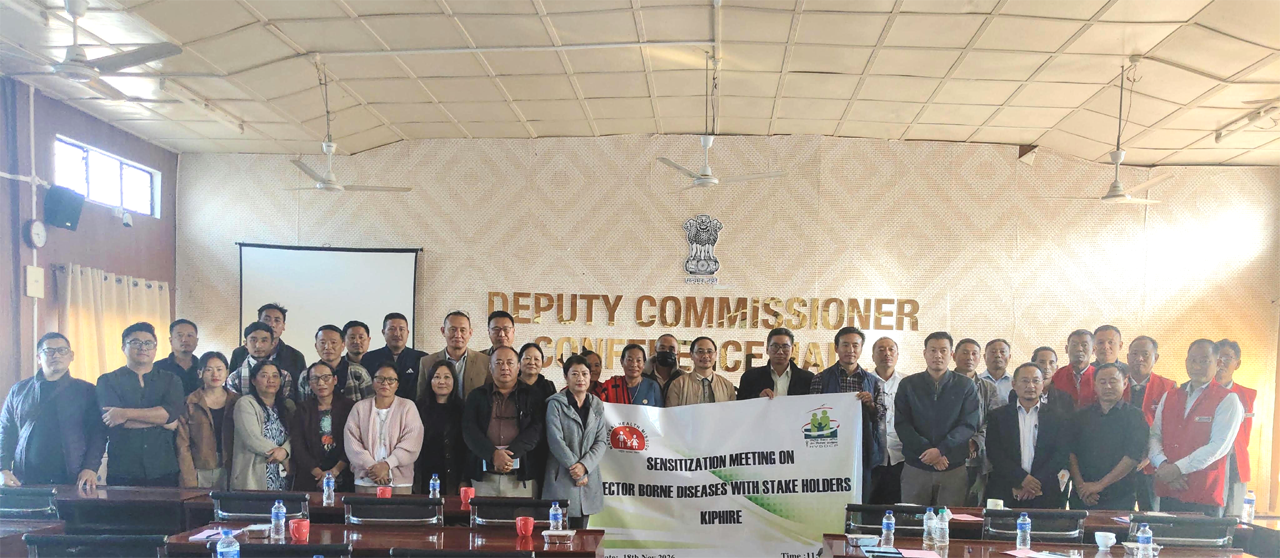
Health officials highlight malaria, dengue and Japanese encephalitis prevention, urge community participation
A sensitisation meeting on vector-borne diseases was held at the Deputy Commissioner’s Conference Hall, Kiphire, on November 18, organised by the National Vector Borne Disease Control Programme (NVBDCP), Department of Health and Family Welfare.
The meeting brought together various stakeholders to strengthen awareness, coordination and community participation in the prevention and control of vector-borne diseases, particularly malaria, dengue and Japanese encephalitis (JE).
The meeting was chaired by Dr Ayangla Saku, Chief Medical Officer (CMO), Kiphire. Participants were sensitised on the causes and modes of transmission of vector-borne diseases, preventive measures and the importance of using Long-Lasting Insecticidal Nets (LLINs).
Deputy Commissioner of Kiphire, Temsuwati Longkumer, welcomed the state NVBDCP team and appreciated its initiative to sensitise the district on vector-borne disease prevention and control.
Dr Imnapokim, Joint Director and State Programme Officer (SPO), NVBDCP, spoke on the national goal of achieving zero indigenous malaria cases by 2027. Emphasising the importance of community participation, he highlighted preventive measures such as the use of LLINs, maintaining cleanliness and sanitation, wearing long-sleeved clothing and using mosquito repellents.
He also stressed the need for source reduction to eliminate mosquito breeding sites and prevent the spread of malaria, dengue and Japanese encephalitis.
Download Nagaland Tribune app on Google Play


Dr Kavito Zhimomi, Deputy Director, NVBDCP, spoke on Information, Education and Communication (IEC) activities and emphasised the need for intensive awareness campaigns involving stakeholders during the pre-monsoon and post-monsoon periods.
The meeting was attended by representatives of the district administration, CMO’s office, education department, civil society organisations, women leaders and other stakeholders.
Emphasising interdepartmental coordination and collective responsibility, the participants were urged to extend their cooperation and support to the Health Department in conducting awareness campaigns, community mobilisation, source reduction activities and other preventive interventions at the grassroots level.
The meeting concluded with a collective commitment from stakeholders to strengthen collaborative efforts towards achieving the national disease elimination goal of 2030.
During their visit to the district, the state NVBDCP team also visited Longmatra Health and Wellness Centre (HWC), Purer HWC, Yingshikur HWC, District Hospital, Pungro Community Health Centre (CHC), Likhimro Primary Health Centre (PHC), Moya village, Chomi HWC and Pungro village Sub-Centre.