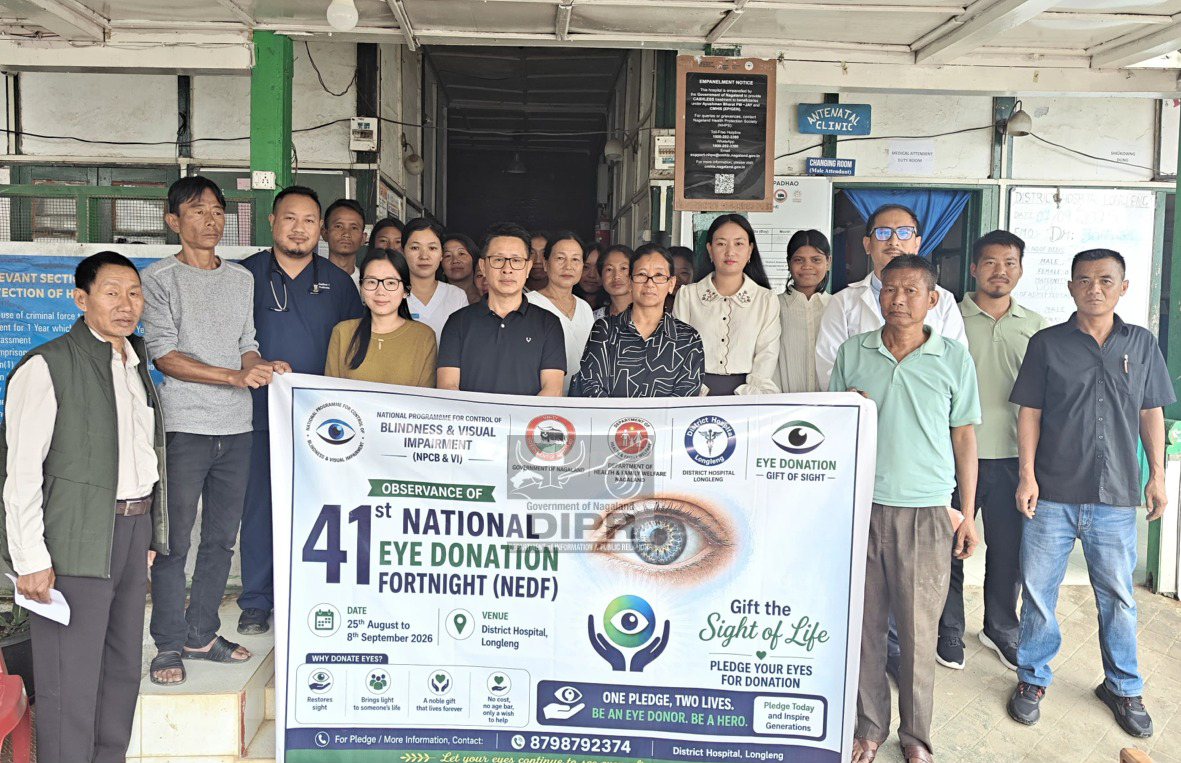
The District Health Society, Longleng, has called upon the public to come forward and pledge their eyes after death to help bridge the shortage of donated corneas and restore sight to people suffering from corneal blindness.
The appeal was made during a sensitisation and awareness programme held at District Hospital, Longleng, as part of the 41st National Eye Donation Fortnight (NEDF) under the National Programme for Control of Blindness and Visual Impairment (NPCB & VI).
Addressing the gathering, Chief Medical Officer Dr Thungchanpeni Patton highlighted the importance of eye donation and the urgent need to dispel myths and misconceptions surrounding the practice. She encouraged people to motivate others to pledge their eyes and understand the vital role of corneal transplantation in restoring vision.
Describing eye donation as a noble gift that lives forever, Dr Patton urged families to honour the wishes of loved ones who have pledged their eyes. She said a pledge made today could give someone the gift of sight tomorrow.
Ophthalmologist at District Hospital, Longleng, Dr Thejavituo Kire said the National Eye Donation Fortnight is a nationwide 15-day awareness campaign observed annually with the support of the Government of India. The campaign, which has been observed since 1985, seeks to encourage healthcare institutions and stakeholders to intensify public awareness and motivate people to pledge their eyes after death.
Download Nagaland Tribune app on Google Play


Explaining the process of cornea harvesting, Dr Kire said people of any age or gender can donate their eyes after death, except in cases involving certain specified diseases. He also outlined the major causes of corneal blindness and the procedure involved in eye donation and transplantation.
He noted that corneal diseases and injuries remain among the major causes of visual impairment worldwide and stressed that there is no artificial substitute for the human cornea. Donated corneal tissue therefore remains essential for restoring sight through transplantation.
Despite advances in corneal transplantation, he said, a significant gap persists between the demand for and availability of donated corneas. This, he stressed, underlines the need for greater public awareness and increased eye pledges.
Dr Kire appealed to the public to learn the facts about eye donation, reject misconceptions and make the noble pledge of donating their eyes after death to help restore vision to those in need.
The programme was chaired by Bingmei, NCD Counsellor, while the invocation was pronounced by Y Chingphuh, Ophthalmic Assistant.
