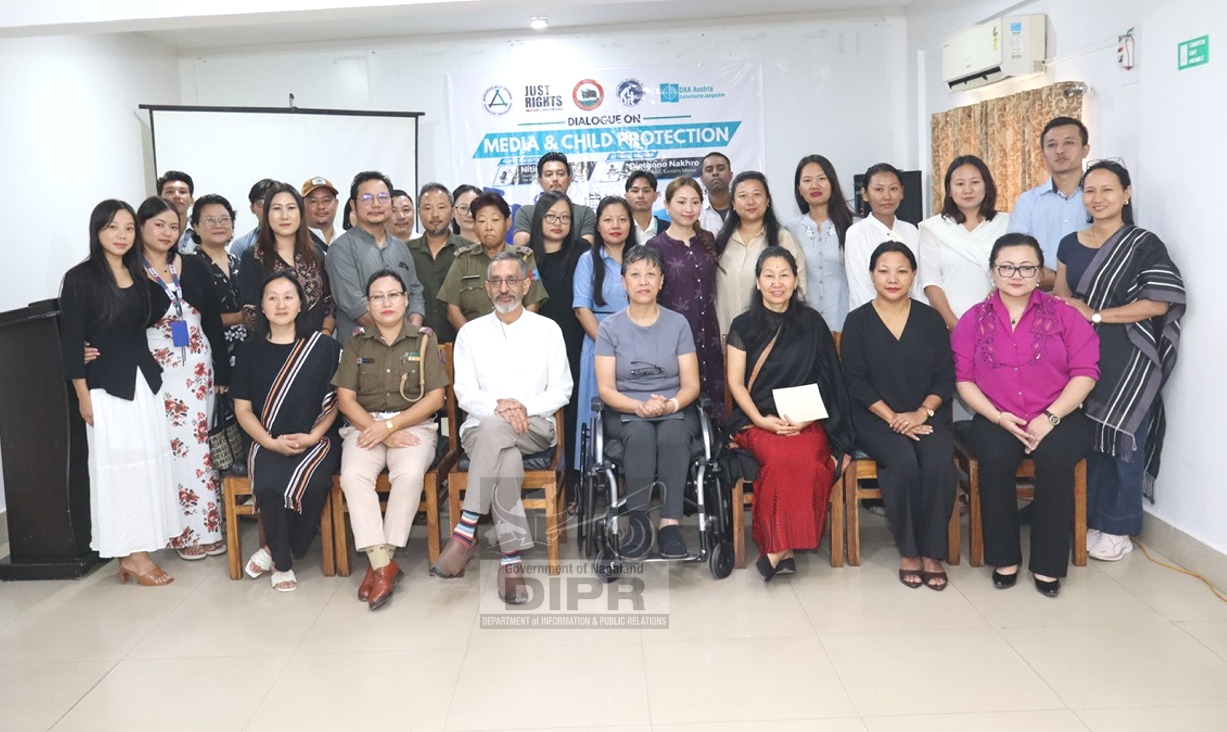
State-level dialogue in Dimapur brings journalists and child protection stakeholders together to promote ethical, responsible and rights-based journalism
Media professionals have been urged to adopt ethical, responsible and rights-based approaches to journalism, particularly while reporting issues involving children, by ensuring that their identity, dignity, privacy and best interests are protected.
The call was made during a State-Level Dialogue on Media and Child Protection held at Hotel Saramati, Dimapur, on November 14. The programme brought together media professionals and child protection stakeholders to strengthen ethical and responsible media engagement in safeguarding children’s rights and welfare in Nagaland.
The dialogue was organised by Prodigals’ Home under its project, “Enabling Wholistic Safety and Protection of Children in Nagaland,” in collaboration with Mission Vatsalya, Department of Social Welfare, Nagaland, and Just Rights for Children, with The Morung Express as media partner.
The programme began with an invocation by Hokhepu Achumi, Project Lead, Building Resilient Families Mission, Prodigals’ Home, followed by a welcome address from K. Ela, Director, Prodigals’ Home.
Delivering the keynote address, former Editor of Eastern Mirror and Founder and Executive Director of Khrieto Nakhro Foundation, Diethono Nakhro, highlighted the media’s important role in strengthening child protection and promoting social inclusion.
She said the media played a vital role in a democratic society by informing the public, exposing injustice, questioning authority and shaping public opinion. However, she stressed that such influence carried significant responsibility, particularly when reporting involved children.
Drawing on her experience in media, child rights and disability rights, Nakhro observed that child protection, disability rights, gender equality, Indigenous identity, access to justice and social inclusion were deeply interconnected.
Emphasising the need to safeguard children’s identities, she said responsible journalism should go beyond withholding names, photographs and other identifying details. Media organisations should also investigate failures in child protection systems, highlight gaps in services, question institutional negligence and draw attention to issues that often remain unreported.
She maintained that reporting on child abuse should not end with the incident or the arrest of the accused. Journalists should also examine whether warning signs had been ignored, whether the child received adequate protection and support, whether authorities responded appropriately and what systemic failures had allowed the abuse to occur.
Pointing to the challenges of reporting in Nagaland’s closely connected communities, Nakhro cautioned that even when a child’s name was withheld, details about the village, school, family circumstances or identity of an accused person could inadvertently reveal the child’s identity.
In tribal communities, where family, clan and village identities were closely linked, she urged journalists to exercise particular caution while reporting cases of sexual abuse, trafficking and other forms of violence and exploitation.
She stressed that protecting a child’s identity required careful editorial judgement over every detail published. At the same time, she cautioned that privacy concerns should not become an excuse to silence legitimate reporting or shield perpetrators and institutions from scrutiny.
Drawing attention to children with disabilities, Nakhro said they faced the same risks of violence, abuse, neglect, exploitation and discrimination as other children, but could be more vulnerable because of communication barriers, dependence on others, social isolation and difficulties in reporting abuse.
She urged the media to move away from narratives of pity, helplessness and tragedy when reporting on disability, emphasising that a child with a disability was first and foremost a child with equal rights to safety, dignity, privacy, participation and protection.
She also called for greater visibility for children often missing from media coverage, including those living in remote villages, children from economically disadvantaged families, those outside the education system and children facing different forms of exclusion.
On cultural and customary practices, Nakhro said respect for culture should never become a reason to overlook violations of children’s rights. She maintained that cultures and customary practices must evolve with changing times, particularly when they perpetuate discrimination, exclusion or denial of rights. She called on the media to encourage informed public discussions, question discriminatory practices and support positive social change while preserving cultural values.
Download Nagaland Tribune app on Google Play


Highlighting the importance of language and digital reporting, she said words shaped public perceptions, attitudes and behaviour, and inappropriate language could label, diminish or stigmatise children.
With news content increasingly shared across digital platforms, she cautioned that even when a report was corrected or removed, the damage to a child’s privacy and dignity could continue long after its original publication. She stressed that speed and competition for public attention should never take precedence over accuracy, dignity and children’s safety.
Nakhro also called for greater awareness among journalists about child protection laws and urged newsrooms to assess whether existing guidelines adequately addressed the rights and specific needs of children with disabilities.
Concluding, she said the media had the power not only to tell stories but also to influence how society viewed, valued and treated children. Journalism, she stressed, should become an active force for child rights, protection and inclusion by challenging prejudice, exposing systemic failures and giving voice to children whose rights and experiences were often overlooked.
She called upon media professionals to ensure that every report involving children upheld their dignity, safeguarded their future and contributed to building a more inclusive and protective society.
The programme also featured Nitin Sethi, journalist and Trustee of The Reporters Collective Trust, Delhi, who conducted a media engagement session titled “Voices in Dialogue” and another session on “Towards Responsible Reporting: Review and Recommendations of Child Safety Guidelines”. The sessions focused on strengthening ethical media practices and responsible reporting on issues involving children.
A panel dialogue on “Sharing Challenges and Exploring Possible Solutions” featured Imkong Walling, Principal Correspondent, The Morung Express; Veroli Zhimomi, Sub-Editor, Eastern Mirror; Bendangchuba, Reporter, Nagaland Post; and Wangzei Konyak, Reporter, Dimapur 24×7. The discussion provided a platform for media practitioners to share their experiences and challenges and explore possible solutions for strengthening responsible reporting on child protection issues.
A pledge against child marriage was also administered by Just Rights for Children and Prodigals’ Home.
The concluding session on reflections and key takeaways included representatives from The Morung Express and Raitale Zeliang, Programme Manager, Mission Vatsalya, Department of Social Welfare, Kohima.
The dialogue aimed to strengthen collaboration between media professionals and child protection stakeholders while promoting a rights-based approach to journalism that prioritises children’s safety, dignity, privacy and best interests.