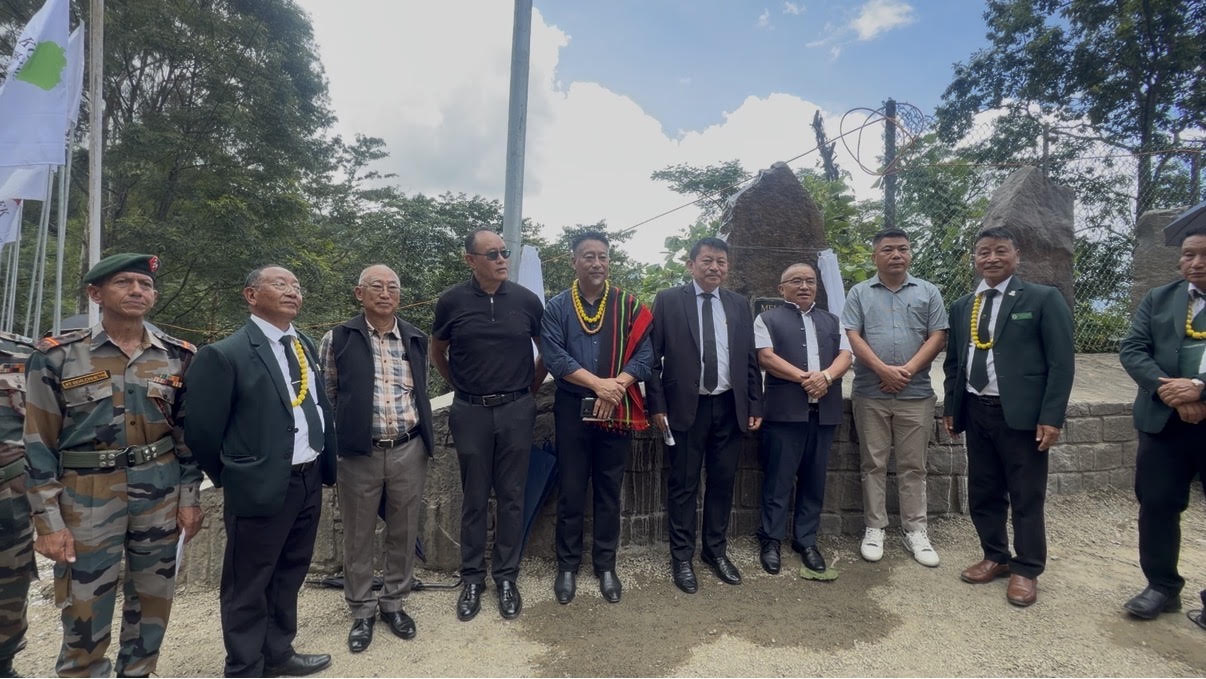
The Tsütuonuomia Khel Council, Kohima Village, unveiled the Meluri District Unity Stone Monolith at Tsütuo Kharu, Kewhitsütuo Model, Kohima, on Wednesday, marking the inclusion of Meluri in the symbolic representation of Nagaland’s districts.
MLA and Advisor for NSDMA and Inland Waterways Nagaland, Z Nyusietho Nyuthe, in his address called for greater unity among the Naga people, urging society to avoid pointing fingers at one another and instead make renewed efforts towards understanding and oneness.
Nyuthe highlighted the historical evolution of the region and the creation of Meluri as Nagaland’s newest district. He recalled that Meluri was once part of the larger Kohima District and that the Eastern Angami area subsequently evolved into Chakhesang and later Pochury administrative areas.
He noted that Phek District was created in 1973, while Meluri District was established in 2024 and inaugurated on February 21, 2025, by Chief Minister, Neiphiu Rio. Nyuthe described the creation of districts across the State as part of the aspiration for every tribal community to have its own administrative home.
Nyuthe said Kohima Village holds a significant place in Naga history and is associated with the early Naga movement as well as the Battle of Kohima during the Second World War. He also noted Kohima Village’s distinction as one of the largest villages in Asia.
Referring to Tsütuonumia Khel and the traditional Khel system of Kohima Village, Nyuthe said the distinct identity and organisation of the four khels reflected the unique social structure and heritage of the village.
On the Naga political issue, Nyuthe said the present government under Chief Minister Neiphiu Rio was committed to pursuing a solution. He pointed to the Naga Consultative Meeting held on September 12, 2024, which brought together representatives from different sections of Naga society, including tribal organisations, civil society organisations, Churches, student bodies, NGOs, political parties, government officials and the two Members of Parliament from Nagaland.
He said the meeting adopted a resolution appealing to all sections of Naga society to strengthen unity and oneness and to bring all stakeholders in the peace process together in a spirit of understanding.
According to Nyuthe, 355 participants had attended the meeting and signed the resolution.
Addressing concerns over divisions among the Nagas, he said, “Nagas, as a nation, people think that we have been badly divided. It is not so.”
He stressed that unity would require a change in attitude among the people, stating, “If we really want to be united, we should not pinpoint to each other.”
Nyuthe called for collective responsibility and renewed efforts to strengthen unity among the Naga people, saying that the aspirations of the people could be advanced only through mutual understanding and cooperation.
Deputy Commissioner of Kohima, B Henok Buchen, NCS, said the creation of a new district is more than an administrative exercise, describing the establishment of Meluri District as an important chapter in Nagaland’s administrative and developmental history.
He commended the Tsütuonuomia Khel Council for constructing the Unity Stone, saying it demonstrated that building a strong and progressive society is a shared responsibility of the government and the community.
Highlighting the historical contributions of Tsütuonuomia Khel, Buchen recalled its resistance to British expansion into the Naga Hills, including encounters with British forces in 1879. He also noted the khel’s contribution to Naga political consciousness, education, cultural preservation and community development.
Download Nagaland Tribune app on Google Play


Buchen urged people to view the monolith not merely as a monument but as a symbol of commitment to unity, mutual respect, peaceful coexistence and cooperation.
“Differences in village, clan, community or individual interests should never become obstacles to the larger collective interest,” he said.
He further called on traditional institutions and community organisations to work closely with the administration to ensure effective implementation of developmental programmes and address the genuine aspirations of the people.
Congratulating the Tsütuonuomia Khel Council, Buchen expressed hope that the monolith would stand for generations as a reminder of the importance of unity and inspire people to “work together, walk together and grow together.”
President of the Pochury Hoho Kohima, Thosiepa Katiry, described the creation of Meluri District as a landmark moment and the fulfilment of a long-cherished aspiration of the Pochury people.
Katiry expressed gratitude to the Nagaland Government, led by Chief Minister Dr. Neiphiu Rio, along with ministers, advisors and MLAs, for recognising the aspirations of the people and granting full-fledged district status to Meluri.
He said the new district should be built on the foundations of peace, good governance, inclusiveness, opportunity and sustainable development.
Katiry expressed hope that Meluri would emerge as a “Fortune District”, symbolising hope, unity, opportunity and progress while contributing to the development and prosperity of Nagaland as a whole.
The programme began with an invocation by Rev Kevimese Suohu, followed by the unfurling of the National Flag and the unveiling of the Unity Stone Monolith by special guest .
The programme also featured a Tsütuonuomia theme song by Avibou Belho, a folk song presented by the TYO in-charge President and a special song by Ledilhounuo Sekhose. Words of appreciation were delivered by Er Thepfuzakie Suahu, General Secretary of the Tsütuonuomia Khel Council.
The Unity Stone initiative symbolises the unity and collective identity of Nagaland’s districts. Seventeen flags, each bearing the name and map of a district, were displayed during the programme, representing the State’s 17 districts.
The Unity Stone initiative originally featured 16 stones representing the districts of Nagaland and was earlier unveiled by Chief Minister Neiphiu Rio. With the creation of Meluri District, the latest monolith represents the State’s expanded administrative landscape and reinforces the message of unity among all districts.