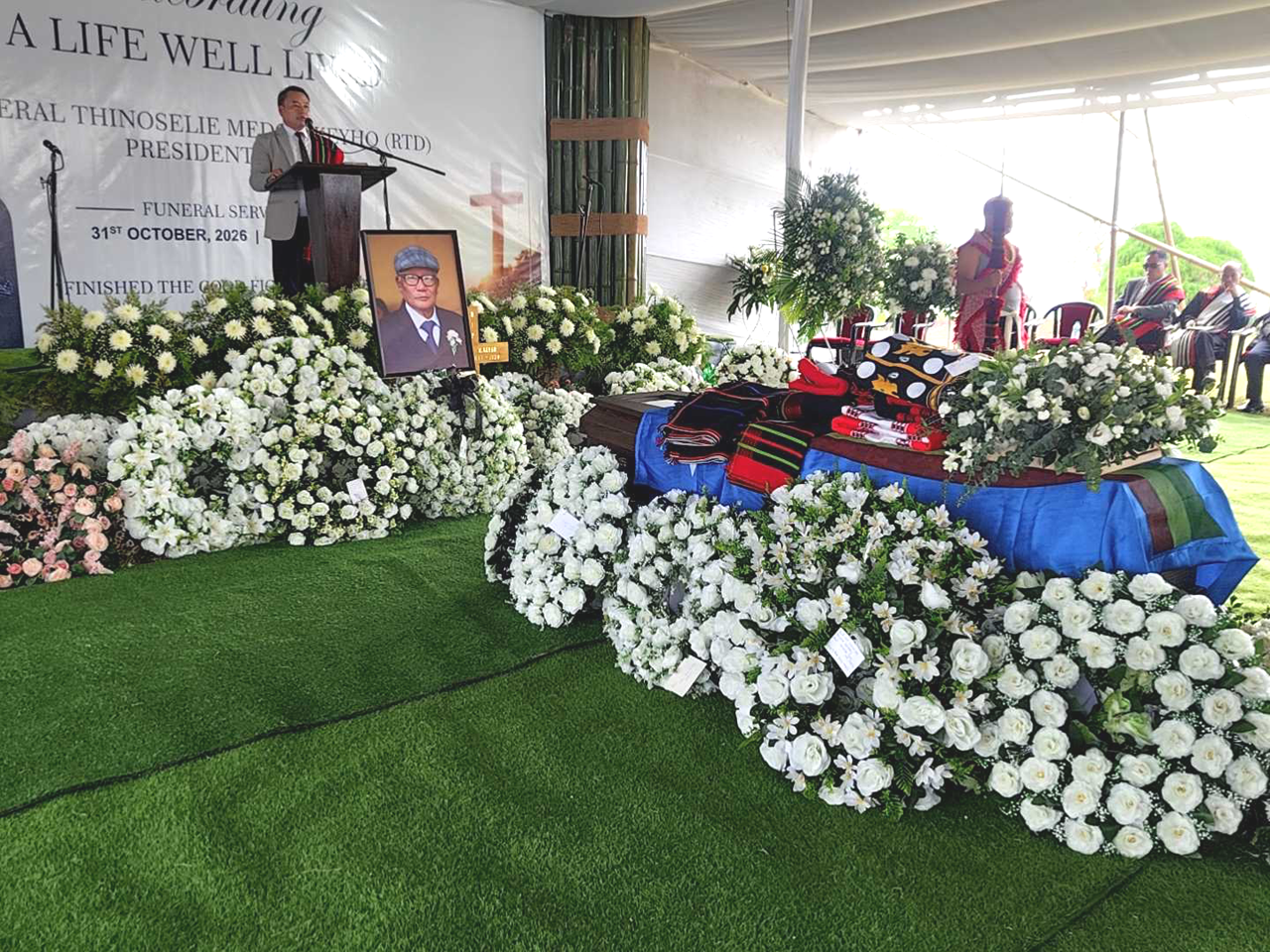
Veteran Naga national leader and president of the Naga National Council (NNC), General (Retd.) Thinoselie Medom Keyho, was laid to rest at his native village Chedema on Saturday, with leaders and representatives of various Naga organisations, family members and well-wishers paying their final respects to a man who devoted nearly seven decades of his life to the Naga national movement.
The funeral service was held at Rüvetsiezou, Chedema, where speakers recalled his unwavering commitment to the Naga political cause, his sacrifices during the difficult years of the movement and his contribution to community leadership.
NNC Central Executive Member Zapuvisie Lhousa, sharing a brief account of Keyho’s life, recalled that their friendship began in 1950 when they became classmates in Class VI at Kohima. Although they studied together for only a year, Lhousa said they developed a close friendship. Keyho later proceeded to Shillong for further studies, where he also learnt typing.
Lhousa recalled that Keyho joined the Federal Government of Nagaland (FGN) in 1956 during the political turmoil in Kohima and subsequently endured imprisonment and other hardships for the Naga cause. He said Keyho had remained committed to the national movement throughout his life, often sacrificing personal comfort and spending sleepless nights in the service of the people.
Recalling his final message, Lhousa said Keyho had urged them never to abandon the NNC and to convey the message to the people.
NNC Central Executive Member Sanguto Chase described Keyho as a leader who had given his entire life to the Nagas without seeking personal or family benefits. He recalled that Keyho had led several Naga Army expeditions to neighbouring countries and had remained steadfast despite the hardships and imprisonment he faced.
Chase also recalled the difficult return journey from China, during which 47 members of their entourage had lost their lives due to armed encounters, hunger, drowning and sickness. He acknowledged the support of Keyho’s wife and children, who had cared for him and enabled him to continue his commitment to the Naga cause.
NNC (HQ) vice president Zapu-o Zhasa, who became acquainted with Keyho in 1966 and accompanied him on the China expedition, recalled their close association over the years. He described Keyho as a tireless worker who consistently maintained that the political rights of the Nagas were distinct and should never be surrendered. He termed his demise a great loss to the Naga people.
Angami Public Organisation (APO) president Thejao Vihienuo, in his eulogy, described Keyho as a member of a generation whose lives were shaped by sacrifice and unwavering commitment to the Naga national movement.
Recalling his encounter with Keyho and General Mowu at Maulai Jail in January 1976, Vihienuo said the experience had left a lasting impression on him. He also recalled Keyho’s contribution to the APO, which he led as president from 1980 to 1984.
Vihienuo said that despite his firm commitment to the principles of the NNC, Keyho had advocated forgiveness and unity among Naga political groups and civil society organisations. He recalled Keyho’s efforts to promote goodwill between the Ao and Sumi communities during a period of misunderstanding and his intervention during the Nagaland-Assam conflict at Merapani, where he led an APO team to the affected area.
Describing him as a leader who displayed patience during disagreements and courage in difficult circumstances, Vihienuo said political differences should never become an excuse to disregard history or deny the sacrifices of those who had shaped the Naga movement.
Chedema Village Council chairman Khriekedolie Thevo described Keyho as a father figure and one of the tallest leaders of the Naga people, saying his absence would be difficult to fill. He conveyed the village’s condolences to the bereaved family and paid tribute to the sacrifices Keyho had made for the people.
Family member Teisovilie Medom remembered Keyho as the kindest person in the family and said his demise had left an immeasurable void. He said Keyho could have chosen a peaceful life but had instead dedicated himself to the Naga cause. He also revealed that 16 members of the Medom Keyho family lineage had served as national workers, with Keyho making the most significant contribution among them.
Chedema Gazetted Officers Krotho president Vikehielie Pienyü said Keyho had always considered the welfare of the village and its people, particularly their social and economic progress.
Keyho’s daughter Akuonuo, in a brief eulogy, remembered her father as a patient and thoughtful person. She said he had expressed the wish that his funeral should be celebrated rather than regarded solely as an occasion of mourning.
Speaking on behalf of the in-laws, retired IAS officer Khekiye K. Sema, who said he had been associated with the family for 50 years, recalled Keyho as a gentle, humble and simple person.
Sema shared an account of Keyho’s younger days around Aizuto Mission in Nabutomi village, where he had developed a close association with the Sumi community and even adopted their traditional attire. Recalling a humorous incident, Sema said Keyho had once refused to change out of his Sumi attire after returning to Chedema.
Download Nagaland Tribune app on Google Play


He described Keyho as a person who never displayed his stature or authority and preferred to listen, consult and consider matters before responding. Sema said Keyho had remained steadfast in his belief that the Nagas had lived as a free people and deserved to remain free, dedicating nearly 70 years to the cause without wavering.
Speaking on behalf of the family, Rev. Dr. Noulezhalie Ricky Medom thanked the villagers, well-wishers, leaders of various organisations and healthcare workers of Naga Hospital Authority Kohima for their support during the family’s time of grief. He also expressed gratitude to Rhieo clansmen of Dapfhütsumia Khel for donating land for Keyho’s burial.
He said working for the Naga political issue had been the calling of his late uncle, who had spoken about it on several occasions.
Delivering the sermon during the final rites, Nagaland Christian Revival Church (NCRC) president Rev. Dr. Neikedozo Paphino said Keyho had lived a glorious life and that his legacy deserved to be celebrated.
He said Naga pioneers had recognised the uniqueness of the Nagas as a people at a time when they were still living in the wilderness and had worked to assert their rights. He observed that countless lives had been lost in the Naga struggle and expressed hope that the sacrifices, tears and bloodshed would not go in vain.
The funeral service was led by Vimedo Keyho, associate pastor of CRC Chedema, while Bible reading and prayer were conducted by Neisatuo Suokhrie, pastor of CRC Chedema. Special musical presentations were made by the youths of CRC Chedema and Ruovipfüvizo Suokhrie.
Born on May 11, 1930, at Chedema village, Kohima, Keyho was the youngest of five sons of Manyio Medom. His brothers included Lhoukuolie Medom and Biseto Medom, a former Kilo Kilonser of the FGN.
According to his biographical account, Keyho joined the FGN on June 11, 1956, as secretary to the Director of Intelligence, Naga Army, FGN. His decision to join the national movement reportedly followed an incident at Kohima market, where he witnessed the public display of two brutally killed Naga civilians, whose stomachs had been cut open, accompanied by insulting and abusive words by Indian armed forces.
He was promoted to Brigadier in the Naga Army in 1957. In 1963, he accompanied a contingent led by General Mowu to East Pakistan, serving as command writer.
A significant chapter of his national service began on October 24, 1966, when he led the first Naga contingent of 132 Naga Army personnel as military commander on an expedition to China. The contingent included civilian leaders, among them then NNC general secretary Th. Muivah as political leader, and reached the Chinese frontier on January 27, 1967.
In 1968, Keyho was promoted to lieutenant general in the Naga Army. During the same year, he led another group of Naga Army personnel, along with Brigadier Neidilie Kuotsu, to the People’s Republic of China (PRC) for further training.
While returning to Nagaland, the group travelled to Dhaka for diplomatic purposes. However, following the outbreak of the Indo-Pak war in 1971 and the surrender of East Pakistan, Keyho and his team were reportedly handed over to the Indian Army by the Red Cross. They were transported to Delhi and incarcerated at Tihar Jail before Keyho was transferred to Shillong Jail. He was released in 1976.
Following his release, Keyho continued his involvement in Naga community and political affairs. He served as president of the APO from 1980 to 1984 and was unanimously elected president of the Naga National Workers’ Conference (NNWC) in 1981, a position he held until 1990, with the objective of promoting unity among Naga political groups.
His commitment to the political rights and sovereignty aspirations of the Nagas remained central to his public life. His biographical account stated that he regarded the PRC as a crucial ally in the pursuit of Naga sovereignty. In 2014, he led another delegation of five Naga leaders to China.
On May 11, 2016, Keyho was unanimously elected president of the NNC (Nagaland) at a general meeting held at Yorüba in Phek district, following a consensus nomination by the NNC Central Executive Council.
He continued to head the organisation until his demise on October 29, 2026, leaving behind a legacy closely associated with the history of the Naga national movement and the generations who dedicated their lives to its political aspirations.