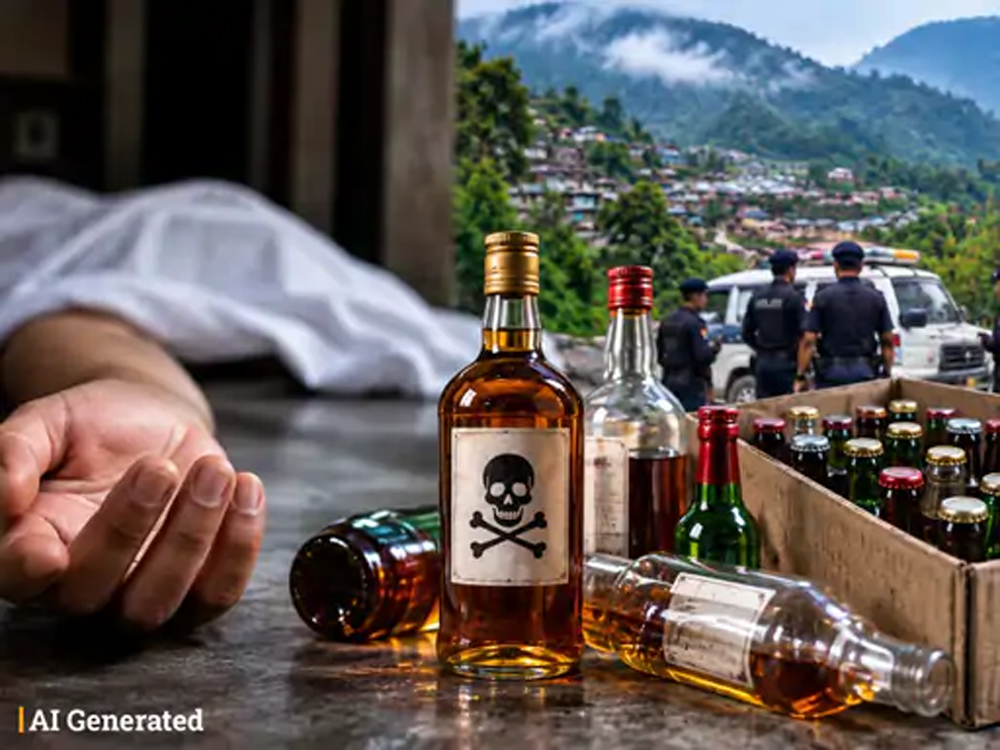
Nagaland BJP president, Benjamin Yepthomi has questioned the State Government’s approach to prohibition amid the recent deaths allegedly linked to consumption of spurious alcohol in Mokokchung and Tuensang, asking how liquor continues to reach dry districts despite the State’s prohibition policy.
Responding to a question on whether a Special Investigation Team (SIT) should be constituted at the district or State level to investigate the deaths, Yepthomi questioned the effectiveness of such probes, alleging that SITs were often constituted without addressing the underlying problems.
“What will forming an SIT do? It is all manipulated,” he said, adding that SITs were being formed in cases ranging from deaths to alleged corruption but questioned whether they actually delivered meaningful results.
On the prohibition policy, Yepthomi said the State needed to make a clear choice between complete prohibition and legalisation rather than continuing with what he described as an inconsistent system.
“After discussions, we either need to legalize alcohol, or if we are going to ban it, we need to ban it completely,” he said.
Also Read: Mokokchung declares zero tolerance on liquor amid suspected spurious liquor deaths
Yepthomi said the BJP respected the Nagaland Baptist Church Council (NBCC) and its work, but questioned how alcohol could be available in the State if Nagaland was officially treated as a “dry state”.
He referred to reports of licences being issued for two bonded warehouses and questioned the movement of alcohol from such facilities to districts where liquor is prohibited.
“If Nagaland is said to be a dry state, how come the Government of Nagaland is issuing licenses for two bonded warehouses for alcohol?” he asked.
Download Nagaland Tribune app on Google Play


Referring to districts such as Zunheboto and Tuensang, Yepthomi questioned how liquor reaches areas where its sale and consumption are prohibited.
“If alcohol is banned, how did it reach there?” he asked, questioning whether liquor was being transported from bonded warehouses and sold illegally in such areas.
Also read: Mokokchung liquor deaths: 25 arrested as police intensify district-wide crackdown
He also questioned the source of liquor reportedly reaching places such as Noklak and Tuensang, saying the continuing availability of alcohol despite prohibition raised questions about enforcement and the supply chain.
On the recent deaths, Yepthomi said that while consumption of alcohol was a personal choice, people who consumed adulterated or spurious liquor and died as a result should not be equated with those responsible for supplying such liquor.
He maintained that merely constituting an SIT would not address the larger issue unless the Government was prepared to examine the entire system of prohibition, enforcement and availability of alcohol.
“If you want to ban it, ban it completely; if you want to open it, open it completely,” Yepthomi said.