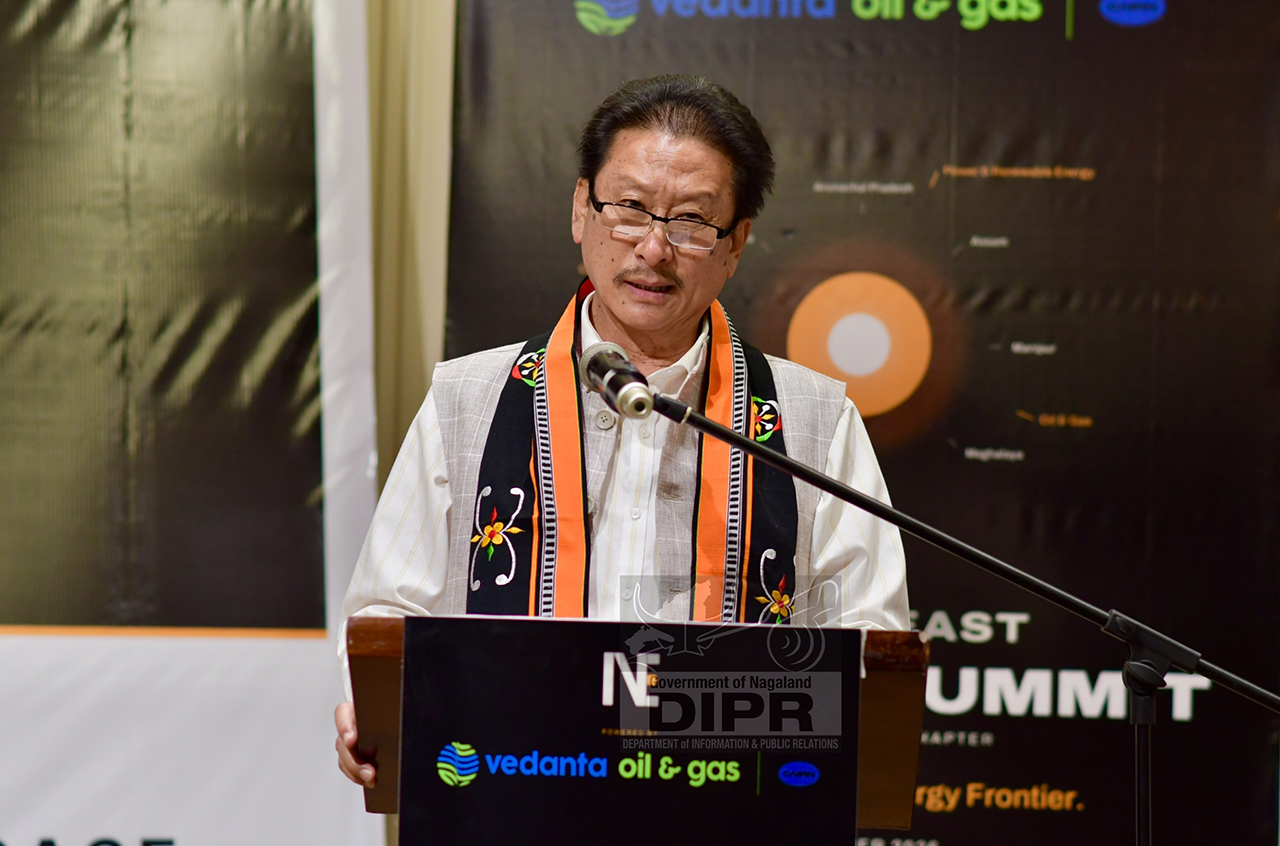
Nagaland has called for greater private-sector participation and investment in its energy sector, with the State Government highlighting opportunities in solar power, hydropower, biomass, thermal energy and natural gas at the North East Energy Summit 2026 held at The Niathu Zone by Park, Chümoukedima, on October 30.
Organised by the Department of Geology and Mining, Government of Nagaland, in collaboration with the North East Energy Summit under the Nagaland Energy Chapter, the summit was held on the theme “Northeast: India’s Energy Frontier”.
According to a DIPR report, the Summit brought together government officials, industry representatives, energy experts, investors and other stakeholders to explore the region’s energy potential and opportunities for investment, development and regional cooperation.
Delivering a special address, Minister of Power and Parliamentary Affairs, KG Kenye urged participating government departments, industry representatives, public sector enterprises and financial institutions to identify priority investment opportunities, prepare viable projects, improve government-industry coordination and establish practical mechanisms to follow up on commitments made during the summit.
He expressed hope that the proposed NEES Declaration would provide a meaningful foundation for sustained cooperation, with clearly identified priorities, responsibilities and timelines.
Kenye reiterated the State Government’s commitment to ensuring that energy development translated into improved infrastructure and public services, greater investment, employment opportunities and a stronger economy. He expressed confidence that the discussions and partnerships emerging from the summit would contribute to the energy future of Nagaland and the Northeast while supporting the national vision of Viksit Bharat 2047.
In his policy keynote address, Principal Secretary to the Chief Minister, Power and Law & Justice, KD Vizo called upon industry leaders, investors and development partners to explore opportunities in Nagaland’s energy sector, stressing that private-sector participation was essential to strengthening infrastructure and accelerating development.
Highlighting the State’s potential in renewable energy, particularly solar and hydropower, Vizo said greater awareness was needed among investors about the opportunities available in Nagaland.
He urged prospective investors to look beyond conventional investment destinations and consider Nagaland as a promising investment destination. “If you are investing in thousands of crores of rupees in other states and regions, why not consider investing in Nagaland?” he remarked, assuring that the Department of Power was ready to welcome investors.
Power projects awaiting implementation
Vizo informed that the State had signed several Power Purchase Agreements (PPAs) with private companies under its Power Policy introduced in 2018, which opened the power sector to private investment and participation.
Among the projects awaiting implementation are a 20 MW solar power project by My Hello Agency, signed at a tariff of Rs. 4.14 per unit, and another 20 MW solar power project by Tenas Bangshal.
Other projects include a 27 MW thermal power plant by NS Petro Method at Tuli, at a tariff of Rs. 4.80 per unit; a 10 MW biomass power plant by MS Group Private Limited at Tuli, at Rs. 5.06 per unit; and a 22.5 MW hydropower project at Khagrachari by MS Haritha Energy Private Limited.
Observing that some of the agreements had been signed nearly four years ago but were yet to take off, Vizo urged investors to translate their commitments into actual implementation.
Solar initiatives and transmission infrastructure
On renewable energy, Vizo said rooftop solar installation was progressing, with 650 installations completed against a target of 10,900. He highlighted the availability of Central and State subsidies, along with banking support, but said limited public awareness had contributed to the slow pace of implementation.
He informed that extensive awareness campaigns were being conducted to encourage consumers to adopt rooftop solar as part of the solution to the State’s energy requirements.
He also highlighted the Chief Minister’s Solar Committee Scheme, for which implementation work was underway. The government was additionally planning to establish 17 Solar Model Villages, one in each district, with the tendering process in progress.
On transmission infrastructure, Vizo said Nagaland was almost at par with other states and had made progress in certain areas. The 220 kV Zathima-Dimapur transmission line project was at an advanced stage and, once commissioned, was expected to improve power stability in districts including Kohima, Phek, Wokha, Tuensang and Mokokchung.
He also informed that initiatives were being taken to extend extra-high-voltage transmission infrastructure to districts such as Mon.
Download Nagaland Tribune app on Google Play


Expressing optimism about the sector’s future, Vizo said the government was making concerted efforts to move the power sector towards profitability within the next two years.
He also highlighted the implementation of various centrally sponsored schemes, including renewable energy initiatives, with work underway on distribution transformer augmentation, strengthening of distribution lines and smart meter installation to improve the efficiency and reliability of power supply.
Acknowledging the challenges facing the sector, he expressed confidence that they could be addressed through proper planning, sustained efforts and cooperation among the government, investors and other stakeholders.
Vizo stressed that Nagaland’s development should not be viewed as the responsibility of the government alone, adding that the private sector had an important role in bringing investment, technology, expertise and resources to accelerate the State’s progress.
He urged industry leaders and development partners to understand Nagaland’s potential and communicate the right perspective to prospective investors, encouraging them to explore opportunities in the State rather than overlooking it in favour of neighbouring states.
He expressed hope that stronger government-industry cooperation would help strengthen Nagaland’s energy infrastructure, bring the sector at par with other states and ultimately make the State energy-sufficient. He also thanked the organisers for providing the platform and expressed optimism that the interaction would lead to meaningful partnerships and increased investment.
Summit focuses on hydrocarbons, minerals and renewable energy
The summit featured a series of keynote addresses and panel discussions on key areas, including hydrocarbon exploration, mineral exploration, renewable energy, natural gas and power-sector development.
Key sessions included “India’s Upstream Outlook and the North East”, “Unlocking Nagaland’s Hydrocarbon Potential”, “North East Gas Grid and City Gas Distribution” and “Northeast: India’s Energy Frontier”.
The discussions provided a platform for government officials, industry representatives, energy experts and other stakeholders to deliberate on the region’s energy prospects, with particular emphasis on Nagaland.
The inaugural session featured the lighting of the ceremonial lamp by Minister K.G. Kenye, along with addresses by representatives of the Department of Geology and Mining and other dignitaries.