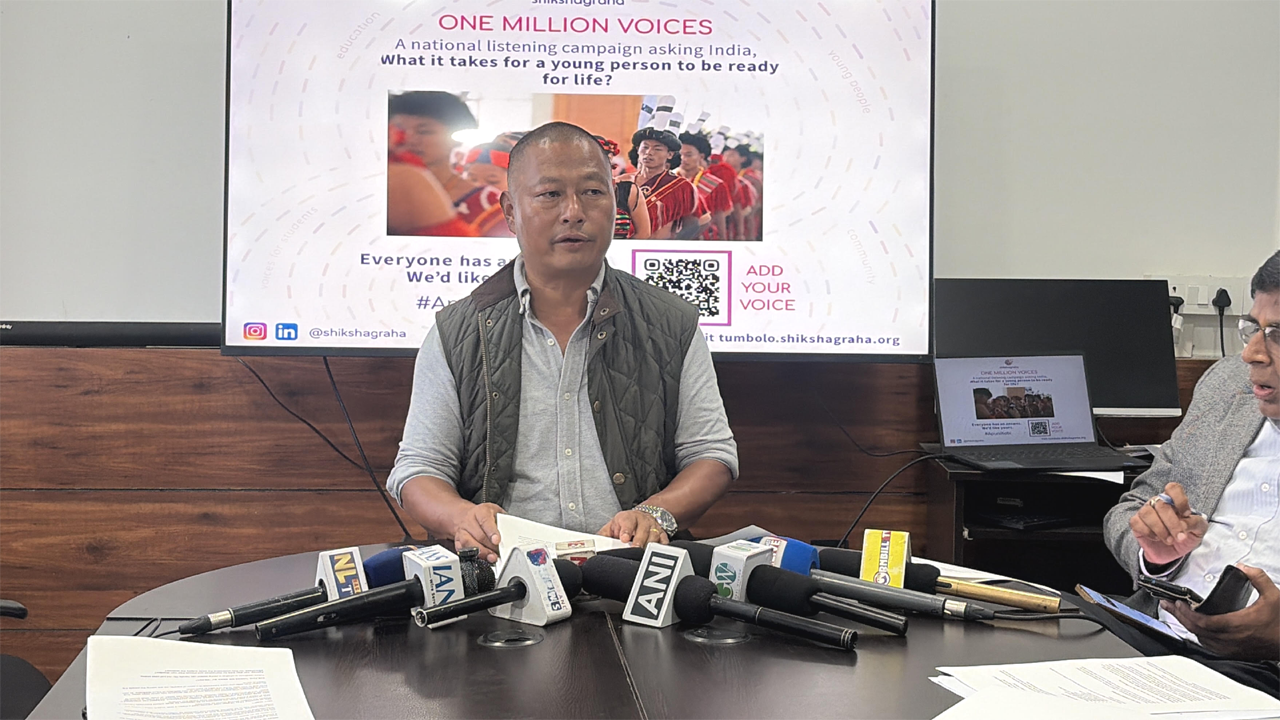
Nagaland has joined the nationwide ‘One Million Voices’ movement under Shiksha Graha, an education initiative aimed at understanding the aspirations, experiences and concerns of young people and making the education system more responsive to the needs of future generations.
Nagaland Advisor for School Education, Dr Kekhrielhoulie Yhome, announced the initiative during a press conference at the NIPUN Bharat Conference Room at Directorate of School Education on November 5, stating that the state would initially target around 1,000 participants, with plans to reach approximately 2,500 students to obtain a meaningful sample of the challenges and expectations of young people.
Dr Yhome clarified that the one million target was for the entire country, covering young people between the ages of 12 and 25, while the broader global movement aims to reach one billion children. He said Nagaland has approximately 4.3 lakh students enrolled in its school education system, from pre-primary to Class 12, and the initiative would also seek to include college-going students.
Yhome said that the Department of School Education will oversee the exercise, which is expected to culminate by next year. The outcomes will also be discussed at a national-level educational festival in Bengaluru in February 2027, bringing together students, policymakers, education stakeholders and philanthropic partners.
Clarifying that Shiksha Graha is not a government programme, Dr Yhome said it is a collaborative movement supported by philanthropists, wealth partners and knowledge partners, with Nagaland among the states participating in the initiative.
He said the movement seeks to move away from the conventional top-down approach to education and adopt a bottom-up approach by listening directly to students, understanding their aspirations and identifying the challenges they face.
Highlighting the state’s education reforms, Dr Yhome said the department was focusing on three major pillars—infrastructure development, human resource management and curriculum reform.
He acknowledged that many government school buildings remain in rundown conditions, with some infrastructure not having undergone proper repairs for decades. However, he stressed that children should not have to wait for infrastructure to improve before receiving quality education.
On curriculum development, he said the State Council of Educational Research and Training (SCERT) was developing indigenous textbooks while also adopting selected NCERT materials, particularly in science and mathematics. The department was also examining best practices from CBSE, ICSE, Cambridge, International Baccalaureate and OECD-based education models to identify and localise approaches suitable for Nagaland.
Emphasising the importance of preparing students for emerging technologies, Dr Yhome said Artificial Intelligence (AI) would become an essential requirement for the younger generation and must be introduced into the school curriculum.
He informed that the department, in collaboration with its knowledge partners under Mission SOAR, was developing an AI curriculum, with plans to introduce it in Class 6 by 2027 . He said the initiative would also require improved digital infrastructure, including Chromebooks and internet access for students.
Deenabandhu Panda, Additional Director, school education informed that AI education had already been introduced on a pilot basis in three government schools—GMS Forest, Government School Sovima and GHSS Jotsoma. The pilot programme had been underway for approximately two weeks and had received a positive response, with the department monitoring its outcomes before expanding it to more schools.
Addressing concerns over internet connectivity in remote areas, Dr Yhome said the department had mapped schools where internet access remained unavailable and was engaging with partners to explore satellite-based connectivity solutions.
He stressed that geographical location should not determine a child’s access to modern education, adding that the objective was to ensure that students in rural and far-flung areas received the same opportunities as those in urban centres.
Download Nagaland Tribune app on Google Play


On the availability of teachers equipped to handle digital education, Dr Yhome disclosed that only 2.83 per cent of the state’s teachers belonged to the 21–30 age group, indicating an ageing teaching workforce. He acknowledged that adapting to digital tools could be challenging for some teachers but said the department would explore AI-powered learning platforms under adult and teacher supervision.
He also revealed that Nagaland was in the process of formulating a state policy on AI safety protocols to ensure responsible and secure use of artificial intelligence in schools.
Outlining the five dimensions of future readiness under the One Million Voices initiative, Dr Yhome identified agency, awareness, connectedness, well-being and continuous learning as key areas for developing future-ready students.
He said agency would enable children to make informed decisions and think independently, while awareness would help them understand emerging opportunities and challenges at the national and international levels.
On connectedness, he stressed the importance of meaningful relationships and support systems involving schools, families and communities. He also expressed concern over growing mental health challenges among students due to academic competition, social media exposure and increasing societal pressures.
In this regard, he said the department was exploring collaboration with church bodies through pastoral counselling to strengthen student support systems, particularly as teachers were not necessarily trained to identify or address mental health concerns.
He further emphasised the need to create safe and supportive learning environments where children are encouraged to learn from their mistakes rather than become discouraged by them.
Dr Yhome also called for vocational education to be aligned with meaningful employment opportunities and future job mobility, stating that vocational training would have limited value if it did not translate into gainful employment.
Referring to Nagaland’s largely agrarian society, he said modern agricultural practices, improved farming technologies, crop selection, high-yielding varieties and sustainable land management should be incorporated into classroom learning.
He welcomed the National Education Policy’s emphasis on mother-tongue-based learning and the integration of indigenous knowledge systems and local practices into the curriculum.
Dr Yhome said the broader objective of Shiksha Graha was to return to classrooms and communities, listen to children and understand their aspirations before redesigning the education system to make it more adaptive and relevant to future generations.
He acknowledged the contribution of Infosys co-founder Shibulal and other philanthropic and knowledge partners supporting the initiative, expressing hope that the participation of Naga children would help the state identify the skills and competencies required to meet the challenges and opportunities of the 21st century.