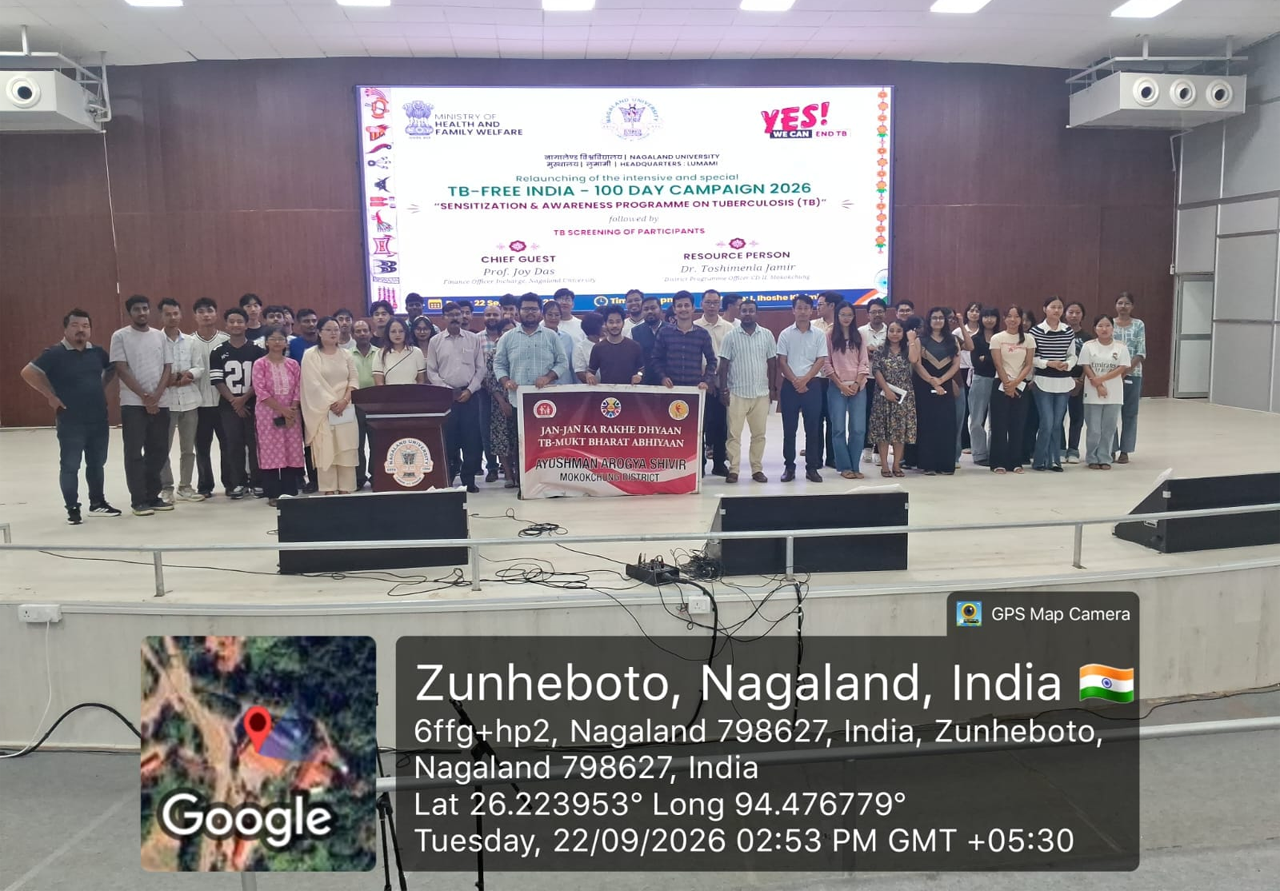
Nagaland University organised a sensitisation and awareness programme on tuberculosis (TB), followed by screening of participants, at the I Ihoshe Kinimi Hall, Lumami, on September 22 under the TB-Free India 100-Day Campaign 2026.
The programme focused on creating awareness about TB, its prevention, early detection and the importance of timely testing and medical intervention. The screening session provided participants an opportunity for early identification and referral, wherever required.
Speaking as Resource Person, Dr Toshimenla Jamir, District Programme Officer, CD-II, Mokokchung, said TB continued to be a major public health concern globally and stressed the need for sustained commitment, national leadership, adequate investment and active community participation to achieve the goal of eliminating the disease.
She said India carries a significant share of the global TB burden and emphasised that eliminating TB would require the participation of communities, educational institutions, civil society, researchers, technical agencies, the private sector and other stakeholders.
Dr Jamir said India’s strategic approach to eliminating TB by 2030 was based on the “Detect, Treat, Prevent and Build” strategy, supported by community participation, stigma-free primary healthcare services and TB champions.
“TB cannot be fought by the health system alone. Everybody should join hands in the fight,” she said, stressing the critical role of communities and institutions in addressing gaps and supporting the national goal of TB elimination.
Download Nagaland Tribune app on Google Play


She also emphasised that TB is curable and that testing and treatment are available free of cost.
Addressing the gathering as Chief Guest, Prof Joy Das, Finance Officer In-charge, Nagaland University, said universities had a responsibility not only to impart academic knowledge but also to create awareness about important social and public health issues.
He said although TB was widely known by name, public understanding of its symptoms, prevention and treatment remained limited. He identified social stigma and fear as major barriers that often prevent people from coming forward for testing.
Prof Das called upon students and scholars to use their position as educated members of society to discuss TB openly with their families, friends and communities. He also appreciated the TB-Free India campaign and the inclusion of on-site screening as part of the programme.
He stressed that TB is preventable, treatable and curable and that there should be no stigma associated with the disease.
The awareness session was followed by TB screening, with a total of 69 participants screened.
The programme was coordinated by a committee comprising Kahoshe Sumi, DR, GAD; Dr Moyasungkum, SMO; Lanumenla, Nursing Officer; and Peter Ki, PRO.
The initiative highlighted the role educational institutions can play in supporting public health programmes by combining awareness with screening and encouraging informed health-seeking practices within the university community.