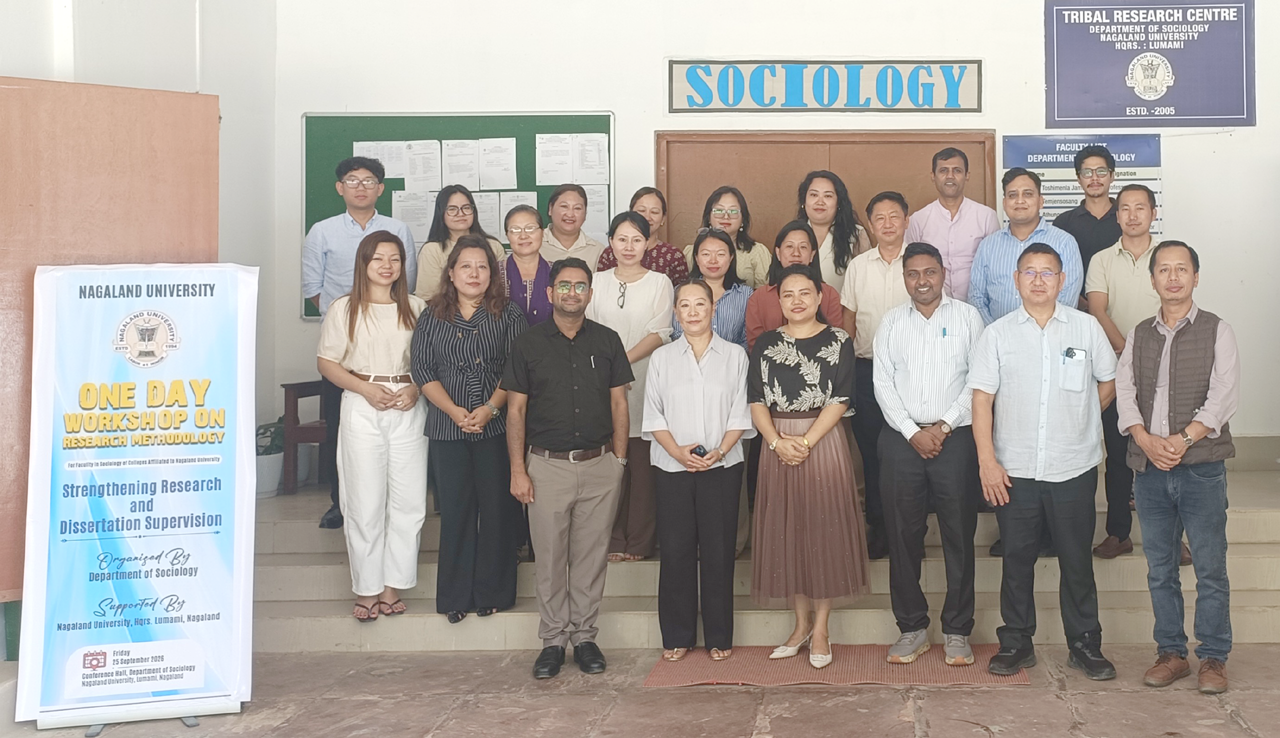
The Department of Sociology, Nagaland University, Lumami, organised a one-day offline workshop on “Research Methodology: Strengthening Research and Dissertation Supervision” at the department’s conference hall on September 25, bringing together 18 faculty members from Sociology departments of colleges across Nagaland.
The workshop aimed to address challenges faced by college teachers in supervising MA dissertations and conducting dissertation research, while strengthening research skills and practices among MA Sociology students.
Welcoming the participants, Prof Toshimenla Jamir, Head of the Department of Sociology, highlighted the need for college teachers to engage in detailed discussions on research formulation, fieldwork and academic writing at the master’s dissertation level.
The first session focused on formulating research topics, research questions and framing them sociologically. Prof Temjensosang explained that almost all phenomena can be studied through the discipline of Sociology when they relate to human society and social relationships. He emphasised that identifying a research problem requires selecting a topic that is interesting and researchable while addressing a gap or issue in existing knowledge.
The session stressed the importance of clarity, specificity and feasibility, particularly within the limited time available for dissertation research. Participants discussed the need to avoid making research topics either too broad or excessively narrow, while considering time and data accessibility. The role of supervisors in helping students develop clear, specific and researchable problems, and align variables with theoretical perspectives, was also emphasised.
The discussion also highlighted concerns over the Eurocentric orientation of some theoretical frameworks. Participants were encouraged to apply such frameworks cautiously and make them relevant to local contexts.
The second session, led by Dr Suraj Beri, focused on literature review, problematisation and conceptual and theoretical frameworks. Common mistakes in reviewing literature, identifying research gaps and developing conceptual and theoretical frameworks were discussed.
The session emphasised that literature reviews should go beyond merely summarising previous studies and instead identify patterns, agreements and disagreements among scholars to establish gaps in existing research. Participants were encouraged to position their own research questions within the wider academic conversation and to use chronological, thematic, theoretical or methodological approaches where appropriate.
The discussion on conceptual frameworks focused on the need to align concepts with the research topic and context and ensure that the framework is reflected throughout the research, including objectives, methodology and findings. Theoretical frameworks were discussed as lenses through which concepts can be examined and research questions and objectives developed.
During the third session, Dr Piethli K Jimo and Dr Yamsani Srikanth engaged participants in formulating dissertation research proposals. Participants were divided into five groups and tasked with developing proposals covering the statement of the problem, objectives, research questions, research design and research methods.
Download Nagaland Tribune app on Google Play


The groups were provided with sample topics representing qualitative, quantitative, mixed-methods, explanatory, descriptive and exploratory approaches, including regionally relevant themes. Groups A to E subsequently presented their proposals, followed by discussions and feedback from faculty members.
Prof Athungo Ovung addressed the fourth session on the basic structure of a research dissertation, focusing on technical requirements under university guidelines. These included a minimum of 100 A4-size pages, Times New Roman font, 1.5 line spacing and APA 7th edition referencing.
The session also covered plagiarism requirements, including generation of a plagiarism certificate by the supervisor using software approved by the UGC. DrillBit was discussed as the appropriate software, with a permissible similarity index of 10 percent.
The distribution of marks for the dissertation was also discussed. Internal assessment carries 20 percent, comprising 10 percent for research proposal defence and 10 percent for data collection, while external assessment carries 80 percent, including 60 percent for dissertation evaluation and 20 percent for viva-voce, making a total of 360 marks.
In the final session, Dr Sandeep Gupta discussed common problems encountered during dissertation work, including vague sample sizes, weak interview schedules and questionnaires, decorative or poorly integrated theoretical frameworks, unconnected literature reviews and inadequate analysis despite extensive data collection.
He also presented a supervisor’s checklist to guide faculty in assessing dissertation proposals and research. Among the issues highlighted were whether a student could clearly state the research problem in two or three sentences without merely repeating the title, whether objectives were specific, limited and achievable within one semester, whether research questions could be answered using realistically obtainable data, and whether the proposal was adequately supported by existing literature.
The workshop concluded with a doubt-clearing session covering issues raised by participants, including mentoring, allocation of students based on faculty strength, internship opportunities and possible changes in the syllabus.