Nagaland’s financial position presents a difficult picture. The state depends on the Centre for 86% of its revenue receipts, spends more than two-thirds of that income on salaries, pensions and interest payments, and has outstanding liabilities exceeding 40% of its Gross State Domestic Product (GSDP). At the same time, its capital outlay is projected to decline by 29% in 2026-27.
The figures in the Nagaland Budget documents and the State of State Finances 2026-27 report of PRS Legislative Research point to a limited financial base for a state that still needs substantial investment in roads, bridges, healthcare, water supply and other public infrastructure.
Nagaland expects revenue receipts of Rs 19,495 crore in 2026-27. Its own tax and non-tax sources are expected to contribute only Rs 2,714 crore, while Rs 16,780 crore is projected from central tax devolution and grants-in-aid.
The pressure becomes clearer when expenditure is considered. The government has provided Rs 13,227 crore for salaries, pensions and interest payments. These three commitments will consume 68% of revenue receipts, against a national average of 52%.
Capital outlay, which finances the creation of long-term public assets, has also been cut from Rs 4,176 crore in the 2025-26 Revised Estimates to Rs 2,978 crore in the 2026-27 Budget Estimates.
The figures raise a basic question for the state: how much can Nagaland invest in development when most of its income comes from the Centre and a large part of that income is already committed to recurring expenditure?
Revenue dependence on Centre reaches 86%
The most striking feature of Nagaland’s budget is the small contribution from its own revenue sources.
The 2026-27 Budget estimates own tax revenue at Rs 2,076 crore and non-tax revenue at Rs 638 crore. Together, they account for about 14% of the state’s projected revenue receipts. The remaining 86% is expected from the Centre.
Composition of Nagaland’s revenue receipts in 2026-27
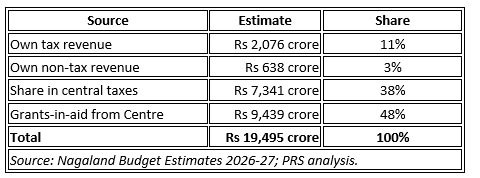
Grants-in-aid alone are expected to account for nearly half of the state’s revenue receipts. The state’s own tax and non-tax collections, by comparison, will provide only a small part of the money needed to run the government.
Nagaland’s dependence on central assistance is partly explained by its small economic base, difficult terrain and the high cost of providing public services across scattered settlements. However, dependence on transfers of this scale leaves the state exposed to changes in central allocations, grant conditions and Finance Commission recommendations.
It also reduces the government’s flexibility in deciding where to spend, particularly when funds are tied to specific schemes.
Reduced share in central taxes adds to concern
The 16th Finance Commission’s revised devolution formula has brought another concern for the state.
Nagaland’s share in the divisible pool of central taxes has fallen from 0.569% under the 15th Finance Commission to 0.481% under the 16th Finance Commission, a reduction of approximately 15%.
The state has estimated Rs 7,341 crore from central tax devolution in 2026-27, compared with Rs 7,926 crore in the 2025-26 Revised Estimates. This represents a decline of about 7%.
While presenting the State Budget on March 26, Chief Minister Dr Neiphiu Rio had expressed concern over the revised formula. He said Nagaland would have received approximately Rs 8,684 crore in 2026-27 under the earlier arrangement, against the projected Rs 7,341 crore under the new formula.
The 16th Finance Commission has retained the states’ collective share in the divisible pool at 41%. However, changes in the criteria used to distribute that share have affected individual state allocations.
PRS also points out that the effective share of states in the Centre’s gross tax revenue has remained between 31% and 37% since 2015-16, partly because cesses and surcharges are kept outside the divisible pool.
For Nagaland, the reduction comes at a time when central transfers remain essential for meeting routine expenditure as well as financing development programmes.
End of revenue deficit grants poses a challenge
The discontinuation of Post-Devolution Revenue Deficit Grants under the 16th Finance Commission is another issue for states with limited capacity to raise their own revenue.
These grants helped states meet the gap between assessed revenue expenditure and the income available after tax devolution. Without them, states will have to manage recurring expenditure through their other revenue sources and available assistance.
Nagaland’s 2026-27 Budget includes a special revenue-gap grant of Rs 4,500 crore. This is an important component of the state’s projected revenue position. The terms and continuity of such assistance will therefore be important in the years ahead.
Salaries, pensions and interest take 68% of revenue
The state’s committed expenditure leaves little room for adjustment.
Nagaland has budgeted Rs 7,856 crore for salaries, Rs 3,928 crore for pensions and Rs 1,443 crore for interest payments in 2026-27. Together, these amount to Rs 13,227 crore.
Nagaland’s committed expenditure in 2026-27
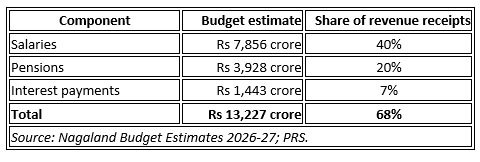
Salaries and pensions alone account for around 60% of revenue receipts. Once interest payments are included, the government has to meet all its other recurring obligations from what remains.
The burden has been high for some time. Actual expenditure on these three items accounted for 71% of revenue receipts in 2024-25, according to the state-wise budget analysis.
PRS notes that North-Eastern and Himalayan states often operate their own employment schemes, adding to recurring expenditure. Such programmes may address local needs, but they also create continuing financial commitments.
Reducing salary and pension payments is not a practical option without affecting employees and public services. The challenge for the government is to manage these obligations while improving the efficiency of expenditure and protecting funds for development.
Capital outlay falls by 29%
The effect of these pressures is visible in the state’s capital expenditure estimates.
Nagaland has proposed revenue expenditure of Rs 17,973 crore in 2026-27, an increase of 13% over the 2025-26 Revised Estimates. Capital outlay, however, has been reduced from Rs 4,176 crore to Rs 2,978 crore.
Capital outlay: 2025-26 and 2026-27
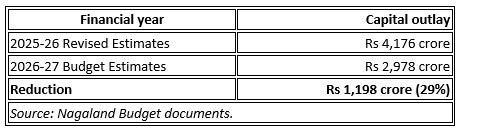
The reduction is particularly sharp in the transport sector, where capital expenditure is projected to fall by 54%, or Rs 625 crore, compared with the previous year’s Revised Estimates.
For Nagaland, where road connectivity and bridges are essential for movement of people and goods, a fall in transport investment deserves attention. Difficult terrain makes construction more expensive, but it also makes sustained spending on connectivity necessary.
Capital expenditure creates assets that can serve the state for years. When such spending is reduced, projects may be delayed, scaled down or pushed into subsequent years. This is especially concerning when the state has considerable infrastructure gaps to address.
The PRS analysis also points to a wider problem in state finances: when revenue falls short of expectations, capital projects are often easier to postpone than salaries, pensions and interest payments. This can make development spending the first casualty of fiscal pressure.
Download Nagaland Tribune app on Google Play


No SASCI loans budgeted for 2026-27
Another finding in the PRS report is that Nagaland has made no budget provision for receipts under the Scheme for Special Assistance to States for Capital Investment (SASCI) in 2026-27.
SASCI provides 50-year interest-free loans to states for capital investment. It has become an important source of additional funding for infrastructure projects.
According to PRS, 26 states have budgeted a combined Rs 1.45 lakh crore in SASCI loans for 2026-27. This amounts to about 13% of their combined planned capital outlay. Nagaland, however, has made no provision for receipts under the scheme.
SASCI funding for capital investment in 2026-27
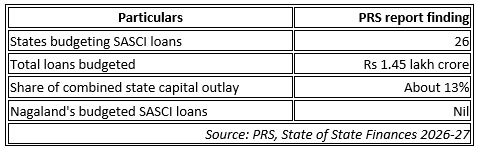
The absence of a provision is worth examining, particularly when Nagaland’s own capital outlay is being reduced by 29%.
The PRS report does not explain why the state has not budgeted for SASCI loans. Nor does the absence of an allocation establish that Nagaland is ineligible. However, it raises questions about whether the state has identified enough suitable projects or made use of the financing opportunities available for infrastructure development.
With limited own revenue and a large share of income committed to recurring expenditure, long-term interest-free loans could help finance projects that create public assets.
Outstanding liabilities remain above 40% of GSDP
Nagaland’s debt position is another area of concern. The PRS report places the state among those whose outstanding liabilities exceeded 40% of GSDP in 2025-26. The separate PRS Nagaland Budget Analysis 2026-27 estimates the liability ratio at 41.03% by the end of 2026-27, excluding central capital expenditure loans.
The Nagaland Economic Survey 2025-26 recorded total outstanding liabilities of Rs 20,274.16 crore at the end of March 2025. This was equivalent to 44.92% of GSDP under the revised estimates for 2024-25.
Nagaland’s outstanding liabilities
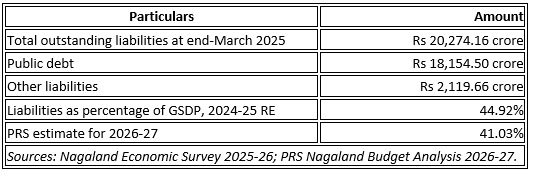
The figures relate to different financial years and may use different accounting treatments. They nevertheless show that the state’s liabilities remain substantial.
The PRS analysis estimates a marginal reduction in the debt ratio from 41.3% in the 2025-26 Revised Estimates to 41.03% in 2026-27.
Nagaland’s outstanding government guarantees stood at Rs 243 crore as of March 31, 2025, equivalent to 0.6% of GSDP. These are contingent liabilities: the government may have to meet the obligations if the entities whose borrowings are guaranteed fail to repay them.
A high debt burden also has a direct effect on future budgets. As interest payments rise, a larger portion of revenue has to be set aside for servicing borrowings, leaving less for public services and new projects.
Own revenue base remains narrow
Nagaland’s own tax revenue is estimated at Rs 2,076 crore in 2026-27, 13% higher than the 2025-26 Revised Estimates. It is projected at 4.3% of GSDP, compared with 4.2% in 2024-25.
State GST is the largest source, with an estimated collection of Rs 1,361 crore, accounting for about 66% of the state’s own tax receipts.
Major sources of Nagaland’s own tax revenue
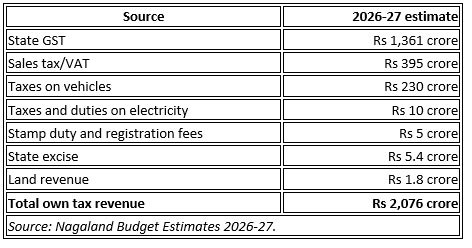
The figures show how much the state relies on a relatively small number of revenue sources. Improving collection from existing taxes and widening the revenue base will be important if Nagaland is to reduce its dependence on central transfers.
Vehicle taxation is one area where the state has recorded significant collections. PRS records Rs 224 crore in vehicle tax revenue in 2024-25, equivalent to 0.55% of GSDP. This proportion was higher than the corresponding figures for other North-Eastern states.
The report also records 9,858 heavy goods vehicles registered in Nagaland in 2024-25, more than the number registered in Assam, Arunachal Pradesh and Tripura during the same period. Between 2021-22 and 2024-25, Nagaland accounted for 3.5% of all heavy goods vehicles registered in India, based on VAHAN data cited by PRS.
These figures make vehicle taxation an important part of the state’s revenue base, although the report does not estimate how much additional revenue could be collected from the sector.
SGST collection is projected to increase by 15% in 2026-27 over the previous year’s Revised Estimates. Better compliance and tax administration will be important in meeting this target.
Budgeted surplus and provisional deficit present different pictures
There is also a difference between the state’s budget projections and the provisional fiscal position recorded for 2025-26.
The 2026-27 Budget estimates a revenue surplus of Rs 1,522 crore, or 3.1% of GSDP. The 2025-26 Revised Estimates had projected a surplus of Rs 1,182 crore, or 2.7% of GSDP.
However, the PRS State of State Finances 2026-27 report, using provisional actual figures for 2025-26, records a revenue deficit of 0.4% of GSDP.
The distinction matters. Budget estimates are projections, while provisional actuals reflect the revenue and expenditure recorded during the year. The difference suggests that the state’s actual revenue position may have been weaker than the budget projections indicated.
The projected surplus for 2026-27 will depend on whether the government receives the expected central grants and tax devolution and achieves its own revenue targets.
Spending priorities: police allocation high, water and sanitation low
The sector-wise allocation in the Budget also shows how the state’s resources are distributed among competing priorities.
Nagaland has allocated approximately 10.2% of its total expenditure to police in 2026-27, compared with the national average of 3.8%. The proportion is among the highest in the country.
Water supply and sanitation, on the other hand, account for about 0.8% of the state’s budget, against the national average of 2.4%. Health and family welfare receives approximately 4.6%, compared with the national average of 6.2% and the 8% spending target under the National Health Policy.
Selected sectoral allocations: Nagaland and national average
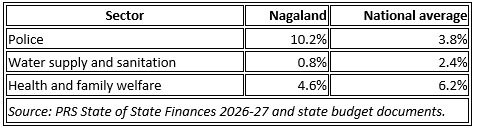
These comparisons do not, by themselves, establish whether a department is receiving enough money or how effectively the funds are being used. They do, however, show the relative weight given to different sectors in the Budget.
The low allocation for water supply and sanitation is worth noting in a state where reliable drinking water and sanitation facilities remain important public concerns. The health allocation must also support medical infrastructure, district hospitals and services in remote areas.
No identified unconditional cash-transfer scheme
The PRS report examined 128 identified state-level unconditional cash-transfer schemes covering women, farmers, youth and social security pension beneficiaries across 28 states and three Union Territories.
Nagaland did not figure among the states with a budgeted allocation for these schemes in the report’s assessment.
This finding needs to be read with caution. The assessment covers only the unconditional cash-transfer schemes identified by PRS. It excludes regular social security pensions and other welfare programmes, and the report says its list is not exhaustive. Nagaland’s absence from the list should therefore not be taken to mean that the state provides no financial assistance to any category of beneficiary.
The comparison is nevertheless relevant as several states have expanded direct cash assistance to different groups. It also indicates that the major expenditure pressure identified in Nagaland’s budget comes from salaries, pensions and interest payments rather than the large unconditional cash-transfer schemes covered by the report.
New rural employment framework may affect state finances
The VB-G RAM G Act, which came into effect on July 1, 2026, replaces MGNREGA and increases the guaranteed employment period from 100 to 125 days.
The new framework also changes the funding arrangement. The general Centre-state sharing ratio is 60:40, while special arrangements apply to specified Himalayan and North-Eastern states.
PRS estimates that, had the new framework replaced MGNREGA in 2025-26, states collectively would have spent around six times their actual expenditure under the earlier scheme. This is a national hypothetical comparison and not an estimate of Nagaland’s individual liability.
The actual financial implications for Nagaland will depend on the applicable funding ratio, allocations, employment generated and implementation requirements. Given the state’s existing expenditure commitments, the cost of the new arrangement will need to be considered in future budget planning.
Revenue estimates and actual receipts do not always match
The PRS report also highlights the gap between budget projections and actual financial performance across states. Between 2021-22 and 2024-25, states’ revenue receipts were, on average, 8% below their budget estimates. Average underspending was 9% of total budgets, with capital outlay particularly vulnerable to shortfalls.
Nagaland’s 2025-26 figures show a similar gap in revenue projections.
Nagaland’s revenue receipts: 2025-26 Budget and Revised Estimates
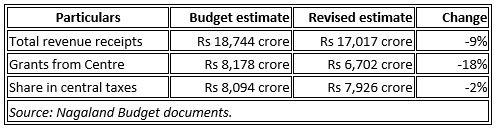
The largest revision was in central grants, which fell by Rs 1,476 crore from the original estimate. A shortfall of this size can affect the release of funds for development programmes and the implementation of capital projects.
For 2026-27, Nagaland has projected revenue receipts of Rs 19,495 crore, an increase of 15% over the previous year’s Revised Estimates. Grants from the Centre are expected to rise by 41%.
Whether these projections are achieved will have a direct bearing on the government’s ability to meet its commitments and carry out planned development work.
Local bodies need stronger financial management
The PRS report notes that the 16th Finance Commission has recommended Rs 7.91 lakh crore in grants for rural and urban local bodies across the country for 2026-31, 121% more than the amount recommended by the 15th Finance Commission.
The release of these grants is linked to conditions relating to local body elections, audited accounts and the constitution of State Finance Commissions.
For Nagaland, stronger financial and administrative systems at the municipal and village levels will be important for accessing and properly using eligible funds. Timely accounts, utilisation certificates and project monitoring can help ensure that money reaches local institutions and is put to use.
The state also needs to improve collection from existing sources and reduce revenue leakages. Proper collection and remittance of user charges for services such as electricity and water can contribute to the finances of public bodies and service providers.
Development needs and financial limits
Nagaland’s budget figures point to a problem that cannot be addressed through a single measure. The state raises only about 14% of its revenue receipts from its own sources, while 86% is expected from the Centre. Salaries, pensions and interest consume 68% of revenue receipts, outstanding liabilities remain above 40% of GSDP and capital outlay is set to decline by 29%.
The absence of a budgeted SASCI provision is also significant at a time when the state needs additional resources for infrastructure.
There is no easy way to reduce these pressures. Salaries and pensions cannot be cut sharply without affecting employees and public services. At the same time, postponing investment in roads, bridges, healthcare, water supply and other infrastructure would add to the difficulties faced by people and businesses.
For Nagaland, securing central assistance will remain important, but strengthening its own revenue base and improving the use of available funds will be just as necessary.