SONYA to test Class 9 students’ ability to analyse evidence and apply scientific concepts to real-life situations
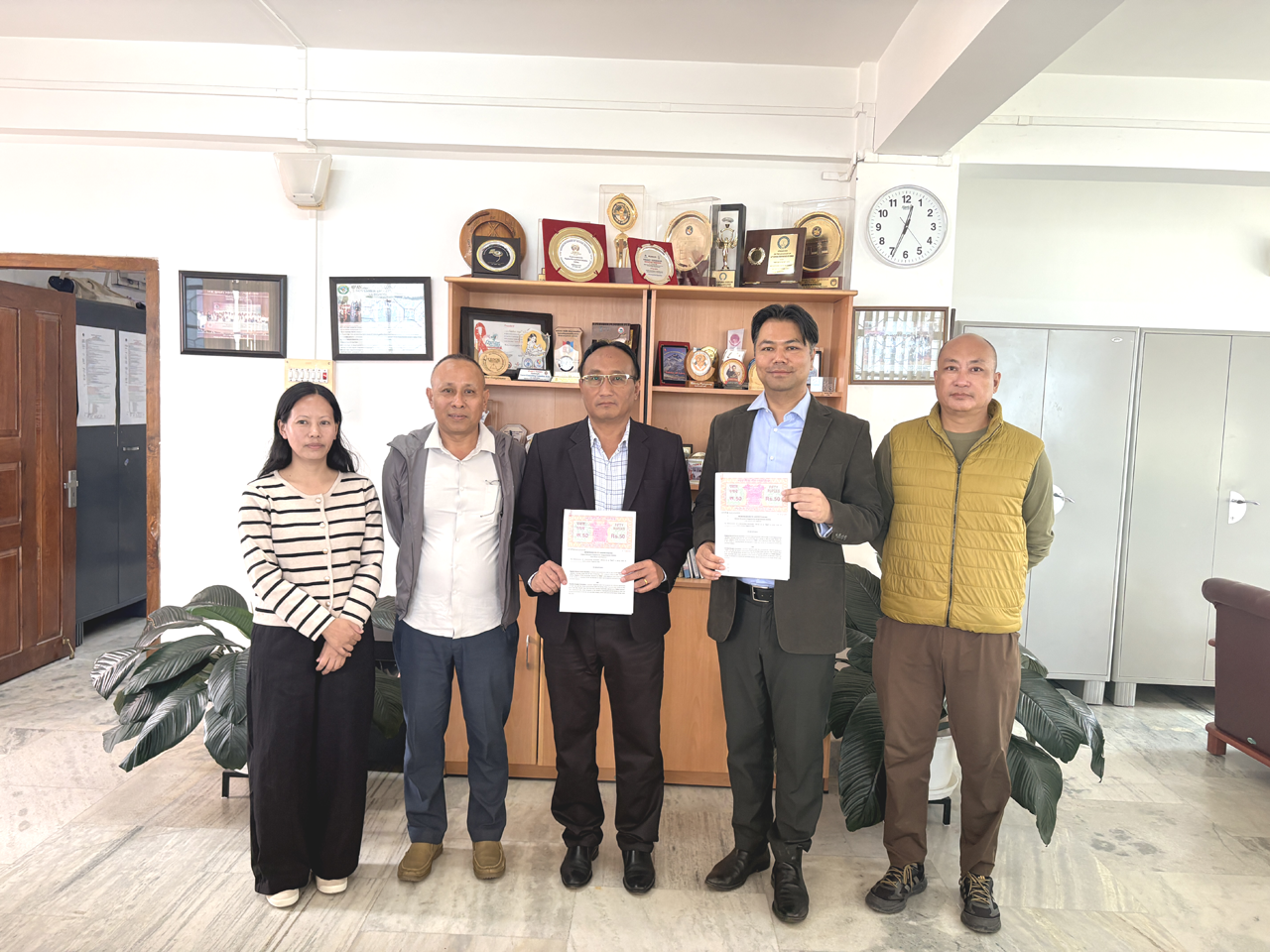
The Nagaland Board of School Education (NBSE) and Mission SOAR on Friday signed a Memorandum of Understanding (MoU) to launch the Nagaland Science Olympiad, named SONYA, aimed at encouraging scientific thinking and problem-solving among Class 9 students across the state.
The MoU was signed at the NBSE office by NBSE Chairperson Rangumbuing Nsarangbe and Karishma Shanghvi, Director of Shikha Institute, Mission SOAR.
SONYA will offer students a different approach to science assessment, with a single written examination based on real-life situations and designed to assess their ability to understand scientific concepts, interpret evidence and apply knowledge rather than rely on memorisation.
Students who have entered Class 9 in NBSE-affiliated schools will be eligible to participate. The examination will be conducted at their respective schools or nearby designated centres.
Describing the initiative as a milestone for the Board, Nsarangbe said, “Signing this MOU to launch the Science Olympiad is a milestone for the Board, the first in so many years. We believe we are doing something new that will change the way science is studied in our schools, and we hope it will strengthen the entire ecosystem of science education in the state.”
A different approach to science assessment
The Olympiad seeks to address the limitations of conventional examinations that often place greater emphasis on memorising definitions and reproducing textbook answers, rather than assessing whether students can interpret graphs, evaluate experiments or apply scientific principles in unfamiliar situations.
SONYA will focus on conceptual understanding and analytical ability, encouraging students to think through scientific problems and draw conclusions from available evidence.
Examination pattern and awards
The examination will be of 150 minutes’ duration and carry 100 marks. Students will be presented with five real-life situations, each accompanied by a graph, table, diagram or experiment, followed by four questions.
The questions will require students to explain scientific phenomena, assess evidence and apply their understanding to new problems. The syllabus will not involve additional content, with all questions based on science concepts covered in Classes 6 to 8. The questions will be designed to test reasoning rather than tricky wording, with simple language to ensure that English proficiency does not become a barrier.
Download Nagaland Tribune app on Google Play


All participants will receive certificates, while the top 100 students will be recognised as awardees under Gold, Silver, Bronze and Merit categories. The top performers will also share a total prize pool of ₹1 lakh.
The NBSE has encouraged schools and parents to motivate all students with an interest in science to participate, rather than limiting registrations to academically high-performing students. The initiative seeks to identify students whose reasoning and scientific abilities may not always be reflected in their regular examination scores.
The Olympiad is sponsored by Shikha Institute, which will collaborate with NBSE in designing the question paper and training evaluators.
Shanghvi said SONYA would assess students’ ability to interpret evidence, analyse data, question claims and apply scientific understanding to real-world problems.
“Shikha’s sponsorship of SONYA signifies our goal not merely to identify students who score well in science examinations, but to nurture young people who think like scientists,” she said.
The NBSE will announce the examination date, registration process and details of examination centres in due course.
About Mission SOAR
Mission SOAR is a statewide initiative aimed at transforming public education in Nagaland into an agile, inclusive and high-performing system. Rooted in Naga culture while aligned with national priorities and global aspirations, the initiative seeks to equip every child with grade-level competencies, 21st-century skills and a strong sense of identity.
Through innovative teaching practices, capacity-building and systemic reforms, Mission SOAR aims to develop an education model that can serve as a benchmark for the rest of the country.