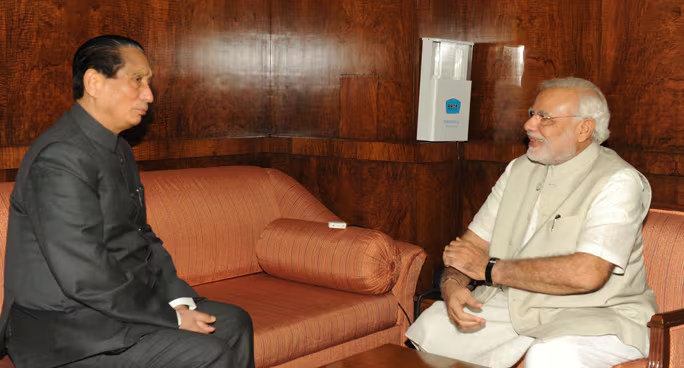
As Prime Minister Narendra Modi surpassed Jawaharlal Nehru to become India’s longest-serving elected Prime Minister in continuous tenure, former Nagaland Chief Minister and veteran statesman SC Jamir offered a rare perspective on the contrasting leadership styles of the two leaders, having closely observed both eras.
Jamir, who served as Parliamentary Secretary to Pandit Jawaharlal Nehru during his early political career, described the two Prime Ministers as fundamentally different in their approach to governance and public engagement.
“Panditji was a philosopher. Modi ji is a practical man. That’s the difference,” Jamir remarked, highlighting what he sees as the defining distinction between India’s first Prime Minister and the current incumbent.
His observations come as Prime Minister Narendra Modi completed 4,399 days in office, overtaking Nehru’s record of 4,398 days as the country’s longest-serving elected Prime Minister in uninterrupted tenure.
According to an IANS report, the comments were shared through a video released by Modi Story, a social media platform that documents and shares accounts related to Prime Minister Modi’s life and leadership.
Reflecting on the governance styles of the two leaders, Jamir said Nehru largely functioned through established institutions and administrative channels, while Modi is known for his direct engagement with issues and people.
“Pt. Nehru largely worked through officers and institutions, whereas Modi engages directly. If you raise an issue with him, he addresses it personally without intermediaries. This direct approach gives Modi firsthand knowledge of challenges across the country, including in the North-East, whereas many concerns during Nehru’s time often did not reach the Prime Minister through layers of administration,” Jamir said.
Jamir also noted changes in political culture and governance practices since the early years after Independence.
Download Nagaland Tribune app on Google Play


“In those days, we were heavily influenced by British etiquette and administrative culture. Today, we have our own Indian model, making Prime Minister Modi far more accessible. Modi ji speaks openly and expresses himself freely, unlike many of his predecessors,” he said.
The veteran Naga leader further stated that the Northeast, which he said remained neglected for decades, has witnessed a significant increase in attention and developmental support under the present government.
“The scale of funding and development support we receive today is something we could hardly have imagined earlier. When I was Chief Minister, budgets often ran into only Rs 10 to 20 crore. Today, the level of investment and support is on an entirely different scale,” he said.
Jamir also highlighted the progress made in the Naga peace process during Modi’s tenure, describing it as one of the most significant developments for the region.
“For the first time, Naga underground groups agreed to sign two landmark political agreements,” he said, referring to the efforts aimed at finding a lasting solution to the decades-old Naga political issue.
Commenting on India’s economic trajectory, Jamir pointed to the differences between the economic models adopted during the Nehru era and the present day.
“The Nehru government followed a Russian model of planned economy. Everything was controlled through licences. Therefore, we could not develop like we are doing now under PM Modi,” he said.
He added that the shift in economic policies over the years has contributed to India’s emergence as one of the world’s fastest-growing major economies.
Jamir’s remarks provide a unique historical perspective, coming from a leader who witnessed the formative years of independent India under Nehru and has also observed the country’s transformation under Modi’s leadership.
It may be mentioned that Prime Minister Narendra Modi assumed office on May 26, 2014, following the BJP’s victory in the Lok Sabha elections. He was re-elected with a larger mandate in 2019 and secured a third consecutive term in 2024, becoming the first Prime Minister after Jawaharlal Nehru to achieve the feat.