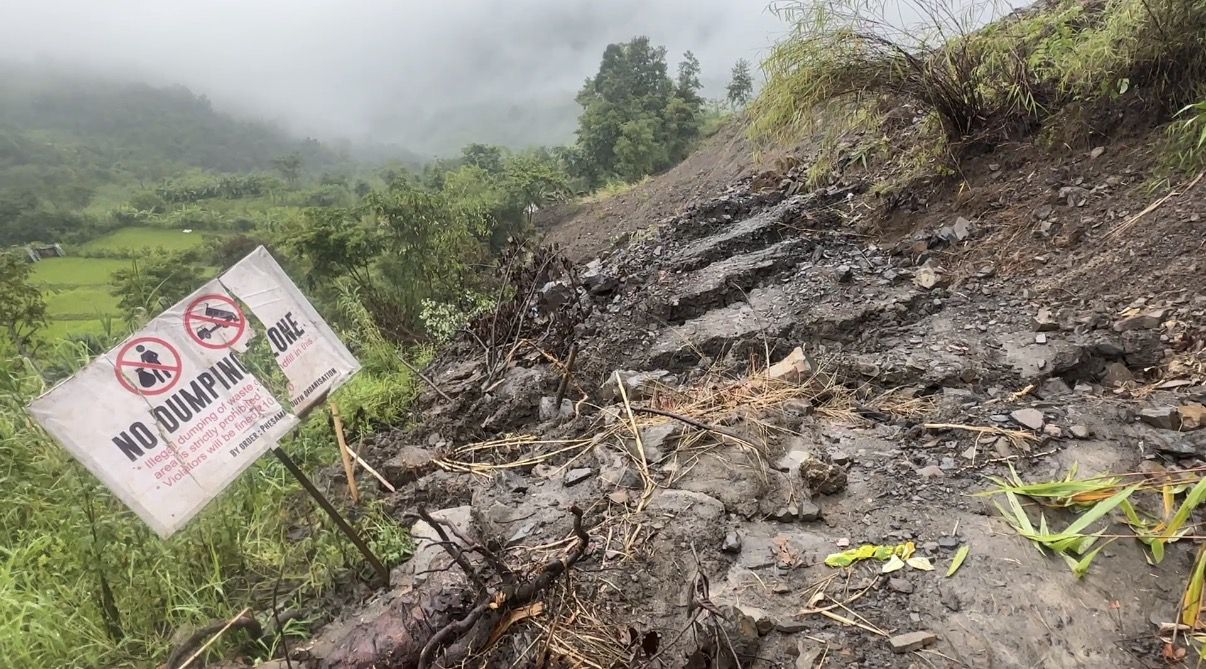
Southern Angami MLAs, Kevipodi Sophie and Er Kropol Vitsu on Monday visited the landslide-hit NH-29 stretch at Kisama, urging NHIDCL to take immediate steps to restore road connectivity.
The inspection by Southern Angami-I MLA Sophie and Southern Angami-II MLA and Advisor for Prison, Printing & Stationery Vitsu came amid continued disruption along the Kisama–Phesama route following the major landslide.
The inspection was conducted in the presence of representatives from the Southern Angami Public Organisation (SAPO), NHIDCL, SDO Jakhama and other officials, following the complete disruption of vehicular movement along the Kisama–Phesama stretch.
Triggered by incessant rainfall, the major landslide has cut off the affected section, causing inconvenience to commuters, pedestrians, villagers and students, while also affecting movement between Nagaland and Manipur.
Following the site inspection, the MLAs held a brief meeting with NHIDCL officials and other concerned officials at the Executive Director’s Chamber in Phesama to discuss immediate measures for restoring connectivity.
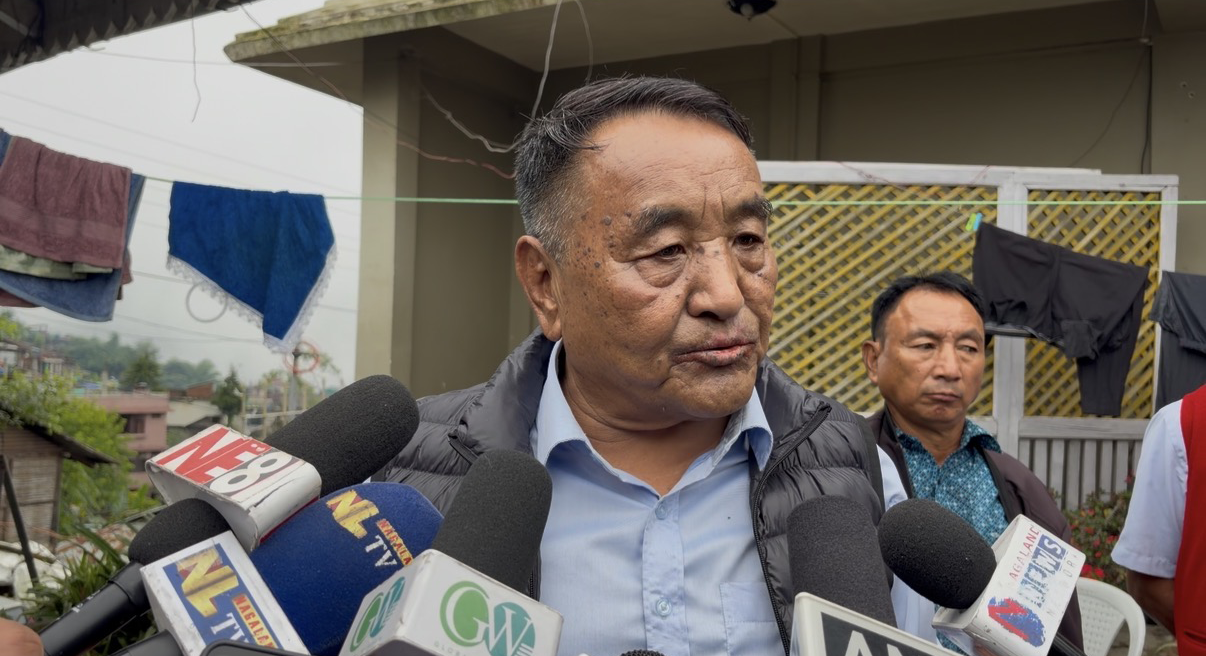
Speaking to the media after the inspection, Advisor Kropol Vitsu said the immediate priority was to restore basic movement along the landslide-hit NH-29 stretch at Kisama.
Vitsu said discussions with NHIDCL centred on opening a passage for pedestrians and light vehicles, as the landslide has resulted in a massive movement of earth from the hillside. The affected stretch is estimated to be around 300 metres, while the upper portion of the landslide extends approximately 70 metres.
He said NHIDCL has agreed to begin work from Tuesday to clear a passage for pedestrians and facilitate limited movement. Restoration for heavier vehicles, however, would require further technical intervention.
Vitsu stressed that opening the road temporarily would not be sufficient, saying permanent restoration would require a detailed assessment of the terrain, proper drainage and slope stabilisation measures. He pointed out that the large catchment area above the highway could result in further water accumulation and soil movement unless adequate channels are created to divert rainwater towards the stream.
Technical experts from outside Nagaland are expected to examine the soil and ground conditions and identify the factors contributing to the landslide before the major restoration work proceeds.
The Advisor also raised concerns over the condition of the alternative route currently being used by light vehicles through Phesama Main Junction, Rhododendron, Kisama and Kigwema. The route, he said, has come under considerable pressure due to the increased volume of traffic following the closure of NH-29.
Vitsu said NHIDCL had informed that the State Government, through the Chief Engineer, Roads & Bridges, could prepare an estimate for maintenance of the alternative road. The proposal could then be processed by NHIDCL for consideration by the authorities in Delhi under the Ministry of Road Transport and Highways.
Download Nagaland Tribune app on Google Play


Meanwhile, NHIDCL Nagaland Executive Director, RP Singh said the landslide occurred on August 13, completely stopping vehicular movement along the affected section.
Explaining the delay in deploying heavy machinery, Singh said the entire mass of earth from the hillside had shifted towards the valley side, making it necessary to first prepare a technically sound restoration plan.
He said technical experts are expected to arrive on Tuesday to examine and vet the proposed plan. Until then, NHIDCL will deploy machinery to create a passage for pedestrians.
The MLAs also raised concerns over the delay in restoring connectivity and made it clear that restoration should not be viewed only in the context of the upcoming Hornbill Festival.
They stressed that NH-29 remains an important year-round link for villagers, students, commuters and travellers between Nagaland and Manipur, and called for restoration efforts to be taken up immediately.
Officials further noted that water accumulation and continuing movement of earth from the upper slope were contributing to the instability of the affected area, making drainage and technical intervention crucial for long-term restoration.
For now, light vehicles continue to use the diversion from Phesama Junction through Rhododendron towards the Kisama Gate area.