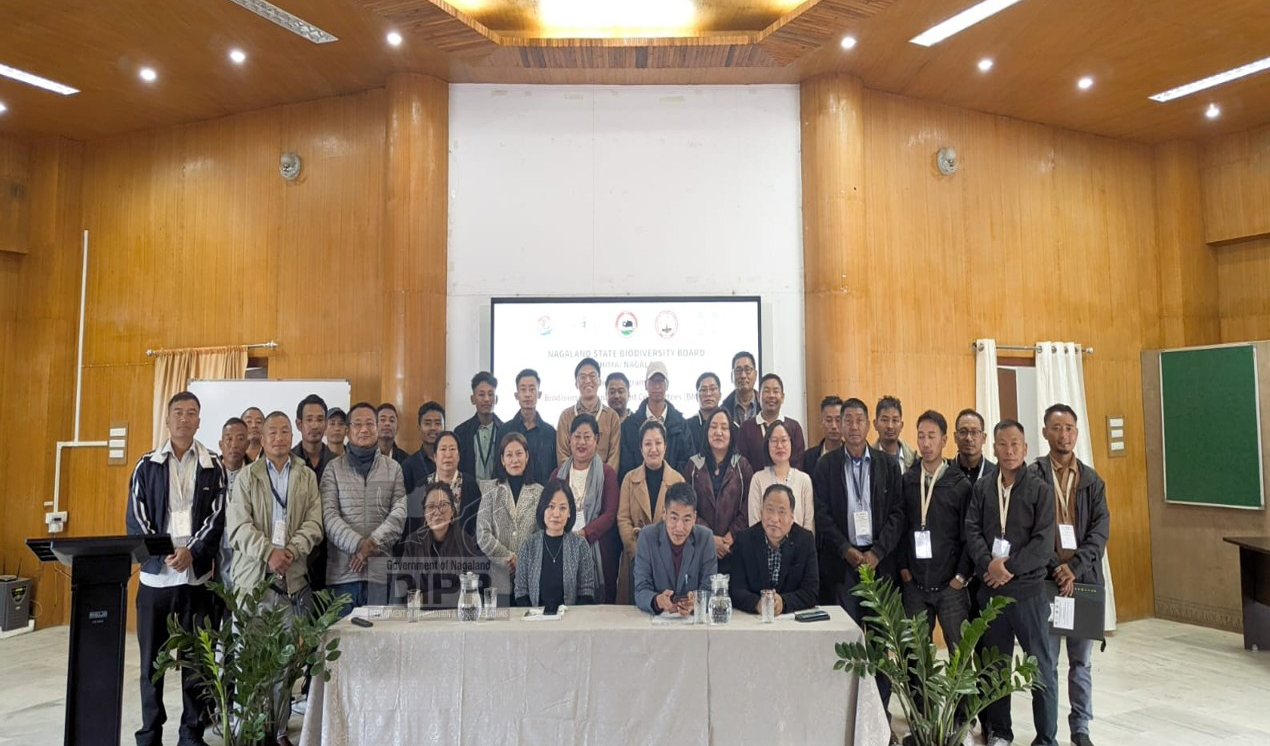
The Nagaland State Biodiversity Board (NSBB) commenced a three-day training programme for Biodiversity Management Committees (BMCs), on the Amended Biological Diversity Act and Rules, scheduled from November 16 to 18.
The programme aims to strengthen the understanding and capacity of BMC members regarding the provisions of the amended legislation, their roles and responsibilities, and the importance of biodiversity conservation. The program is supported by the FTBC Scheme of the Ministry of Environment, Forests and Climate Change, GoI.
The inaugural programme was chaired by Consultant, NSBB, Khotuo Belho. APCCF (Territorial), Department of Environment, Forests and Climate Change (DoEFCC), Supongnukshi Ao, IFS, graced the occasion as the special guest.
In his address, Supongnukshi highlighted the challenges faced by the NSBB in implementing the Biological Diversity Act, particularly in relation to the constitution and strengthening of BMCs, capacity building, awareness generation and preparation of People’s Biodiversity Registers (PBRs). He acknowledged the support extended by the Forest and Biodiversity Management Project (KfW Project) towards the documentation of PBRs in 70 villages across the State.
Emphasising the importance of PBRs, he stated that systematic documentation of biological resources and associated TK is essential for safeguarding them against misappropriation. He also encouraged BMC members to act as ambassadors of biodiversity conservation within their respective villages and neighbouring communities, thereby promoting wider awareness and participation.
The keynote address was delivered by Conservator of Forests, DoEFCC, Lhinghoikim Touthang, IFS. She emphasised the significance of BMCs as important village-level institutions for the conservation and sustainable management of biodiversity. She highlighted the role of BMCs in exercising their responsibilities over local biological resources and associated TK, and in exploring opportunities to generate economic benefits through the sustainable utilisation of these resources.
Download Nagaland Tribune app on Google Play


She further stressed that a sound understanding of the Biological Diversity Act and its provisions is essential for BMCs to effectively safeguard their community’s biological wealth and interests.
Team Leader, Nagaland Bioresource Mission, Kruolalie Tsürho also addressed the gathering. He highlighted the rich diversity of medicinal plants in Nagaland and drew attention to concerns relating to biopiracy and the unauthorised use of biological resources. He also emphasised the need to explore the potential of insect resources through further study and documentation. He underscored the importance of the Biological Diversity Act and the need to strengthen BMCs to ensure effective conservation and sustainable utilisation of the State’s biological resources.
The programme began with a welcome address by Range Forest Officer, NSBB, Savinuo Kikhi, while the vote of thanks was delivered by Keneizenuo Seletsu, Technical Executive, NSBB.
The inaugural programme will be followed by technical sessions on the first day, focusing on key provisions of the amended Biological Diversity Act and Rules, and the roles and responsibilities of BMCs. The subsequent two days will feature field visits to Khonoma Village and Sendenyu Village, respectively, providing participants with an opportunity to gain practical exposure to community-based biodiversity conservation initiatives and the functioning of BMCs at the village level.