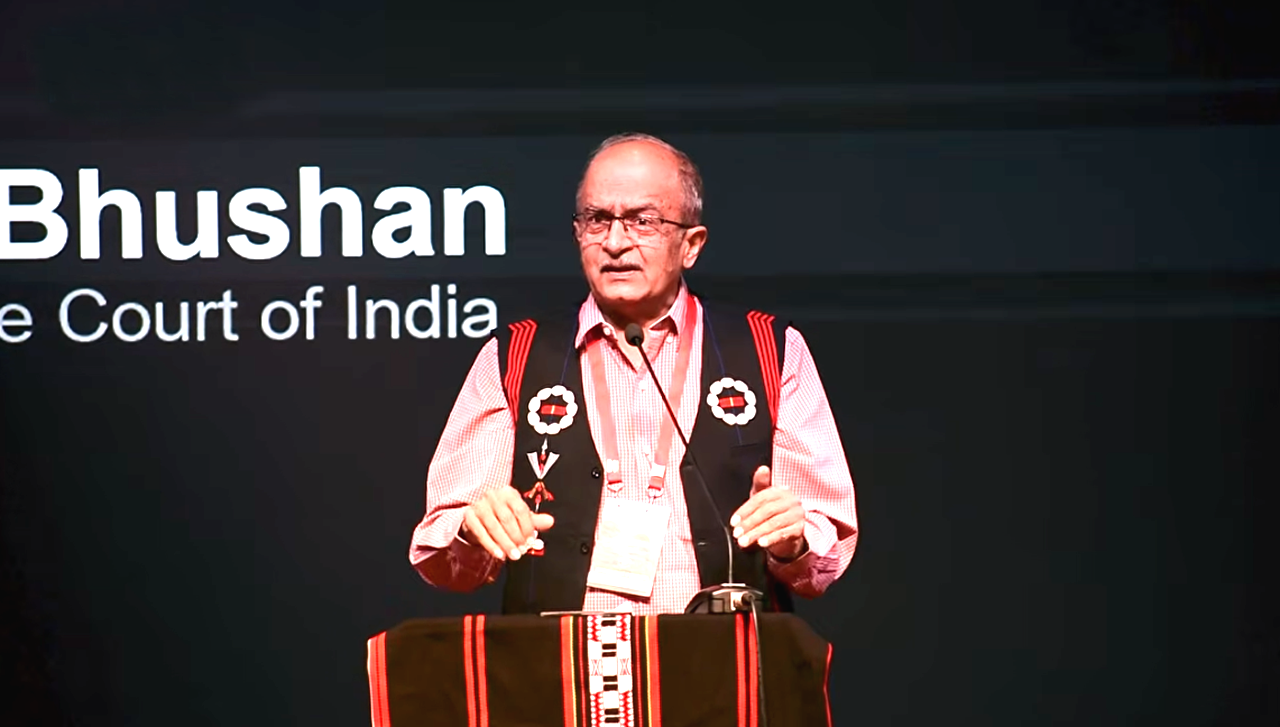
Senior Supreme Court advocate Prashant Bhushan has called for a balanced approach towards the Inner Line Permit (ILP) system in Nagaland, arguing that protecting indigenous identity and culture should not lead to isolation from the rest of the country.
Addressing the National Seminar on the Bengal Eastern Frontier Regulation (BEFR), 1873, organised by the Naga Students’ Federation (NSF) in Dimapur, Bhushan said the strength of Naga society lay in its rich cultural diversity and that such a culture should be preserved through openness and interaction rather than by creating barriers.
Bhushan acknowledged the importance of protecting the language, culture and traditional knowledge of indigenous communities, saying the Naga culture was “rich” and “precious”. However, he maintained that strong cultures had little to fear from interaction with other communities and could instead influence and enrich others.
“It has nothing to fear. It is not that outsiders, if they come, they will swamp you and they will wipe out your culture. Indeed, the opposite is likely to happen. If your culture is strong, if your culture is rich, then others will imbibe your culture,” he said.
He cautioned that outsiders can come and swamp and even destroy a culture of indigenous people, when those outsiders acquire political power and when they use that political power to destroy a culture.
Referring to the changing nature of communication and mobility, Bhushan said it was increasingly impossible to isolate communities through physical barriers. With people able to travel and communicate easily across states and countries, he argued that excessive restrictions could prevent societies from benefiting from interaction and exchange.
“So, therefore, isolationism or trying to isolate a people or their cultural traditions is certainly not the way in which you can preserve a culture,” he added.
Bhushan also questioned the constitutional basis of the ILP system, pointing to fundamental rights under Article 19, including the right of citizens to move freely throughout India and practise a profession. He said that, in his view, restrictions imposed through ILP on the movement of Indian citizens raised constitutional concerns.
He acknowledged that concerns over outsiders acquiring land and exploiting indigenous communities were legitimate, but suggested that such concerns could be addressed through specific and proportionate regulations rather than broad restrictions on entry.
“Outsiders will use their money to just come and buy all their lands and they will exploit them,” he said, referring to the concern behind land restrictions, while suggesting that limits on the amount of land an outsider could acquire could address the problem.
Nagaland Tribune app on Google Play


The senior advocate argued that the deeper solution lay in decentralising political and administrative power. Decisions affecting a village, he said, should primarily be taken by the people of that village, while matters concerning districts and states should similarly be handled at the appropriate level.
He stressed that decentralisation would have to operate within the framework of fundamental rights guaranteed by the Constitution.
Bhushan also drew parallels between the India-Myanmar border and inter-State boundaries, pointing out that such borders can disrupt the lives of communities that share cultural, familial and economic ties across them.
He also addressed the future impact of Artificial Intelligence, particularly the possibility of Artificial Super Intelligence. While acknowledging widespread concerns over its potential risks, Bhushan expressed the view that highly rational artificial intelligence could eventually contribute to a more just and cooperative society.
He predicted that technological development could eventually make national borders and systems such as visas and ILPs increasingly irrelevant, although people would still be required to abide by the laws of the places they enter.
Bhushan reiterated that he had deliberately presented views that might differ from those of the NSF, and praised the student organisation for providing a platform where differing perspectives could be openly discussed.
He said the Naga culture was sufficiently strong and distinctive not merely to survive interaction with the outside world but to spread and gain wider recognition.