Vice-Chancellor rejects ‘crumbling’ narrative; speakers examine press freedom, journalistic responsibility and the future of vernacular media
Whether India’s fourth pillar of democracy is crumbling under mounting pressures or transforming in response to a changing media environment became a point of discussion at Nagaland University’s National Press Day observance on Monday. Speakers during the program offered contrasting perspectives on the state of journalism, its democratic responsibilities and the challenges confronting the profession.
While Dr Arjun Das, Assistant Professor, Department of Journalism and Mass Communication, called for introspection into what he described as the internal weakening of mainstream journalism, Vice-Chancellor Prof Jagadish Kumar Patnaik challenged the description, maintaining that the press was not crumbling but evolving. Guest speaker Akangnungsang Jamir, Editor of Ao Milen, an Ao vernacular newspaper, and executive member of the Mokokchung Press Club, meanwhile, focused on the need to restore public confidence through verification, editorial independence and sustainable journalism.
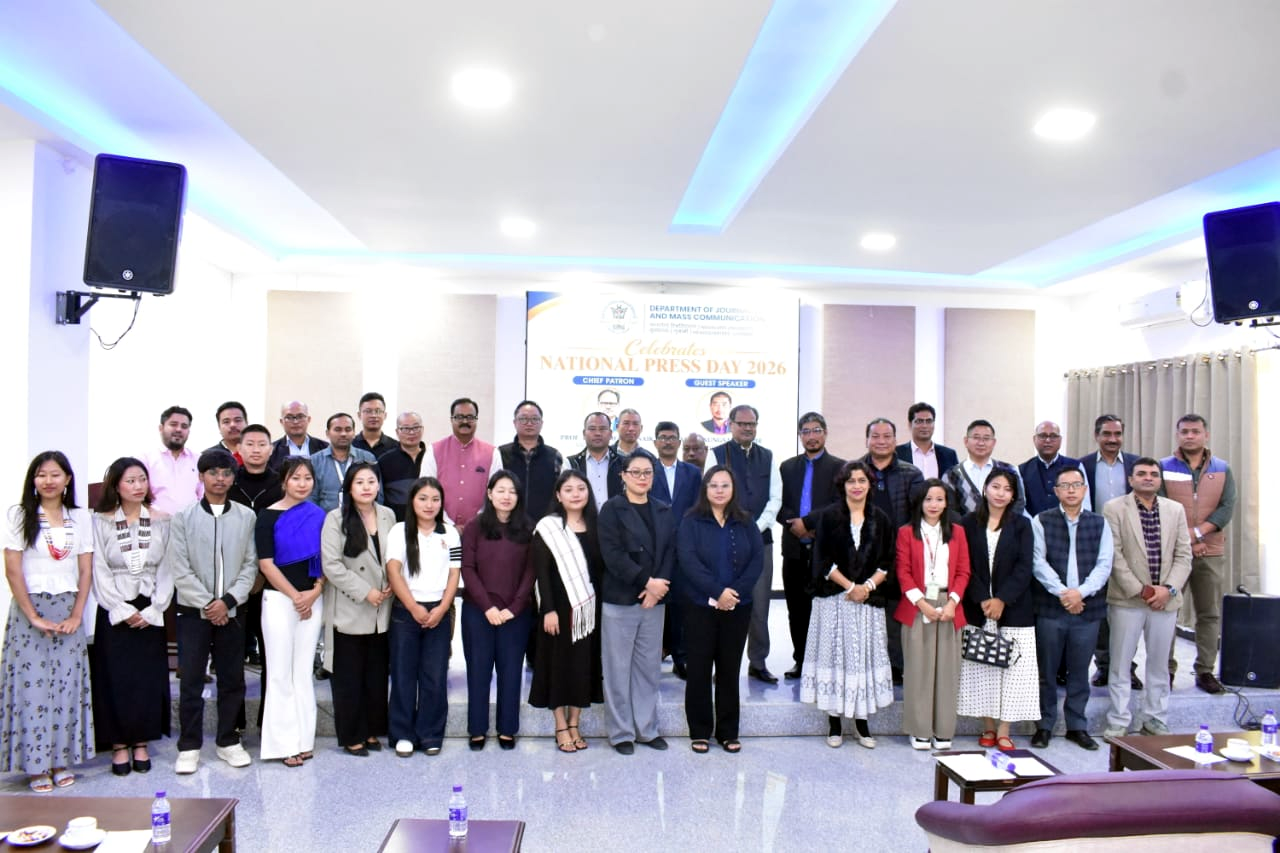
The Department of Journalism and Mass Communication observed National Press Day 2026 at the Conference Hall, Administrative Block, Nagaland University, Lumami.
In his welcome address, Dr Arjun Das, Assistant Professor, Department of Journalism and Mass Communication, raised concerns over the growing challenges confronting mainstream journalism in India, arguing that the profession was facing a crisis from within.
“We are not gathered here merely to celebrate the fourth pillar of democracy, but to examine why that pillar is crumbling from within,” he said.
Tracing Indian journalism’s historical contribution to the freedom movement, Das recalled how publications such as Raja Ram Mohan Roy’s Samvad Kaumudi, Bal Gangadhar Tilak’s Kesari and Mahatma Gandhi’s Young India served as instruments of political awakening, social reform and resistance against colonial rule. He also referred to the restrictions imposed through the Vernacular Press Act of 1878 and the press’s efforts to overcome colonial censorship.
Turning to the present, he highlighted the contrast between the expansion of India’s media industry and concerns over press freedom, noting the growth in registered publications from around 60,000 in 2004-05 to more than 1.54 lakh by 2025.
He identified deepfakes, cheapfakes, misinformation and algorithm driven echo chambers as growing threats to information credibility. He also drew attention to the economic insecurity of journalists, including shrinking newsroom budgets, layoffs and unstable freelance arrangements, particularly for reporters working in difficult conditions at the local level.
Das further expressed concern over political polarisation in mainstream broadcasting and the pressures faced by independent digital platforms. Calling for a shift away from sensationalism, he advocated independent, reader-funded financial models to reduce advertiser influence and protect editorial autonomy.
“The press that crawls, when asked to bend, does not merely betray its own profession. It deserts the citizen, and weakens the republic,” he said.
Press freedom as a constitutional and public responsibility
Speaking on the significance of National Press Day, Petekhrienuo Kulnu, Research Scholar, highlighted the constitutional basis of press freedom and its importance in ensuring an informed and democratic society.
Referring to the theme of the observance, ‘Journalism, Populist or Responsibility’, she said the changing media environment demanded greater commitment to fairness, impartiality and responsible reporting, particularly amid the growing circulation of misleading information.
She explained that a free press served as a bridge between the government and the public by communicating important policy decisions, scrutinising public actions and bringing neglected issues into public discussion.
Citing the Bofors scandal investigation by journalist Chitra Subramaniam of The Hindu, Kulnu illustrated how investigative journalism could expose matters of public concern and strengthen accountability.
“The role of a journalist is a very important and huge responsibility,” she said.
She explained that freedom of the press was an extension of the fundamental right to freedom of speech and expression guaranteed under Article 19(1)(a) of the Indian Constitution, rather than a separate privilege.
Addressing the growing circulation of fake news, she urged journalists to prioritise correctness over the pressure to publish first.
“It is not about being the first one to report. It is about being the right one to report,” she stressed.
Kulnu also extended the significance of the observance beyond the media fraternity, saying readers and viewers had an equally important stake in safeguarding a free and credible press.
“A free press is not a luxury, it is a necessity in our society,” she said.
‘It is not crumbling. It is becoming what it ought to be’
Offering a different assessment, Vice-Chancellor Prof Jagadish Kumar Patnaik cautioned against describing the Indian press as a crumbling institution, particularly on the basis of international press freedom rankings.
Responding to the earlier observation, he said, “It is not crumbling. It is becoming what it ought to be.”
Drawing from his background in political science and international relations, Patnaik explained that the press functioned as an important mechanism of checks and balances alongside the legislature, executive and judiciary, helping maintain equilibrium within the political system.
He questioned the applicability of Western assessments to India’s particular historical and developmental circumstances, stating, ‘India is a developing country and India is also not a banana republic.’
The Vice-Chancellor drew extensively from his personal experiences growing up in Odisha to illustrate the influence of regional-language newspapers. Recalling how a neighbourhood paan shop owner read the Odia newspaper Dainika Asha, while his own mother also followed the publication to remain informed about local, national and international developments, he highlighted the accessibility of vernacular journalism.
“The panwala sitting in his pan shop, preparing pan for you, reads the newspaper. And for him, the window is the vernacular newspaper,” he said.
He also recalled his family’s association with The Statesman, which his father regularly purchased, and narrated an anecdote about a newspaper compositor who was once asked to write an editorial and eventually became an editor.
On the transformation brought about by information and communication technology, Patnaik said social media had changed the dynamics of public communication and political participation across the world. Referring to the influence of digital platforms, he said social media had become an important force in shaping political discourse.
However, he cautioned that its effectiveness depended on responsible use and human conduct. Referring to the circulation of information through messaging platforms, particularly WhatsApp, he warned against the misuse of digital communication and its potential to disturb social harmony.
He also referred to the role of investigative journalists in keeping those in authority accountable, citing the Bofors investigation discussed during the programme.
“The bottom line is eternal vigilance,” he said emphasising that public institutions required continuous scrutiny.
Calling for greater recognition of the vernacular press, Patnaik said regional newspapers played an important role in bringing ordinary citizens into the larger political and decision-making process.
“Your freedom means liberty with restraint,” he said.
Download Nagaland Tribune app on Google Play


Regional journalism must remain relevant and financially sustainable
Guest speaker Akangnungsang Jamir, Editor of Ao Milen and executive member of the Mokokchung Press Club, addressed the changing professional and economic realities of journalism, drawing from his experience across different stages of newspaper production and editorial work.
Beginning with the transformation in news consumption, he observed that people who once waited for morning newspapers or evening bulletins now received information continuously through smartphones and digital platforms.
However, he questioned whether the greater availability of information had necessarily made people better informed.
“Are we genuinely better informed today simply because we receive more information?” he asked.
Referring to the 60-year journey of the Press Council of India, Jamir recalled that its establishment was based on the recognition that freedom from improper interference and accountability to the public were inseparable principles.
He also recalled the Emergency of 1975-77, when newspapers faced censorship and journalists were arrested, saying the experience demonstrated the vulnerability of press freedom.
“Press freedom is never permanently inherited; every generation must actively defend it,” he said.
Sharing his professional journey, Jamir said he had initially entered the field out of an interest in understanding the newspaper business rather than through formal journalism training. Having worked as a reporter, translator and sub-editor before becoming an editor, he had witnessed the transition from traditional print and physical distribution to digital editions, social media reporting, Reels, YouTube and podcasts.
He maintained that technological developments had not altered the fundamental obligation of the profession.
“Through every technological shift, one obligation has remained constant: reporting facts accurately and remaining accountable to our readers,” he said.
On the distinction between professional journalists and content creators, Jamir said the ability to publish information had become widely accessible, but professional journalism demanded verification, corroboration, editorial judgement and an understanding of context.
“Speed matters, but accuracy defines the profession. Being first means nothing if the report is false,” he said.
A substantial part of his address focused on the financial difficulties faced by regional newspapers, particularly in smaller media markets such as Nagaland. He cited rising printing and production costs, changing readership patterns and the difficulty of converting online readership into sustainable revenue.
Acknowledging the importance of government advertisements to regional and vernacular publications, he cautioned that substantial dependence on a particular revenue source could complicate editorial independence.
“Independence is not merely a matter of personal courage. It also depends on the economic conditions under which news organisations operate,” he said, advocating diversified revenue models for the sustainability of independent journalism.
Making a case for local reporting, Jamir pointed out that issues such as damaged village roads, teacher shortages in government schools and shortages of essential supplies at primary health centres often remained outside the attention of national television channels, despite directly affecting people’s lives.
He said vernacular newspapers in Nagaland had a wider responsibility beyond reporting official announcements, as they connected communities, documented everyday concerns and preserved indigenous languages and cultural memory.
“Meaningful journalism does not require a metropolitan newsroom or a national broadcast studio. Sometimes, the most consequential reporting begins in a village council hall, a local school, or a farming community,” he said.
He added that journalism’s worth should be assessed through its contribution to society rather than audience ratings or social media following.
“The value of journalism is measured not by ratings or follower counts, but by its tangible impact on people’s lives,” he said.
Jamir also examined the opportunities and challenges presented by artificial intelligence in the media industry.
“AI can summarize information, but it cannot walk into a remote village, interview witnesses, or verify official records,” he said.
He stressed that technological systems could not assume the moral or legal responsibility associated with publication. “That accountability remains strictly human,” he added.
Political loyalty cannot replace editorial independence
Addressing political polarisation, Jamir criticised television debates in which shouting and spectacle frequently overshadowed serious discussions, while issues such as unemployment, education, healthcare and public expenditure received inadequate attention.
“When noise replaces reasoning and outrage replaces evidence, the audience leaves entertained or angry, but rarely informed,” he said.
He cautioned against media organisations becoming uncritical extensions of either the government or the opposition, arguing that journalism had a separate responsibility to examine facts and serve the public interest.
He said government achievements should be reported fairly, failures scrutinised and opposition claims examined on the basis of evidence.
Addressing the students, Jamir encouraged them to acquire skills in digital storytelling, data journalism, fact-checking and the responsible use of AI tools, while retaining the fundamentals of reading official documents, listening to ordinary citizens and asking difficult questions.
‘The true test of journalistic independence is not how loudly you criticize those you oppose, but whether you are willing to report an inconvenient truth about the side you personally favour,’ he said.
He concluded by reminding the future media professionals that the purpose of journalism should remain unchanged despite political and technological transitions.
“We exist not to flatter power or manufacture outrage, but to verify facts, hold authority accountable, and help citizens make informed decisions,” he said.
The observance was chaired by Easter T Sangtam, Research Scholar, and commenced with the University Anthem. The Department of Journalism and Mass Communication presented a performance titled A Million Dreams.
Dr Shivajyoti Das Baruah, Assistant Professor, delivered the vote of thanks. The programme concluded with the National Anthem.