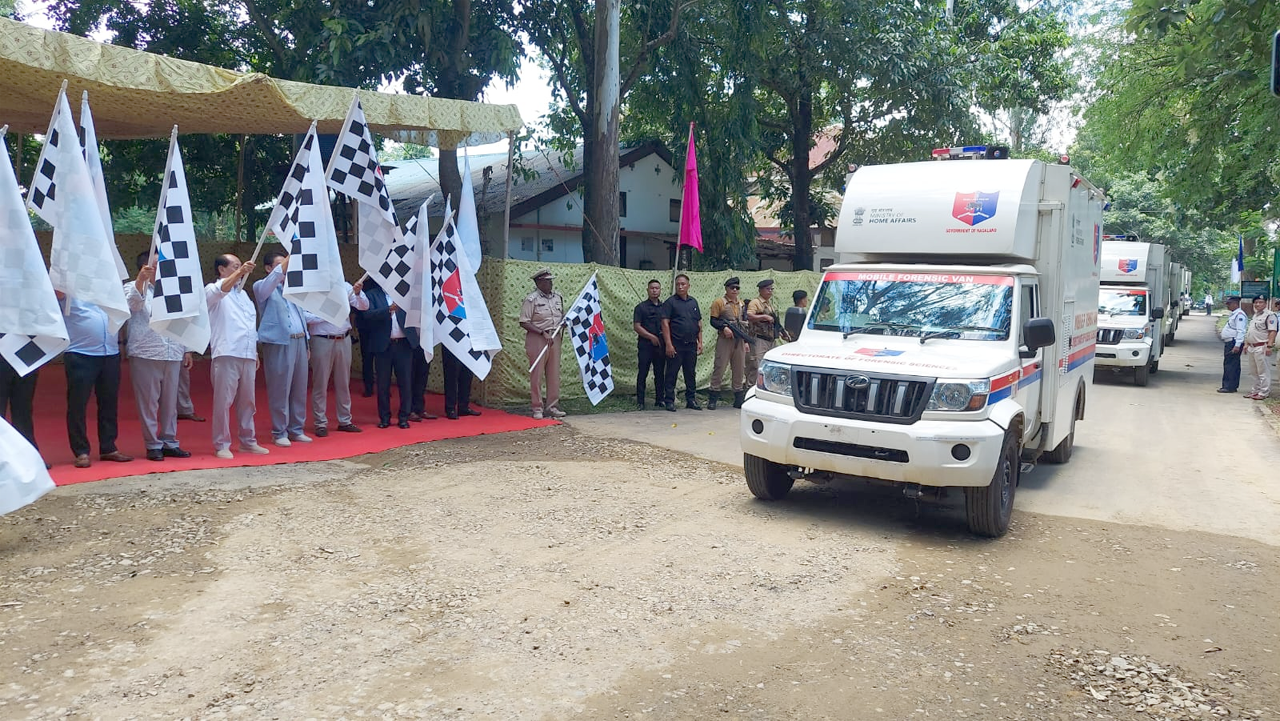
Nagaland Chief Minister, Neiphiu Rio on Monday flagged off 549 new police vehicles and 12 Mobile Forensic Vans at the Police Complex, Chumoukedima procured under the Assistance to States and Union Territories for Modernisation of Police Scheme in a major step towards strengthening policing, mobility and scientific investigation in Nagaland.
Speaking at the flagging-off ceremony of the new fleet procured under the Assistance to States and Union Territories for Modernisation of Police Scheme for 2025-26, Rio described the induction of 549 new police vehicles as a significant milestone in the modernisation of the Nagaland Police, saying the initiative reflects the state’s commitment to building a modern, responsive and people-centric police force capable of addressing evolving security challenges.
He said the vehicles were not merely an addition to the police fleet but represented a major investment in strengthening policing, mobility and public safety across the state.
The Chief Minister congratulated the Police Department for securing enhanced funding under the police modernisation scheme and thanked the Union Ministry of Home Affairs for its continued support. He noted that the programme had initially been planned to coincide with the visit of Union Minister Nitin Gadkari, which was later postponed.
Rio said Nagaland Police has served the people with courage, resilience and dedication through decades of difficult circumstances, safeguarding peace, maintaining law and order, protecting lives and property, and upholding the rule of law.
He stressed that an effective police force requires adequate infrastructure, modern communication systems, mobility, technology, arms and equipment, along with trained and motivated personnel. While successive governments had worked to strengthen these capabilities despite limited financial resources, he acknowledged that significant gaps had remained.
Recalling developments over the past year, Rio said Director General of Police Rupin Sharma had briefed him about the opportunity to significantly upgrade police infrastructure under the Centre’s modernisation scheme, which required the state government to contribute only 10 per cent of the project cost.
He noted that Nagaland had traditionally received only around Rs 4-6 crore annually under the scheme, but through the coordinated efforts of the Police Headquarters, the Home Department, Deputy Chief Minister, Y Patton, and support from the Ministry of Home Affairs, the state had now secured an allocation of nearly Rs 150 crore for police modernisation.
According to Rio, the allocation includes funding for mobility, automatic number plate recognition (ANPR) systems, CCTV surveillance infrastructure, smart police facilities and other critical technological upgrades.
He said the 549 vehicles, procured at a cost of approximately ₹81.65 crore, represent the first major outcome of this initiative and expressed gratitude to Prime Minister Narendra Modi, Union Home Minister Amit Shah, and the Ministry of Home Affairs for extending substantial support towards strengthening policing in Nagaland and the Northeast.
Highlighting the importance of mobility, Rio said reliable transportation is an operational necessity rather than a luxury in a hilly state like Nagaland, where difficult terrain, scattered habitations, long travel distances and heavy monsoon conditions often hamper policing.
He observed that nearly half of the existing police fleet had become old, unserviceable or had exceeded the service life prescribed under the Government of India’s vehicle scrapping policy, adversely affecting district policing, police stations, Indian Reserve Battalions, highway patrols, quick reaction teams and investigation units.
Download Nagaland Tribune app on Google Play


The newly inducted vehicles, he said, would replace nearly 35 to 40 per cent of the ageing fleet and substantially improve the operational readiness of the force. The fleet comprises light motor vehicles, medium pick-up trucks, motorcycles, minibuses, medium trucks and specialised four-wheel-drive vehicles suited to Nagaland’s terrain.
Rio instructed the police to ensure that the vehicles are used strictly for operational purposes and maintained with the highest standards of accountability and transparency. He emphasised that deployment should be based on operational necessity rather than official status, with priority given to district executive forces, police stations and personnel serving in remote areas.
He also stressed the importance of timely maintenance, regular servicing, proper documentation and systematic replacement of vehicles that have exceeded their service life to ensure an efficient and sustainable fleet.
Referring to emerging security challenges, Rio said policing today extends beyond conventional law and order duties to combating organised extortion, drug trafficking, cybercrime, financial fraud, human trafficking and crimes against women and children.
He said the implementation of the new criminal laws—the Bharatiya Nyaya Sanhita (BNS), Bharatiya Nagarik Suraksha Sanhita (BNSS) and Bharatiya Sakshya Adhiniyam (BSA)—requires scientific investigation, data-driven policing and improved inter-agency coordination.
Rio informed that the state has already procured and distributed 12 Mobile Forensic Vans to districts and executive police units to strengthen scientific investigation, adding that the government plans to provide additional forensic vans to all districts and the Crime Investigation Department (CID) in the coming years.
He stressed that technological advancement must be matched by investments in human resources, including recruitment through open competition, continuous professional training and specialised skills in cyber forensics, digital evidence, financial intelligence and data analytics.
He called upon police personnel to strengthen community policing, respect citizens’ rights and remain sensitive to Nagaland’s unique social fabric, Rio urged them to serve with fairness, impartiality and humility.
Appealing to the public, he said the police are partners in ensuring peace, security and development and urged citizens to cooperate by promptly reporting crimes, assisting investigations and working together to preserve harmony.
Welcoming the gathering, Director General of Police (DGP), Rupin Sharma described the induction as a major milestone in improving the operational and forensic capabilities of Nagaland Police. He said the fleet also includes ambulances and water tankers, which will improve emergency response and public service delivery.
Sharma expressed gratitude to the Ministry of Home Affairs, Government of India, and the State Government for their continued support towards police modernisation. He particularly acknowledged Chief Minister Dr. Neiphiu Rio for consistently pursuing the state’s proposals with the union Home Minister which enabled Nagaland Police to secure unprecedented financial assistance.
He revealed that funding under the Police Modernisation Scheme increased from the usual annual allocation of Rs5 crore to Rs 20 crore in previous years to nearly Rs 155 crore during the financial year 2025–26. He said the achievement followed extensive scrutiny by the Ministry of Home Affairs and persistent efforts by Nagaland Police officers in preparing and defending the proposals.
Sharma also stressed the importance of timely release and utilisation of both Central assistance and the State’s matching share to ensure continued eligibility for higher allocations in the future. While noting the progress made in modernising equipment and mobility, he pointed out that police infrastructure such as police stations, outposts and residential accommodation still requires greater support.
He further emphasised that future police modernisation should increasingly focus on technology, cybercrime, forensic science, intelligence gathering and investigative capabilities to meet emerging security challenges.
In his introductory remarks, Additional Director General of Police (Law & Order), Sandeep M Tamgadge, IPS, informed that the newly inducted fleet comprises 152 light motor vehicles, 325 medium vehicles, 68 heavy vehicles and four motorcycles, along with 12 Mobile Forensic Vans.
He said the forensic vans have been introduced in line with the implementation of the new criminal laws and are equipped with facilities for biological, cyber, explosives and narcotics forensics, among others. The vehicles and vans, he said, would significantly enhance operational mobility and strengthen scientific investigation at the district level.
The programme concluded with the ceremonial flagging off of the vehicles and forensic vans by the Chief Minister with his colleagues comprising of Ministers and advisors.