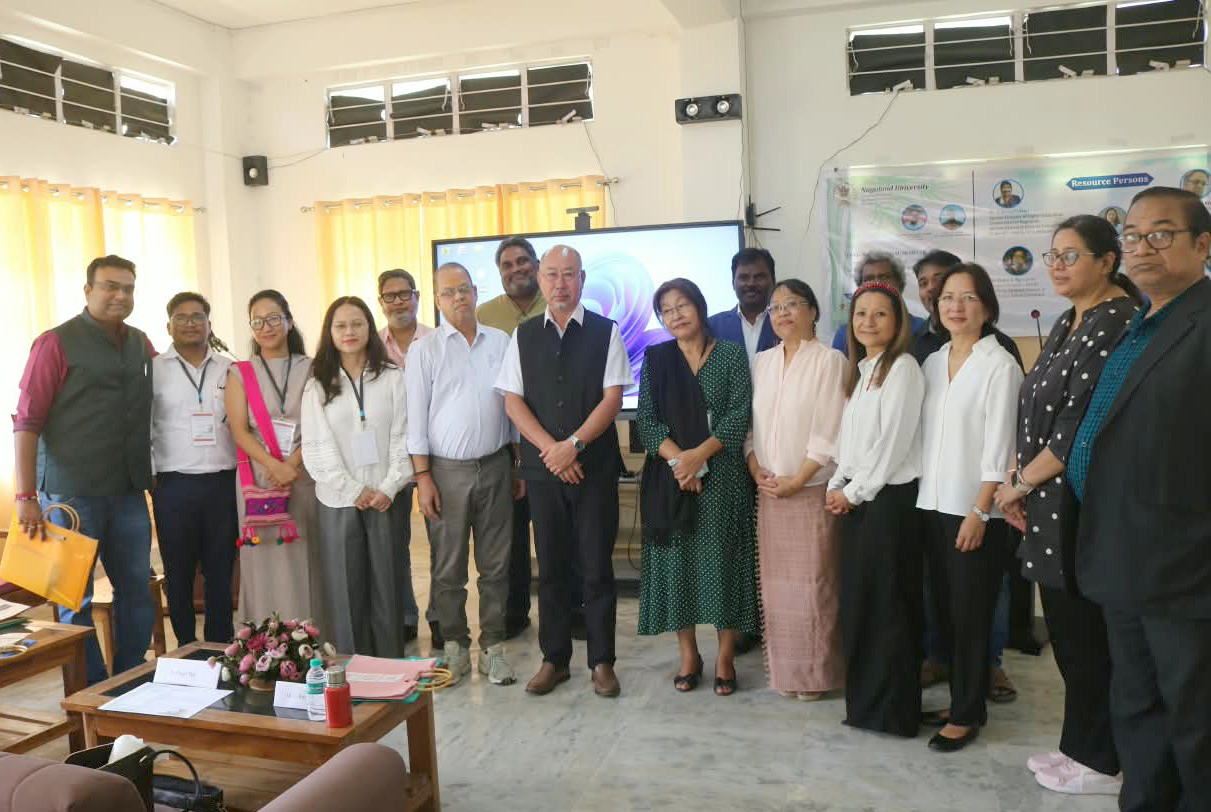
The Department of English, Nagaland University, Kohima Campus, Meriema, hosted a two-day national seminar on “Indigenous Knowledge Systems and Artistic Traditions in Northeast India: Literature, Culture and Community Wisdom” on September 15 and 16. The seminar brought together scholars, writers, artists, research scholars and students to deliberate on indigenous knowledge, cultural traditions and community wisdom in Northeast India.
The inaugural session began with a welcome address by Prof Mohammad Akhtar Jamal Khan, Head, Department of English, and a concept note presented by Prof Suresh Kurapati, Coordinator of the seminar. Prof N Venuh, Pro Vice-Chancellor, Kohima Campus, NU, emphasised the importance of indigenous knowledge for young scholars and highlighted the challenges involved in translating indigenous concepts such as “Kenyü” into English.
Prof JK Patnaik, Vice-Chancellor, Nagaland University, in his online address, stressed the need to recover, preserve and recognise indigenous traditions transmitted across generations.
Keynote address was delivered by Dr I Anungla Aier, former Director of Higher Education, Nagaland, and Former Principal of Kohima Science College. Speaking on community wisdom and culture, she identified indigenous knowledge, folklore and cultural identity as three interconnected pillars of community life. She described folklore as the framework, indigenous knowledge as its substance, and cultural identity as emerging from their interaction.
The plenary session, moderated by Prof Nigamananda Das, featured Prof Pradeep Kumar Patra of Bodoland University and Prof Robin S Ngangom, Retired Professor, NEHU.
Prof Patra emphasised collective community well-being and the need for greater research into indigenous cultural traditions. Prof Ngangom highlighted the responsibility of poets to engage with political violence, social trauma and everyday realities in the Northeast, referring to such writing as “poetry of witness.”
Download Nagaland Tribune app on Google Play


The first day also featured parallel offline and online technical sessions chaired by Dr Lemtila Alinger and Dr Subhashis Banerjee, respectively. Presentations addressed traditional food systems, folklore, oral traditions, cultural memory, medicinal knowledge, ritual practices and tribal literature. The day concluded with a cultural programme presented by students and research scholars of the Department of English, showcasing indigenous artistic expression.
The second day opened with a panel discussion moderated by Prof Jano S Liegise, Dean, School of Humanities and Education, Nagaland University. The panel featured Prof Pradeep Kumar Patra, Scholar in Tribal Studies; Dr Doyir Ete, Poet and Writer in Tribal Studies, Faculty, RGU, Arunachal Pradesh; and Lepden Jamir, Practitioner of Tribal Arts, Painter, Sculptor, Lyricist and Poet.
Dr Ete called for indigenous-centred approaches and a more inclusive literary canon, while Prof. Patra stressed indigenous agency and integrating community experiences into classrooms. Lepden Jamir highlighted art as a medium of expression and explored the relationship between indigenous craftsmanship, nature and cultural identity, urging young people to remain connected to their roots and heritage.
Parallel offline and online technical sessions, chaired by Dr I Talisenla Imsong and Dr Khriereizhunuo Dzuvichu, respectively, were also conducted on the second day. The sessions featured papers on indigenous epistemology, folk narratives, translation, cultural identity, traditional medicine, sacred rituals, performing arts and changing indigenous practices.
The seminar concluded with the valedictory session, beginning with the seminar report presented by Elong Konyak, Research Scholar, Department of English. This was followed by the valedictory address by Prof Nigamananda Das, Senior Professor, Department of English, certificate distribution and the vote of thanks delivered by Dr I Talisenla Imsong.
The two-day seminar highlighted the importance of preserving and promoting indigenous knowledge through the integration of Indigenous Knowledge System into school curriculum. It also reaffirmed the role of education and research in sustaining cultural heritage and strengthening its connection with younger generations.