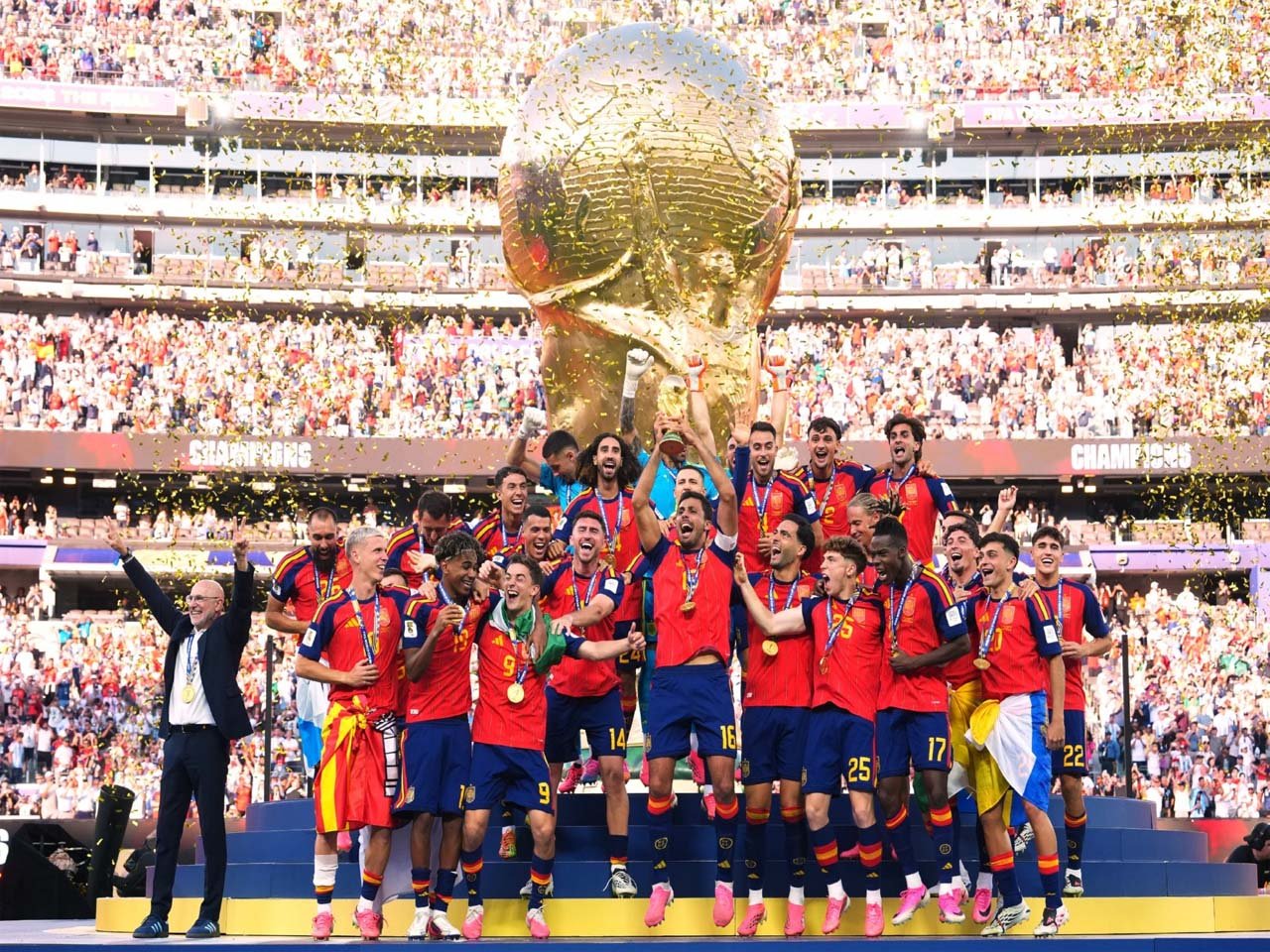
Spain were crowned FIFA World Cup 2026 champions after defeating defending champions Argentina 1-0 after extra time in a gripping final, ending Lionel Messi’s World Cup title defence and completing a remarkable unbeaten campaign in which La Roja conceded just one goal throughout the tournament.
Substitute Ferran Torres emerged as the match-winner, scoring the decisive goal in the 106th minute with a powerful finish into the roof of the net beyond Argentina goalkeeper Emiliano Martínez.
The victory secured Spain’s second FIFA World Cup title and their first since their historic triumph in 2010. It also marked a memorable milestone for 19-year-old Barcelona star Lamine Yamal, who was only three years old when Spain won their maiden World Cup in South Africa.
For Argentina, the defeat brought an end to a remarkable era led by Lionel Messi, who guided the Albiceleste to the 2022 FIFA World Cup title and Copa América triumphs in 2021 and 2024.
Having already won UEFA Euro 2024, Spain now hold both the European and World titles, reviving memories of their golden era between 2008 and 2012, when they won back-to-back European Championships and the FIFA World Cup.
Although Yamal found the net only once during the tournament, Spain’s triumph was built on collective excellence. Midfield general Rodri dictated play throughout the competition, Mikel Oyarzabal finished among the tournament’s leading scorers with five goals, while goalkeeper Unai Simón claimed the Golden Glove Award after a series of outstanding performances.
Torres also etched his name into World Cup history by becoming only the fifth substitute to score in a FIFA World Cup final and the first since Germany’s Mario Götze, who netted the extra-time winner against Argentina in the 2014 final. He also became only the second Barcelona player to score in a World Cup final after Andrés Iniesta’s famous extra-time winner for Spain in 2010.
Spain’s road to the title began with a goalless draw against surprise package Cape Verde, before comfortable victories over Saudi Arabia (4-0) and Uruguay (1-0) secured top spot in Group H. They then defeated Austria 3-0 in the Round of 32, edged past Portugal 1-0 in the Round of 16, overcame Belgium 2-1 in the quarterfinals and beat France 2-0 in the semifinals to book their place in the final.
At the New York New Jersey Stadium, Spain dominated possession for much of the contest and created the better chances, registering 12 shots on target while restricting Argentina to just one effort on target.
Argentina’s hopes suffered a major setback in extra time when midfielder Enzo Fernández was sent off after receiving his second yellow card, leaving the defending champions with 10 men. Spain capitalised on the numerical advantage and successfully held on to Torres’ extra-time strike to reclaim football’s biggest prize after a 16-year wait.
Nagaland Tribune app on Google Play


Spanish Football Federation celebrates historic triumph, says ‘Dreams do come true’
The Spanish Football Federation (RFEF) on Monday celebrated Spain’s historic FIFA World Cup 2026 triumph after La Roja defeated defending champions Argentina 1-0 after extra time in a thrilling final at the New York New Jersey Stadium, declaring that “dreams do come true.”
Spain’s victory ended Lionel Messi’s reign as world champion and secured the country’s second FIFA World Cup title, 16 years after its maiden triumph in South Africa in 2010. The triumph also completed an outstanding unbeaten campaign in which Spain conceded only one goal in eight matches.
Celebrating the achievement through a series of posts on X, the RFEF hailed the team’s remarkable journey and paid tribute to the players for scripting another glorious chapter in Spanish football history.
“Dreams do come true. Believe. Fight. Never stop. Because sometimes… football gives you everything,” the federation posted.
In another message, the federation wrote: “WE DID IT. World Champions. Twice. Forever part of football history.”
Describing the victory as a defining moment for Spanish football, the RFEF added, “WORLD CHAMPIONS. History has a new chapter… and it’s written in Spanish. The dream is ours.”
The federation also celebrated the addition of a second star to Spain’s national team crest, symbolising its second World Cup success.
“Hello, second star. For 16 years, the first one carried our greatest memory. Now it has company. And our badge shines brighter than ever,” the post read.
Spain sealed the title thanks to substitute Ferran Torres, who scored the decisive goal in the 106th minute of extra time with a powerful finish past Argentina goalkeeper Emiliano Martinez.
The victory marked Spain’s first World Cup title since 2010 and confirmed its status as one of world football’s dominant forces. Having already lifted the UEFA Euro 2024 trophy, Spain now simultaneously hold both the European Championship and the FIFA World Cup, drawing comparisons with the country’s golden era between 2008 and 2012 when it won two European Championships and one World Cup.
The final also marked the end of a remarkable era for Argentina captain Lionel Messi, whose team had entered the tournament as defending champions after winning the FIFA World Cup in 2022, in addition to Copa America titles in 2021 and 2024.
Although teenage sensation Lamine Yamal found the net only once during the tournament, Spain’s success was built on collective excellence rather than individual brilliance. Midfield general Rodri dictated play throughout the competition, while Mikel Oyarzabal emerged among the tournament’s leading scorers with five goals. Goalkeeper Unai Simon produced a string of outstanding performances to win the Golden Glove award.
Torres’ match-winning strike also earned him a place in World Cup history. He became only the fifth substitute ever to score in a FIFA World Cup final and the first since Germany’s Mario Gotze netted the famous extra-time winner against Argentina in the 2014 final. Torres also became only the second Barcelona player to score in a World Cup final after Andres Iniesta’s iconic winner for Spain in 2010.
Spain’s road to the title began with a goalless draw against tournament surprise package Cape Verde before registering victories over Saudi Arabia (4-0) and Uruguay (1-0) to finish atop Group H.
In the knockout stage, Spain defeated Austria 3-0 in the Round of 32, edged neighbours Portugal 1-0 in the Round of 16, overcame Belgium 2-1 in the quarterfinals and beat France 2-0 in the semifinals to set up the title clash against Argentina.
The final saw Spain dominate possession and create the better chances, registering 12 shots while restricting Argentina to just one effort on target. Argentina’s task became even more difficult after midfielder Enzo Fernandez was sent off in extra time following two yellow cards, allowing Spain to maintain control before Torres delivered the decisive blow that secured the World Cup crown.
The victory not only crowned Spain as world champions once again but also signalled the emergence of another exciting generation capable of extending the country’s legacy at the highest level of international football.
(with inputs from ANI)