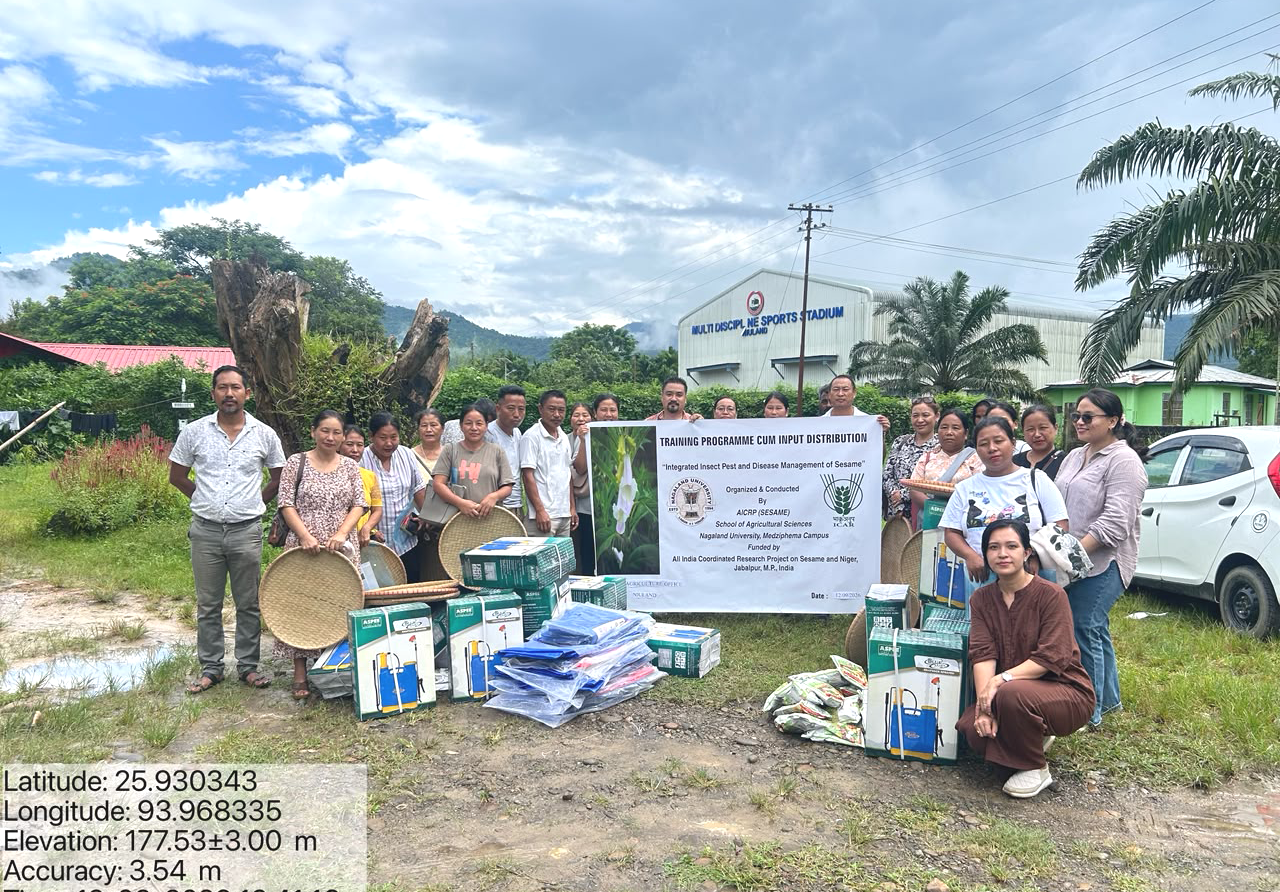
The All India Coordinated Research Project (AICRP) on Sesame, School of Agricultural Sciences (SAS), Nagaland University, Medziphema Campus, organized a one-day training programme on “Integrated Insect Pest and Disease Management of Sesame” at the Agriculture Office, Niuland on September 12.
The programme was chaired by Demalu Hasnusa, Block Technology Manager, Niuland, and was attended by 20 sesame-growing farmers from seven different villages of Niuland.
The training focused on major insect pests and diseases affecting sesame. It was highlighted that pest and disease infestations, if left unmanaged, can cause yield losses ranging from 30–50 per cent and, under severe conditions, up to 100 per cent.
Resource person, Dr Rokozeno, Scientist (Entomology), AICRP on Kharif Pulses, SAS, Nagaland University, explained the major insect pests and diseases of sesame and sensitized the farmers to integrated management practices, with emphasis on cultural practices and the use of organic pesticides.
Download Nagaland Tribune app on Google Play


Dr Debika Nongmaithem, Assistant Professor, Department of Agronomy, SAS Nagaland University, and Project In-charge, AICRP on Sesame, emphasized that adoption of scientific methods of sesame cultivation can substantially improve productivity compared to the yields obtained through traditional practices commonly followed by farmers in the state.
She explained that successful sesame cultivation involves a series of scientific practices, beginning with the selection of suitable soil and quality seed, followed by proper sowing, weed management and other crop-management practices, which together can help enhance productivity and improve market returns.
The importance of seed treatment with biofertilizers and fungicides was also highlighted as an important measure for protecting the crop against diseases and promoting beneficial microorganisms in the soil, thereby supporting healthy crop growth.
The programme concluded with the distribution of agricultural inputs to the participating farmers, aimed at encouraging the adoption of improved and integrated crop-management practices in sesame cultivation.