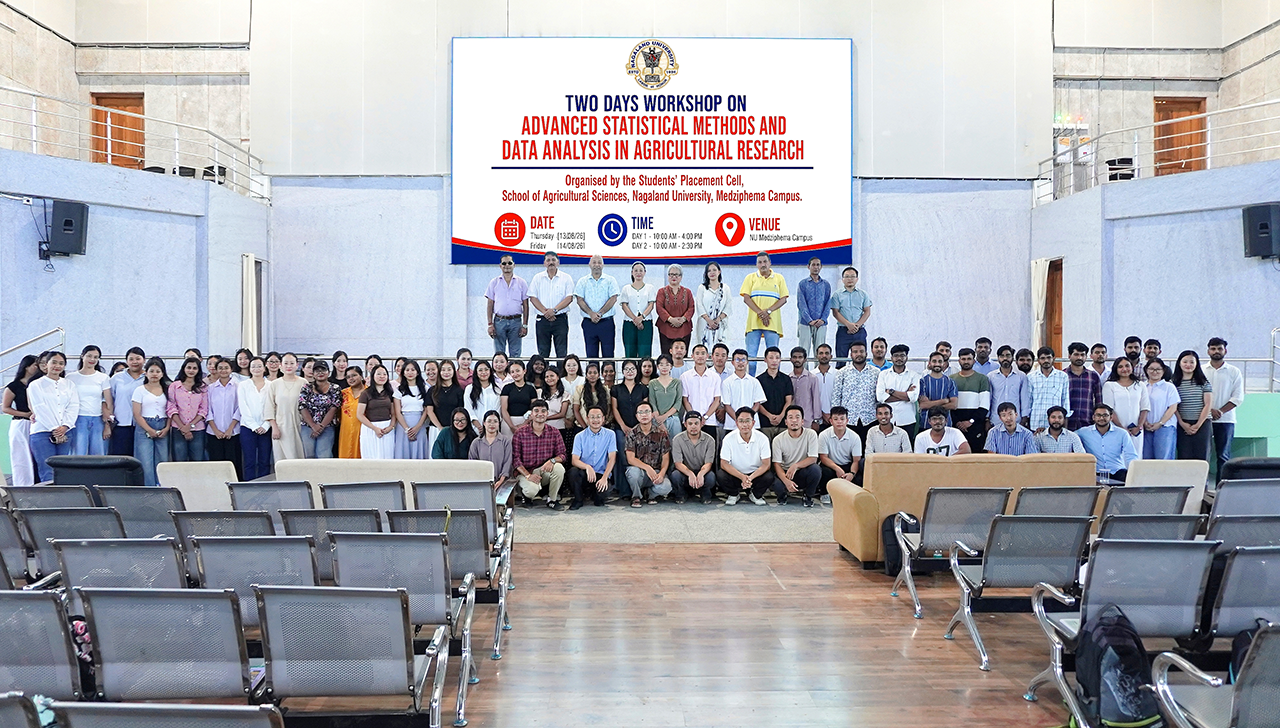
A two-day workshop on Advanced Statistical Methods and Data Analysis in Agricultural Research was organised by the Students’ Placement Cell, School of Agricultural Sciences, Nagaland University (SAS, NU), Medziphema Campus, with the support of the PhD Scholars Forum and Nagaland University Students’ Union (NUSU), Medziphema Campus on August 13 and 14.
The workshop brought together 110 postgraduate students and research scholars from 11 departments of the School of Agricultural Sciences. The programme was designed to address the statistical challenges encountered by students and scholars in their ongoing research. A preliminary survey was conducted to identify the areas in which participants required greater understanding and practical guidance and the sessions were subsequently structured around these requirements.
A major feature of the workshop was its emphasis on practical application and research problem solving. Rather than focusing only on the theoretical understanding of statistical methods, the sessions provided participants with opportunities to work with data, understand appropriate analytical approaches and discuss specific research problems with the resource persons. The participants were also grouped according to their respective research areas, allowing the technical sessions to address the diverse statistical requirements of agricultural research.
The programme included sessions on the importance of statistics in agricultural research, data analysis and practical application using statistical tools.
The technical sessions were conducted by Dr Sh Herojit Singh, Assistant Professor, Department of Agricultural Economics, SAS, NU, and Dr. Damitre Lytan, Guest Faculty, Department of Entomology, SAS, NU. The workshop included lectures, practical sessions, data analysis and a combined question and answer session, providing participants with opportunities to clarify their doubts and relate statistical methods to their own research work.
In the inaugural session, Dr Mary N Odyuo, Students’ Placement Officer, SAS NU, welcomed the participants and highlighted the importance of developing statistical competence for effective agricultural research.
Prof Dipak Sinha, Pro Vice-Chancellor, Nagaland University, Medziphema Campus, in his address, exhorted the participants to look beyond the workshop certificate and recognise that advanced statistical knowledge would provide an important advantage in their research careers.
Prof KK Jha, ICAR Nodal Officer, encouraged the participants to develop critical thinking and explore how the knowledge gained during the workshop could be applied to their actual research problems.
Download Nagaland Tribune app on Google Play


Giving an overview of the two-day programme, Naccaseng, General Secretary, PhD Scholars Forum, outlined the structure and objectives of the workshop. Mhachen Yanthan, President, Nagaland University Students’ Union, Medziphema Campus, proposed the vote of thanks during the inaugural session.
During the valedictory session, Prof Pauline Alila, Dean, School of Agricultural Sciences, Nagaland University, congratulated the participants for their active engagement and encouraged them to create opportunities for knowledge exchange with undergraduate students. She also motivated the participants to take greater initiative in organising similar academic programmes and knowledge sharing activities in the future.
Speaking on behalf of the participants, Imtitoshi, MSc. student and Bornali Phukan PhD Scholar, appreciated the practical nature of the workshop, particularly the hands-on sessions and direct interaction with the resource persons. They noted that the programme helped them gain greater confidence in analysing their research data and selecting appropriate statistical methods.
They also appreciated the grouping of participants according to research areas, which made the sessions more relevant to their work, and expressed interest in participating in more advanced training programmes in the future.