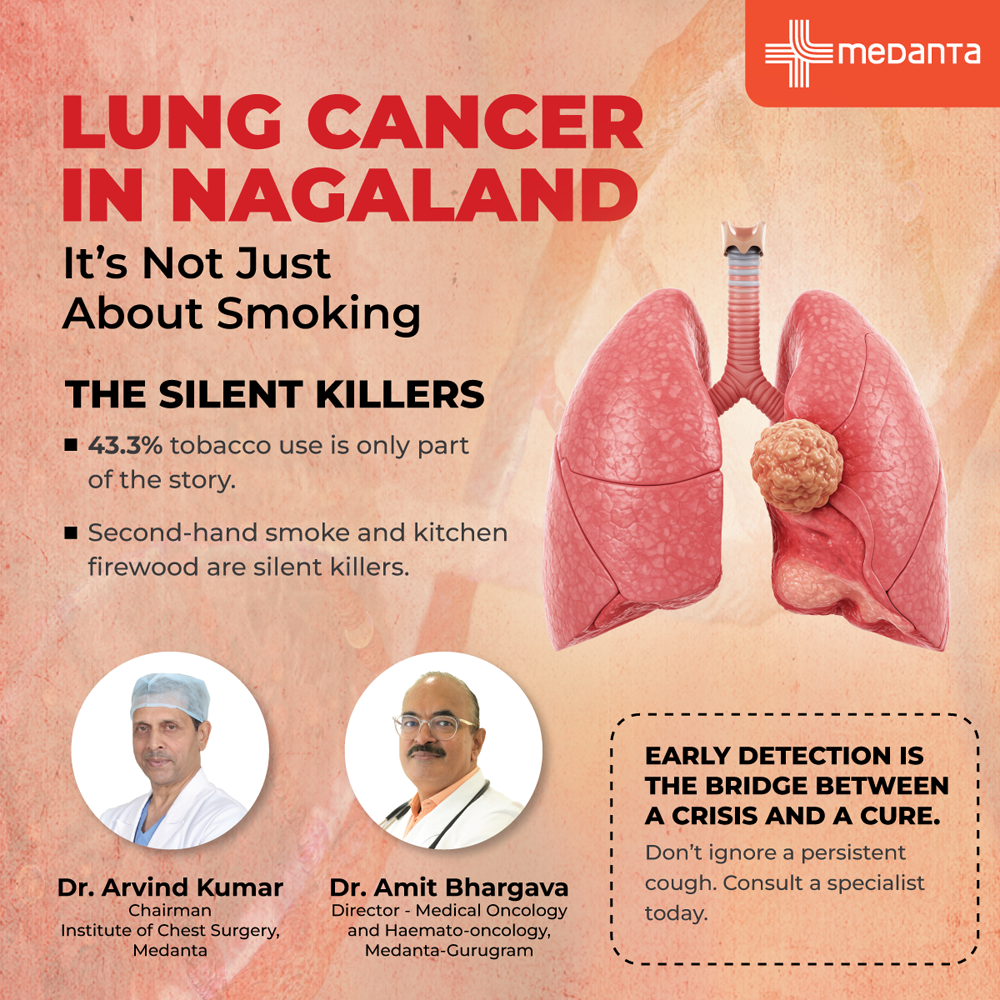
Tobacco use remains common across Nagaland, from cigarettes and beedis to khaini and gutka, and e-cigarettes and vapes added to the list in recent past. In fact, data from the Global Adult Tobacco Survey (GATS) India 2016–17 shows that nearly 43.3% of adults use tobacco in the region — significantly higher than the national average, which is below 30%. Smoking is still the most common form of tobacco use, and alarmingly, many school children have picked up the habit.
The consequences are becoming increasingly visible. Lung cancer cases are rising steadily in Nagaland, and it is no longer a disease seen only in elderly male smokers.
The earlier a person starts smoking and the longer they continue, the greater is the damage. The good news is that quitting helps at any stage. Within hours of stopping tobacco, the body begins to repair itself. Over time, the risk of heart disease, stroke and cancer falls significantly.
To be fair, lung cancer is not a just a smoker’s disease, even though smoking is the biggest risk factor. Many patients diagnosed today have never smoked a single cigarette. Some have lived in homes where others smoked around them for years, breathing in second-hand smoke.
At the same time, in many homes, especially in rural areas, women use firewood to cook in enclosed spaces with limited ventilation. Years of breathing in thick smoke every day can damage the lungs in much the same way as smoking. Women, who spend longer hours in the kitchen, are particularly vulnerable.
This makes awareness and early testing crucial for everyone — not just smokers.
One of the biggest challenges in Nagaland is late detection. Early lung cancer may not cause severe symptoms. A mild but persistent cough, chest discomfort or breathlessness is often ignored. This is why screening — simple tests done to detect disease early — can be life-saving. When caught in the first or second stage, lung cancer can often be treated with surgery. Modern procedures use small cuts, leading to less pain and faster recovery.
Treatment options have also improved dramatically. This is where targeted therapy plays a crucial role — unlike traditional chemotherapy, which attacks both healthy and cancer cells, targeted therapy works like a smart missile. Doctors first test the cancer to look for specific changes inside the cancer cells. These changes act like “switches” that help the cancer grow. Targeted medicines are then chosen to block those switches. Because the treatment focuses mainly on cancer cells, side effects are often fewer compared to older treatments.
Immunotherapy is also used when needed. Immunotherapy helps the body’s own immune system — its natural defence force — recognise and attack cancer cells more effectively.
Lung cancer is serious, but it is no longer hopeless. Early detection can save lives. In the present scenario, with modern surgical techniques such as keyhole and robotic surgery, early-detected lung cancers can be removed surgically, and the patient can be cured.
(Dr. Arvind Kumar is the Chairman of Institute of Chest Surgery at Medanta and Dr. Amit Bhargava is the Director of Medical Oncology, Cancer Care at Medanta)

