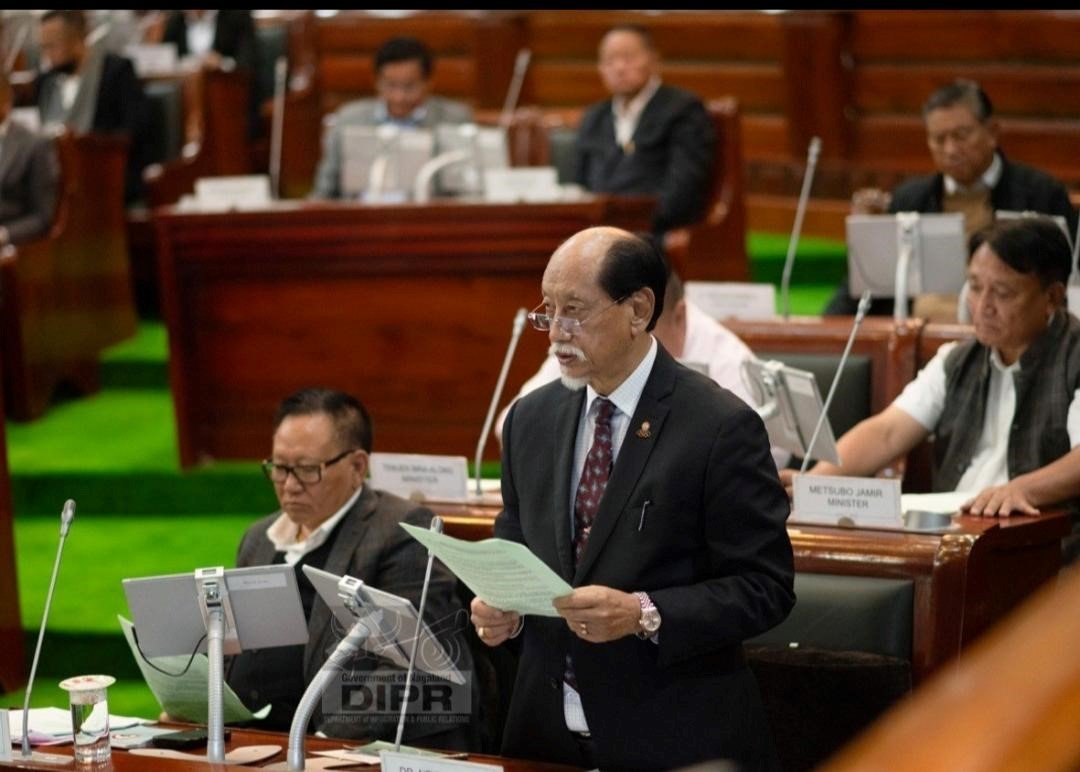
Chief Minister Neiphiu Rio said that strengthening the Micro, Small and Medium Enterprises (MSME) sector was essential for expanding employment opportunities and stimulating economic activity in Nagaland.
Replying to a discussion on the “Critical Role of MSMEs in Improving Nagaland’s Economy” in the Assembly session on March 10, the Chief Minister acknowledged the importance of the issue raised by members and said the sector had immense potential to contribute to the state’s economic development.
The discussion had been initiated by Hekani Jakhalu and supported by Nyusietho Nyuthe and Kudecho Khamo, while Jwenga Seb and Wangpang Konyak also took part in the deliberations.
Placing the current status of the sector before the House, Rio said that as on March 9, 2026, Nagaland had 48,655 enterprises registered under the Udyam Registration Portal. Of the total, 48,464 were micro enterprises, many of them falling in the category of nano enterprises with turnover below ₹25 lakh, while 175 were small enterprises and only 16 were medium enterprises.
The Chief Minister noted that nano entrepreneurs often required very small loans, typically between ₹10,000 and ₹50,000, but banks and financial institutions were sometimes reluctant to process such small-scale credit needs.
Rio highlighted that the Chief Minister’s Micro Finance Initiative had played an important role in encouraging entrepreneurship in the state. Since the scheme’s inception, 777 MSME units had been established with a combined project investment of ₹65.31 crore.
Out of this amount, government subsidy of ₹19.37 crore had leveraged private investment and bank financing, generating a fiscal multiplier effect of around 3.3 times. According to Rio, these enterprises had the potential to create more than 1,500 direct jobs, particularly in sectors such as transport services, retail trade, hospitality and small-scale manufacturing.
He said the initiative helped expand financial inclusion and encouraged many young people to explore entrepreneurship instead of depending solely on government employment.
The Chief Minister also informed that 13 MSME development projects were currently under implementation in Nagaland, while 15 additional proposals had been submitted to the Ministry of Micro, Small and Medium Enterprises for approval. These projects are aimed at improving industrial infrastructure, strengthening cluster-based development and enhancing the competitiveness of local MSMEs.
Under the Prime Minister’s Employment Generation Programme, the state has set a target of 454 projects for the 2025–26 financial year. So far, 66 projects have been sanctioned by banks and margin money amounting to ₹178.98 lakh has been claimed. Over the last five years, a total of 3,715 beneficiaries have received support under the programme in Nagaland.
Rio also highlighted other initiatives being undertaken to strengthen the MSME ecosystem, including the Raising and Accelerating MSME Performance which focuses on improving competitiveness through training programmes, MSME registration drives and buyer–seller meets.
He informed that the PM Vishwakarma Scheme had received more than 25,000 applications from artisans in the state, with training and financial support being facilitated under the scheme.
The government was also focusing on cluster-based development and value addition in sectors such as food processing, handloom, handicrafts and agro-based industries, which have strong growth potential in Nagaland. Rio said the government was examining the possibility of introducing provisions to ensure that a certain percentage of procurement by state departments and agencies could be sourced from indigenous MSME enterprises.
Speaking about the handloom sector, the chief minister informed that the state government was working towards establishing a Yarn Bank in Nagaland to ensure consistent supply of quality yarn at affordable prices. The initiative is expected to help reduce production costs and support the work of local weavers.
He added that the yarn bank could also serve as a platform to document and standardise traditional Naga designs and motifs for commercial applications while preserving their cultural authenticity. Such an initiative could help expand market opportunities in areas such as fashion, home décor and handicrafts.
On skill development, Rio said training programmes were being implemented under the Nagaland Skill and Entrepreneurship Development Mission to equip youth with skills aligned to employment opportunities within and outside the state.
As of February 2026, 3,091 candidates had enrolled in various NSEDM training programmes. Of these, 2,365 had completed their training successfully, while 495 were currently undergoing training and five candidates had dropped out.
Download Nagaland Tribune app on Google Play

Preparations were underway to introduce additional training programmes under the second and third phases of the mission, with 1,102 training seats planned in the upcoming phase. With this expansion, the total number of training seats would reach 4,193, leaving 807 candidates to achieve the mission’s target of skilling 5,000 youth.
Rio also drew attention to emerging opportunities in the drone technology sector. The Drone School and Drone Centre of Excellence was inaugurated on January 26, 2026 under the Nagaland GIS and Remote Sensing Centre, making Nagaland the second state in the Northeast to establish such a facility.
He said the state had also been among the early adopters of drone technology for mapping, surveying, geospatial data collection and disaster management applications.
The government has partnered with Droneverse Aviation Pvt Ltd as the industry partner to provide technical expertise, develop specialised courses and facilitate job placements.
Two new non-DGCA training programmes—Drone Cinematography and Drone GIS Mapping and Survey—have also been introduced to widen employment opportunities in the sector.
Rio further pointed out that Nagaland was emerging as a strong performer in the agri and allied sector. The state ranked third nationally among small states in the Export Preparedness Index 2024 released by NITI Aayog and was identified as a “leader” in export potential.
He said Nagaland coffee was currently being exported to the United Arab Emirates, while demand was also growing from Bahrain, Europe, South Korea, Singapore and Japan. Pineapple from the state was also being exported to the UAE, while processed Naga King Chilli was finding markets in several European countries.
While acknowledging the progress made, the Chief Minister said MSMEs continued to face challenges in areas such as access to credit, bank approvals and market linkages. He added that the government was working closely with banks, District Industries Centres and other stakeholders to address these issues.
Rio assured that the government would continue to improve the ease of doing business, strengthen financial support mechanisms and promote innovation so that MSMEs could develop into sustainable and competitive enterprises contributing to the state’s economy.