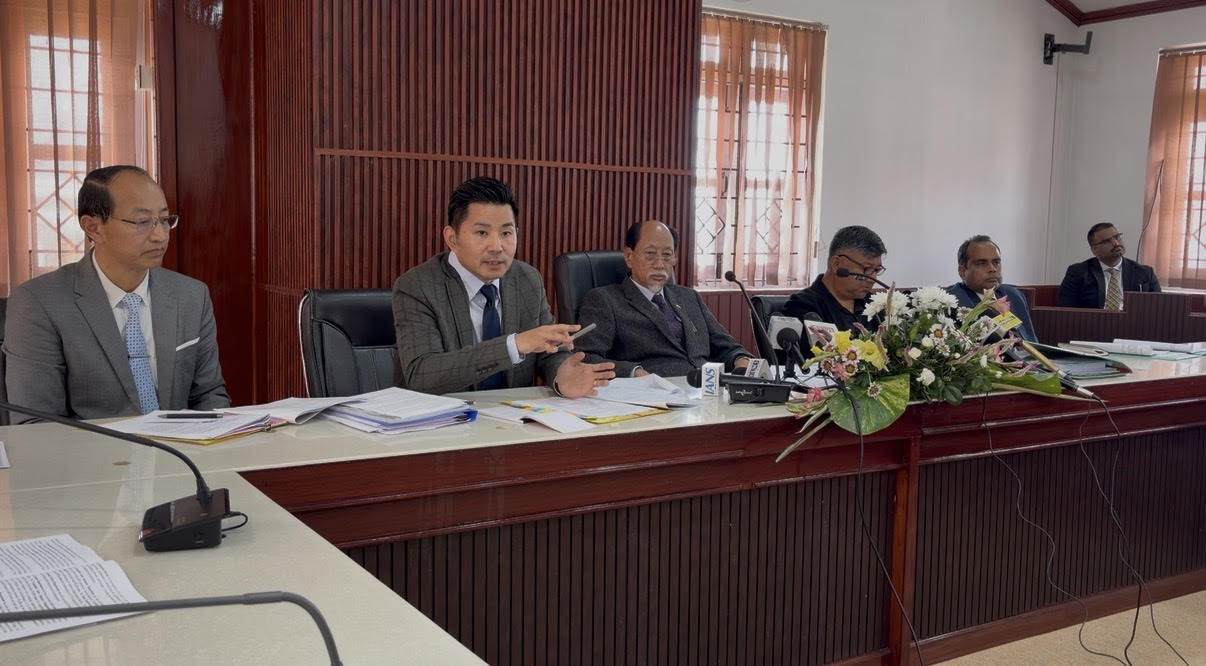
Nagaland Chief Minister, Neiphiu Rio on Thursday described the State’s 2026–27 budget as “inclusive, sustainable and growth-oriented,” outlining it as a strategic roadmap towards the vision of a developed Nagaland by 2047. He was addressing the press after presenting the budget during the Eighth Session of the 14th Nagaland Legislative Assembly.
Explaining the delay in presenting the budget, Rio said it was primarily due to changes introduced by the 16th Finance Commission, which discontinued the revenue deficit grant. He noted that Nagaland’s share in central taxes had also declined from 0.569% to 0.481%, resulting in a projected shortfall of ₹7,552 crore between 2026 and 2031.
The Chief Minister said the State had projected ₹8,113.70 crore before the Commission but received less than expected. He added that he personally met the Union Finance Minister in February to highlight the issue, stressing that without adequate funds, the State would struggle to meet obligations such as salaries, pensions, and debt servicing.
Rio said the government waited over three weeks for clarity from the Centre before proceeding with the budget. He had sought a minimum of ₹4,500 crore to manage essential expenditures but moved ahead with the presentation after receiving assurances of support.

On the fiscal front, he stated that Nagaland’s own revenue remains limited at 10.52%, amounting to ₹197.75 crore, while non-tax revenue is expected to grow by 7.5%.
The Chief Minister announced a total outlay of ₹1,350 crore, marking a 12.5% increase over the previous year. Key allocations include ₹100.57 crore for grants to local bodies and ₹62 crore for 17 new initiatives. The State’s share for Centrally Sponsored Schemes has been fixed at ₹250 crore.
Despite earlier concerns, Rio said the State’s fiscal position had improved. The estimated deficit of ₹843.27 crore was reduced by ₹111.81 crore, and the projected deficit for 2026–27 is expected to close at ₹337.07 crore—an improvement of ₹74.77 crore.
He expressed optimism that with continued support from the Centre, the State would stabilise its finances and move towards sustained development.
Briefing the media, Rio said the legislation follows a Memorandum of Agreement (MoA) signed on February 5, 2026 between the Government of India, the State government, and the Eastern Nagaland People’s Organisation. The bill has been drafted by the Law and Justice Department by incorporating provisions of the agreement.
He stated that although the State had written to the Union Home Secretary seeking consultation as mandated under the MoA, no response was received. However, based on legal advice from the Advocate General, the government proceeded with tabling the bill in line with its commitment to ENPO.
The bill was formally introduced in the Assembly by Deputy Chief Minister Yanthungo Patton and is scheduled to be taken up for discussion and passage on March 27.
Rio added that during his interaction with Union officials, including Union Home Minister Amit Shah, there was a clear push to expedite the process. He said the Centre is keen to see the FNTA formally launched, possibly as early as April.
The Chief Minister affirmed that the State has completed its part of the process and that the bill is now moving forward as planned.
17 new budget initiatives target youth and economic growth
Neiphiu Rio highlighted that the 17 new initiatives announced in the State budget will be implemented through respective nodal departments to boost performance and accountability.
Rio noted that the initiatives are backed by financial support to ensure departments give greater attention to priority sectors.
He said the government’s focus is on creating opportunities for youth and strengthening economic activities across the State.
“These initiatives are aimed at energising departments and directing efforts towards key growth areas,” he stated, adding that the targeted approach is intended to drive overall development in Nagaland.
Centre yet to name Chairman for Naga talks panel
Dr. Rio said that while the Centre has appointed Ajit Lal to play a key role in the ongoing Naga political talks, the proposed chairman for the negotiation panel is yet to be officially announced.
Addressing the media, Rio said Ajit Lal, a senior retired Joint Chief from the Intelligence Bureau, had recently visited the State and held discussions with the government.
He added that during earlier talks, Union Home Minister Amit Shah had indicated that a Union Minister of State from the Ministry of Home Affairs would be appointed as chairman of the panel overseeing the negotiations.
“However, that appointment has not yet been announced,” Rio said, adding that Ajit Lal reiterated the Centre’s commitment as conveyed by the Home Minister during their meeting on March 5.
The Chief Minister expressed hope that further clarity from the Centre would come soon, as efforts continue to advance the long-pending Naga political dialogue.

Finance Commissioner explains Budget dip, cites reduced Central share and GST slowdown
Nagaland Finance Commissioner, Kesonyu Yhome attributed the decline in this year’s State budget primarily to a reduction in Nagaland’s share of central taxes and a nationwide slowdown in GST collections.
Yhome said the 16th Finance Commission Award led to a significant cut of around ₹752 crore in the State’s share of central taxes. He noted that while some states benefited, nearly 14 states, including Nagaland, witnessed a decline.
He added that GST collections across India have slowed following the rationalisation of tax rates in recent months, impacting overall revenue trends.
Yhome also pointed to a technical change in budgeting practices. He explained that earlier, “Ways and Means Advances” from the Reserve Bank of India were included in budget estimates. However, the State has now aligned with standard practices by excluding these from Budget Estimates and instead reflecting them in Revised Accounts.
“This adjustment has also contributed to the apparent reduction in the overall budget size compared to last year,” he said.
The Finance Commissioner maintained that the dip is largely structural and procedural, rather than indicative of a broader financial crisis.
Yhome also clarified that the ₹100.57 crore allocation under the proposed FNTA framework would translate to slightly over 30% of the State’s resources, based on population and area proportions outlined in the Memorandum of Agreement (MoA).
He explained that the calculation excludes “common pool” components—funds retained by the State such as those linked to departments not being transferred and major heads like LADP—resulting in the effective 30% share.
On concerns regarding funding uncertainties, Yhome said the issue carries both financial and political dimensions. He expressed optimism that, with the intervention of Chief Minister Neiphiu Rio, the State would secure the necessary financial support.
However, he noted that if expected funds do not materialise, the government may undertake a mid-course review of its finances, revisit plan outlays, and, if needed, recast allocations at a later stage.
“We will cross the bridge when it comes,” he added, indicating a cautious but flexible approach to managing the State’s fiscal situation.