Nagaland University researchers have carried out an integrated geological investigation of the Upper Disang Formation in Nagaland, generating new insights into the origin, transport and evolution of ancient sediments deposited along the eastern boundary of the Indian tectonic plate.
The findings help improve scientific understanding of basin evolution, sediment dispersal and tectonic processes within the Indo-Myanmar sedimentary domain. The study was supported by the Start-up Research Grant of Nagaland University.
The research further enhances scientific understanding of sediment dispersal patterns and basin dynamics along the eastern margin of the Indian plate, which remains one of the most tectonically complex regions in South Asia.
While earlier geological studies on the Upper Disang Formation were largely concentrated in Upper Assam and other parts of Northeast India, limited geological information was available from this region of Nagaland. The present research addressed this gap through an integrated approach combining petrography, heavy mineral analysis and studies of post-depositional changes in sediments.
Congratulating the research team for their significant contribution to understanding the geological evolution of the Upper Disang Formation in North-East India, Prof. Jagadish Kumar Patnaik, Vice-Chancellor, Nagaland University, said, “The study reflects the university’s growing commitment to high-quality geoscientific research and its role in advancing knowledge on the tectonic and sedimentary history of the Indo-Myanmar region. Such research strengthens the scientific visibility of Nagaland University at both national and international levels and encourages young scholars to engage in interdisciplinary earth science research.”
Download Nagaland Tribune app on Google Play


The findings were published in Evolving Earth (https://doi.org/10.1016/j.eve.2026.100128), a multidisciplinary, peer-reviewed, open-access journal that publishes research on Earth system science, planetary evolution, and global environmental change.
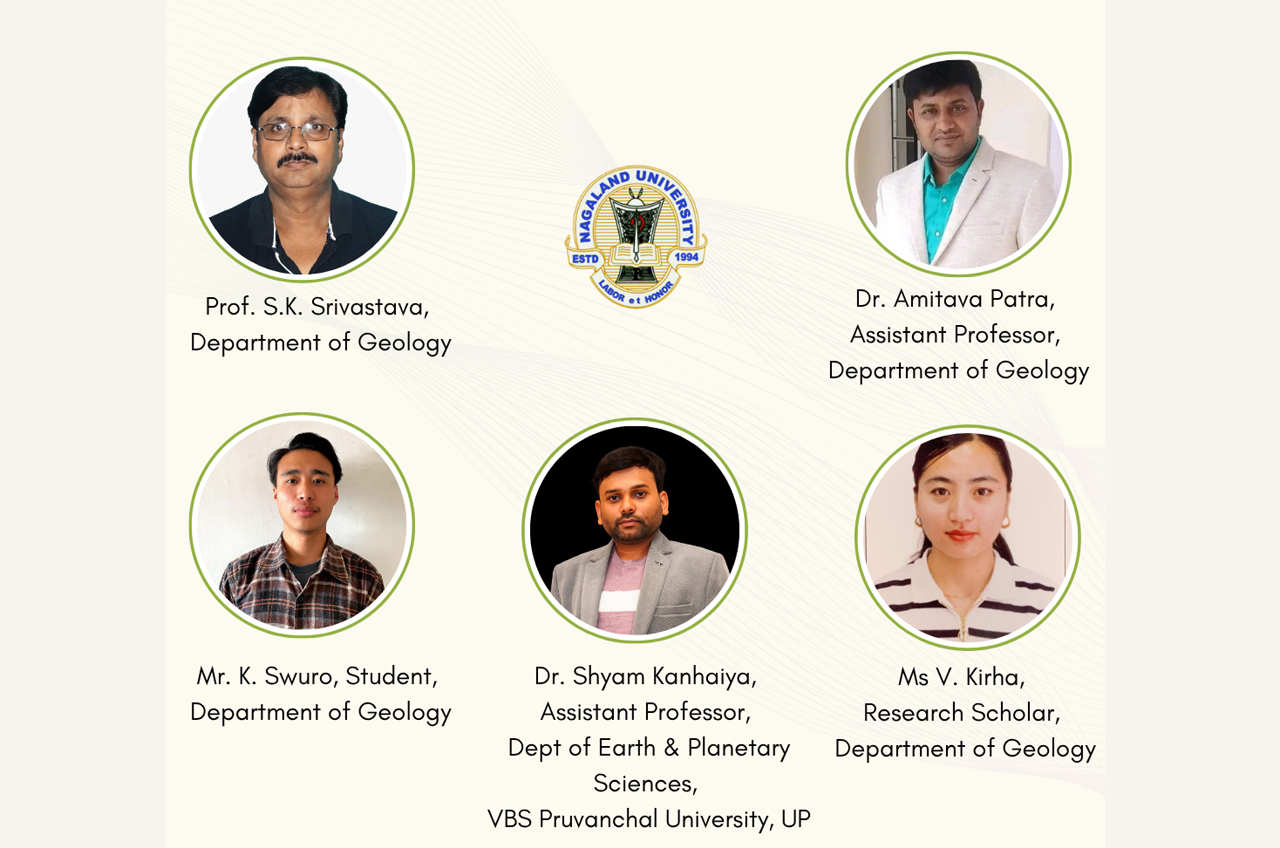
The paper was co-authored by Dr SK Srivastava, Dr Amitava Patra, K Swuro and V Kirha from the Department of Geology, Nagaland University and Dr Shyam Kanhaiya, Assistant Professor, Department of Earth and Planetary Sciences, VBS Pruvanchal University, Uttar Pradesh.
Elaborating on the study, Prof SK Srivastava, Department of Geology, Nagaland University, said, “Our study revealed that the Upper Disang sandstones were derived from multiple and compositionally diverse sediment sources, including igneous, metamorphic and sedimentary terrains. We also identified signatures of tectonically active depositional settings and drainage reorganisation during sediment accumulation.”
The findings provide a clearer understanding of how sedimentary basins evolved in tectonically active regions linked to the Indo-Myanmar ranges. The results can also be correlated with other Palaeogene siliciclastic sedimentary sequences deposited under similar geological conditions elsewhere.
Highlighting the importance of the findings, Dr Amitava Patra, Assistant Professor, Department of Geology, Nagaland University, said, “The geological data generated through the study could support future tectonic reconstruction models, basin evolution studies, sediment provenance analysis and regional geological correlation across Northeast India and adjoining regions.”
The researchers also documented diagenetic features preserved within the Upper Disang sandstones, indicating that the sediments largely underwent shallow burial changes after deposition. These post-depositional signatures provide important clues about the thermal history, compaction processes and fluid interactions that affected the basin over geological time.
Such findings can aid future studies related to sediment quality assessment, basin modelling and tectono-sedimentary reconstruction in complex geological terrains.
Another key outcome of the study is the identification of evidence pointing to sediment supply from both nearby and distant geological sources, reflecting dynamic sediment transport and rapid basin evolution during the Middle to Late Eocene period.
The researchers observed that the sediments were deposited in an active-margin tectonic setting linked to the convergence of the Indian and Burma plates, helping scientists better understand the closure history of ancient oceanic domains and the geological evolution of the Indo-Myanmar ranges.