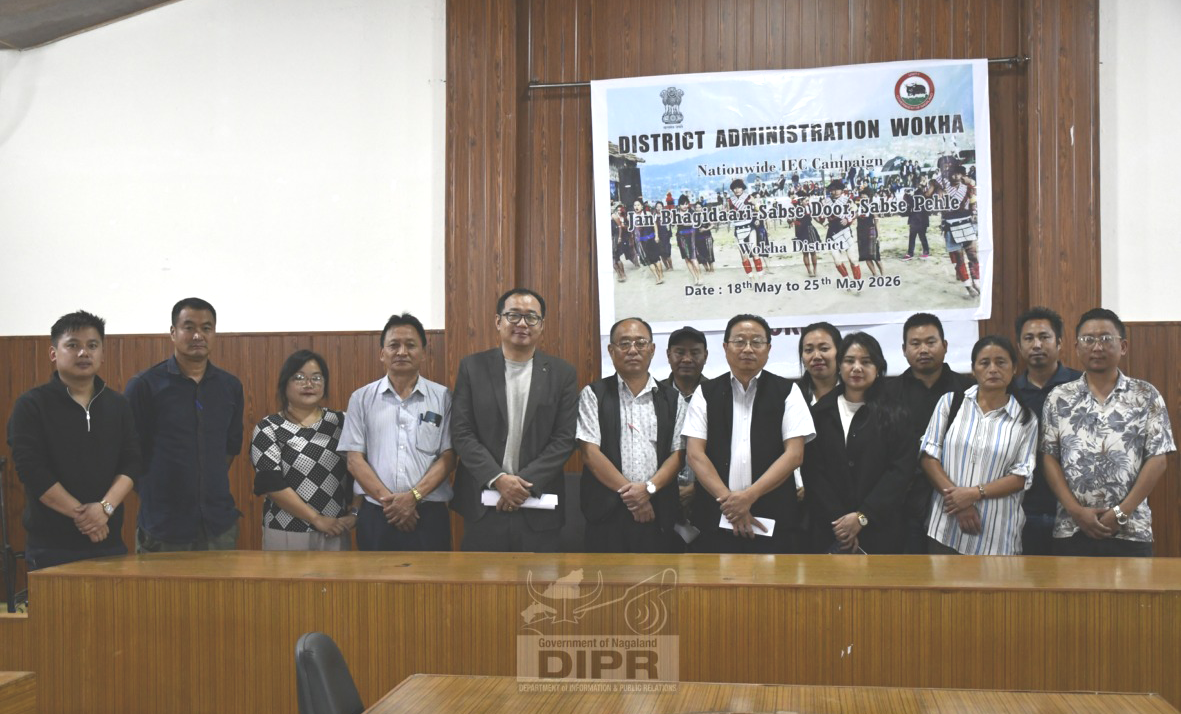
The week-long Information, Education and Communication (IEC) Campaign under PM JANMAN and DA-GUA concluded in Wokha district on Monday, following intensive outreach activities conducted from May 18 to 25. Organized on the theme “Jan Bhagidari Sabse Door Sabse Pehle,” the initiative aimed at intensifying awareness, ensuring last-mile delivery of government services, and achieving saturation of welfare benefits for tribal communities, particularly the Vulnerable Tribal Groups (PVTGs).
During the campaign, coordinated field-level outreach programmes were held across identified villages, focusing on dissemination of information on government schemes, beneficiary saturation, health screening, livelihood promotion, grievance redressal, and facilitation of entitlement services.
Deputy Commissioner Wokha, K Mhathung Tsanglao, while reviewing the campaign, noted that the programme covered a significant number of villages through decentralized efforts. He emphasized that the campaign served both as an awareness initiative and as an assessment exercise to gauge the extent to which people had benefitted from government schemes.
Tsanglao highlighted that activities such as community screenings, awareness on risks and welfare schemes, livelihood promotion, and dissemination of entitlement information were undertaken, with special attention given to vulnerable sections of the population. He acknowledged challenges faced during the campaign, including financial constraints, poor accessibility to remote areas, and adverse weather conditions, but commended the departments and stakeholders for their dedicated efforts.
Download Nagaland Tribune app on Google Play


He further stated that the campaign should be seen as the beginning of a larger process, expressing optimism that future outreach rounds would be better coordinated and more comprehensive to ensure 100 percent saturation of benefits among eligible populations.
Stressing the importance of convergence, he called for stronger collaboration among the district administration, health department, line departments, self-help groups, village councils, organizations, and banking institutions to strengthen service delivery mechanisms.
The DC also noted that the exercise generated valuable data and insights, which would help authorities identify gaps and areas requiring greater focus to improve accessibility and ensure that eligible beneficiaries receive entitlements under various government schemes.
The campaign concluded with officials sharing their experiences, affirming that lessons learnt would contribute to more effective implementation of future programmes in the district.