A landmark survey of 1,250 users across Nagaland and North East India has laid bare a stark and troubling reality: while the vast majority of people in the region recognise the urgency of digital threats and desire better protection, almost none are taking concrete steps, whether through investment, training, or practice, to safeguard themselves online. Conducted by NEXUSCIPHERGUARD INDIA, Nagaland’s lone private cybersecurity firm and potentially the only such dedicated entity in the entire North East, the 2024‑25 study paints a detailed portrait of a region at a critical crossroads in its digital journey.
Public Opinion: What the Numbers Say
According to the NEXUSCIPHERGUARD INDIA survey of 1,250 users across Nagaland and North East India, conducted between 2024 and 2025, the findings reveal a region grappling with a profound disconnect between awareness and action in cybersecurity.
(The survey was conducted between July 2024 and August 2025 among 1,250 respondents across Nagaland and North-East India through online questionnaires and field interviews. The participants included working professionals, entrepreneurs, business owners, freelancers, and students, all aged over 22 years old, from tier 2 and tier 3 cities in the North East region of India.)
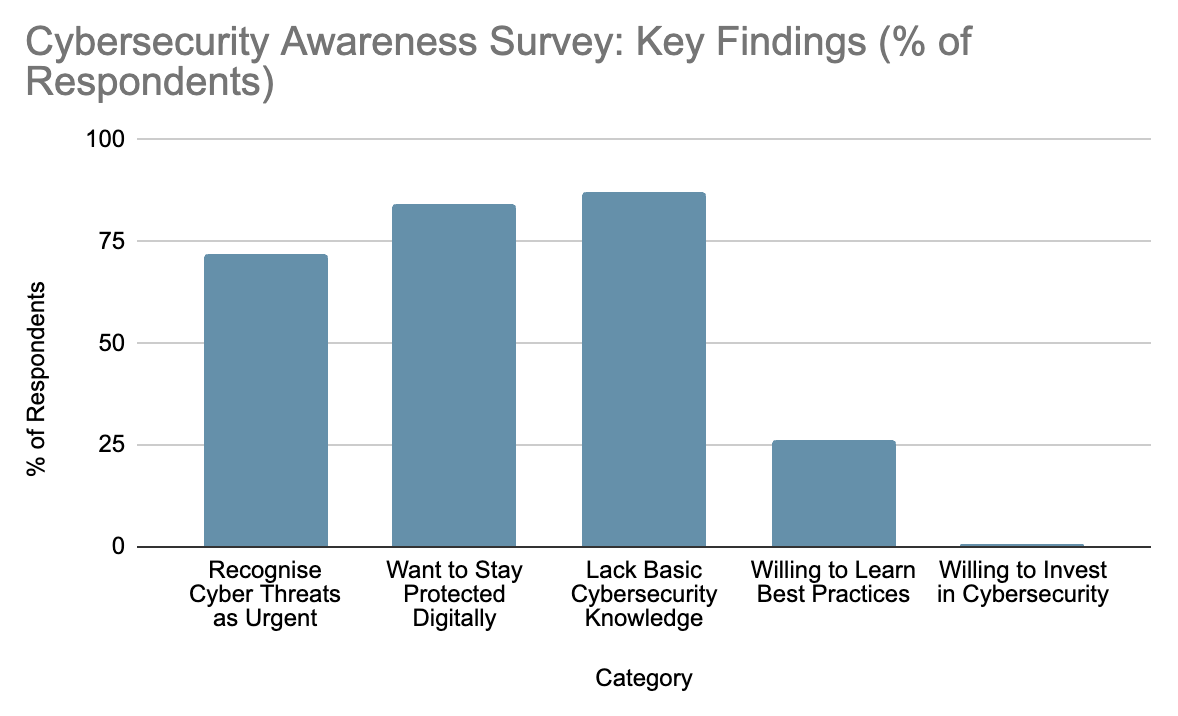
The most striking finding is that 87% of respondents lack basic cybersecurity knowledge, meaning the overwhelming majority of users in the region do not possess even foundational understanding of how to protect themselves online. This includes identifying phishing attempts, creating strong passwords, recognising unsafe websites, or understanding two-factor authentication.
Yet, paradoxically, 72% of respondents acknowledge that cyber threats and digital security are the need of the hour. The awareness of danger is there; what is missing is the knowledge and tools to respond to it.
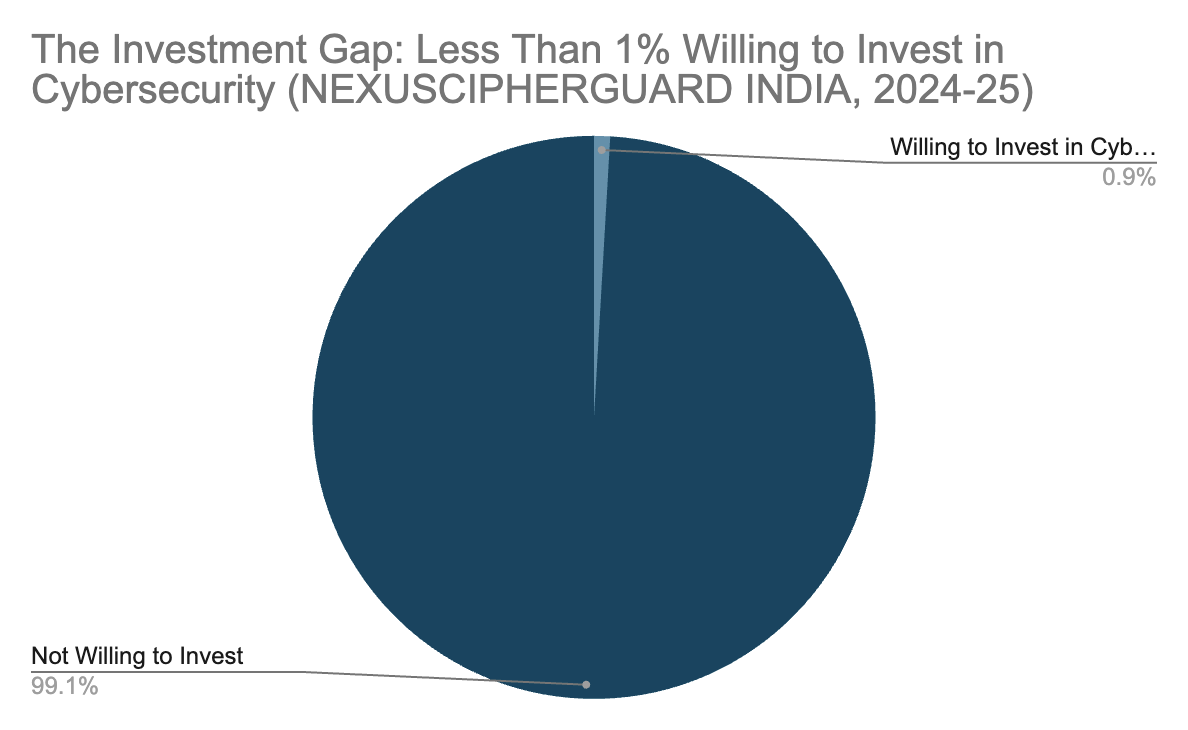
More than 84% of those surveyed said they want to stay protected digitally, a clear and resounding demand for safety. However, that desire has not translated into tangible action. Fewer than 0.92% of respondents indicated a willingness to invest in cybersecurity, whether through services, products, or protective practices. This near-zero investment rate is alarming, and signals both a lack of financial prioritisation and, likely, a lack of accessible, affordable options in the region.
Over 26.4% expressed willingness to learn cybersecurity best practices, a modest but meaningful silver lining, suggesting that with the right educational outreach and programs, a significant segment of the population can be mobilised toward safer digital behaviour.
A Region at Risk: The Digital Landscape of Nagaland and North East India
The North East of India, including Nagaland, has witnessed rapid smartphone adoption and internet penetration over the past decade. Social media, digital payments, e-governance services, and online communication have become integral to daily life. Yet, infrastructure development has far outpaced digital safety education, leaving millions of users vulnerable to cyber threats that they neither understand nor are equipped to counter.
Phishing attacks, social media scams, identity theft, SIM-swapping fraud, and data breaches have become increasingly common across the region, according to local cybersecurity practitioners and law enforcement reports. Despite this, there has been a notable absence of dedicated cybersecurity institutions, public or private, working to address the gap at scale.
A stark example of these threats occurred in 2024, when a female College student from Kohima lost access to her Gmail, WhatsApp, and Telegram accounts after clicking a malicious link from a contact claiming to have her childhood images. The perpetrator then demanded Rs. 25,000 for account restoration. Even after paying, she was further threatened with her personal photos stored in Google Photos, leading to another extortion attempt of Rs. 25,000.
As cybersecurity expert Pangerkumzuk Longkumer warns, “In the digital world, not every “helper” has good intentions. Sometimes, the person warning you about the fire is the one who lit the match.”
It is against this backdrop that the NEXUSCIPHERGUARD INDIA survey assumes significant importance. It is not merely a collection of statistics, it is a call to action.
NEXUSCIPHERGUARD INDIA: Nagaland’s Pioneer in Private Cybersecurity
NEXUSCIPHERGUARD INDIA holds the distinction of being potentially the only dedicated private cybersecurity entity operating across the entire North East India region, and, by current accounts, potentially the only dedicated private cybersecurity entity operating across the entire North East India region. In a landscape where cybersecurity has long been the exclusive concern of large metropolitan corporations or central government agencies, NEXUSCIPHERGUARD INDIA’s presence in Nagaland represents a significant and pioneering development.
The firm has taken a proactive stance in conducting outreach programs, community workshops, and awareness campaigns across the region, often at little or no cost to participants. Recognising that the cybersecurity awareness gap cannot be bridged by commercial incentives alone, NEXUSCIPHERGUARD INDIA has positioned itself as both a service provider and an educator, a dual role that is especially vital in a region where digital literacy resources remain scarce.
The 2024‑25 survey itself is a testament to this commitment. Rather than simply offering services, the firm invested in understanding the ground reality of its own user base and the broader community, gathering credible, region-specific data that can inform both public policy and private initiatives.
MMB Cyber School: Grassroots Education for a Safer Digital Community
Complementing the efforts of NEXUSCIPHERGUARD INDIA is MMB Cyber School, an NGO/NPI (Non-Profit Institution) that has been quietly but effectively working at the grassroots level to expand cybersecurity education across communities in Nagaland and the broader North East. Where private firms may focus on formal service delivery, NGOs like MMB Cyber School fill the essential role of reaching those who are most vulnerable, school-going youth, rural communities, senior citizens, and economically marginalised groups.
MMB Cyber School’s work has centred on demystifying cybersecurity for everyday users, translating complex concepts like password hygiene, phishing awareness, safe browsing habits, and two-factor authentication into accessible, practical guidance. Through community-level training sessions, school programmes, and public awareness initiatives, the organisation has made meaningful inroads in a domain that was previously almost entirely neglected at the local level.
Importantly, MMB Cyber School and NEXUSCIPHERGUARD INDIA share a common recognition: that no single entity can solve the cybersecurity awareness crisis in the North East alone. Collaboration between the private sector, civil society, educational institutions, and government is not merely desirable, it is essential.
Bridging the Gap: What Needs to Happen Next
The survey findings make clear that good intentions alone are not enough. While 84% of users want digital protection and 72% recognise the urgency of the threat, less than 1% are willing to invest in solutions, and only 26.4% want to learn best practices. Bridging this intention-action gap requires a multi-pronged strategy.
First, cybersecurity education must be embedded into school and college curricula across Nagaland and neighbouring North Eastern states. Digital safety should be taught not as an elective or supplementary topic, but as a core life skill, as fundamental as reading, writing, and arithmetic in the modern world.
Second, government bodies, including the Directorate of Information Technology, Nagaland, and the Department of Electronics and Information Technology at the central level, must partner with organisations like NEXUSCIPHERGUARD INDIA and MMB Cyber School to fund, scale, and sustain awareness campaigns and training programs.
Third, the near-zero investment rate reveals a market gap: affordable, region-appropriate cybersecurity products and services designed for the North East are urgently needed. NEXUSCIPHERGUARD INDIA, as the region’s only known private cybersecurity firm, is uniquely positioned to develop and offer such solutions, if adequately supported by policy incentives and institutional partnerships.
Finally, community champions, local leaders, teachers, youth volunteers, must be trained and empowered to spread cybersecurity awareness within their own networks. The 26.4% who are willing to learn best practices represent a ready and reachable audience that can, in turn, become ambassadors for digital safety in their communities.
Conclusion: A Defining Moment for Digital Nagaland
The NEXUSCIPHERGUARD INDIA survey of 2024‑25 is more than a data report, it is a mirror held up to Nagaland and North East India, reflecting with uncomfortable clarity the scale of the digital vulnerability that exists in the region. With 87% of users lacking basic cybersecurity knowledge and less than 1% willing to invest in protection, the gap between risk and readiness has never been more apparent.
As Longkumer emphasizes, “The biggest vulnerability in cybersecurity isn’t software—it’s human error.”
Yet, amid the sobering statistics, there is cause for cautious optimism. The desire for digital safety is strong. The willingness to learn, however modest, is present. And critically, organisations like NEXUSCIPHERGUARD INDIA and MMB Cyber School are already on the ground, doing the difficult and necessary work of raising awareness, building capacity, and advocating for a safer digital future for the people of Nagaland and the North East.
What is now needed is urgency, scale, and collective commitment, from government, educational institutions, civil society, and individuals alike. Cybersecurity is no longer a concern exclusive to banks, corporations, or intelligence agencies. In a world where every smartphone user is a potential target, digital safety is a public good, and protecting it is everyone’s responsibility.
As Longkumer aptly summarizes, “Cybersecurity is not just about technology—it’s about people. Awareness and proactive behavior are our best weapons against these evolving threats.”
The call of the hour has been heard. The question now is: who will answer it?