The first phase of Census Training for Enumerators and Supervisors for Chiephobozou Sub-division was commenced on June 9 at DIET conference Hall, Chiechama, Kohima.
Delivering a keynote address, Additional Deputy Commissioner Chiephobozou, Vekusheyi Rhakho and Sub- divisional Census Officer, Chiephobozou said that Census is one of the largest administrative and statistical operations undertaken by the Government, where it would provide vital information on the population, demographic characteristics, literacy, housing amenities and socio-economic conditions of our people.
They also informed that the data collected will form the basis for policy formulation, developmental planning and resource allocations by the Government. He appealed the Enumerators and Supervisors to be the backbone of this census exercise. Success and credibility of the exercise will depend on their sincerity, dedication and professionalism, they added.
They directed them that information collected must be accurate, unbiased and complete, and urged upon all to familiarise with the concepts and instructions provided during the training that every household and every individual must be covered without omission and duplication and confidentiality of the information furnished by the public must be maintained at all time.
They asserted that supervisors have a very important responsibility of guiding and monitoring the work of the Enumerators and ensure that the highest standard of accuracy and quality is maintained.
They reminded that Census work is not merely a routine administrative task, but it is a historic responsibility and a contribution towards nation building.
Encouraging the trainees that quality and accurate enumeration, would depend on the sincerity and accountability of the Enumerators and Supervisor, they said they must be accountable and bear responsibility for any omission, negligence or irregularity in the conduct of Census operation. He expressed his confident that with their dedication and cooperation “we would be able to conduct Census 2027 successfully and set the high standard of excellence in our Sub- division”.
The inaugural session was chaired by EAC and Census Charge Officer, Chiephobozou Rural, Viketoulie Metha who also delivered a welcome address.
Brief Overview of Training were highlighted by Field trainers, Alemsongla Jamir and Ruthla Sangtam. Concluding remarks by Ane Khieya, EAC Kohima and Census Charge Officer, Botsa. The first Phase training was attended by 23 Trainees from Botsa, 7 from Chiephobozou (Rural) and 13 from Chiephobozou Town.
Kohima:
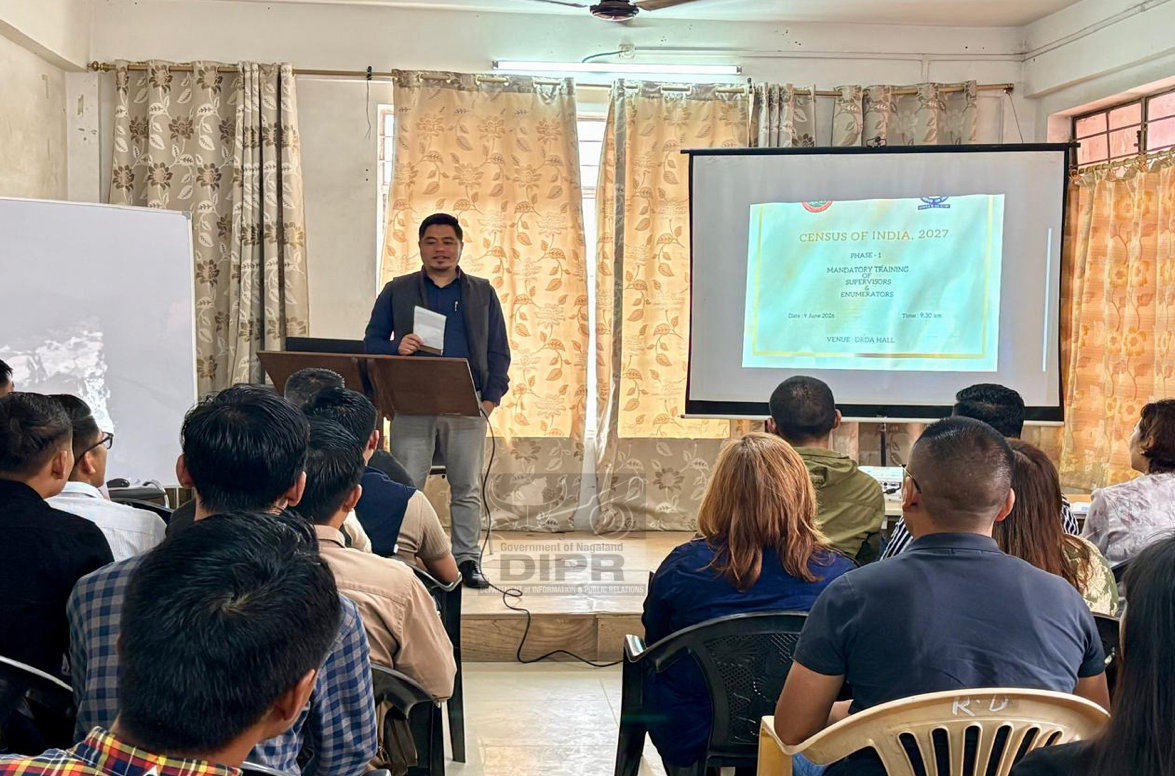
Meanwhile, training for Enumerators and Supervisors under Phase-I of the Census of India 2027 commenced across Kohima district on June 9 and will continue till June 11.
The three-day programme covers census concepts and legal provisions, ground-truthing of House Listing Block boundaries, preparation of layout maps, and the use of the House Listing Operation (HLO) Mobile App. Participants are also being trained in data collection, verification, self-enumeration procedures, and data security measures.
Practical sessions include mobile app-based data entry, error detection, household approaches, handling refusals, and communication protocols. The training will conclude with role-play exercises, a Seva Bhaav Pledge, and distribution of kits to the participants.
The training is being conducted in four batches covering various charge clusters.
Download Nagaland Tribune app on Google Play


At DIET Chiechama, 43 trainees from Chiephobozou Rural, Chiephobozou Town and Botsa charge clusters are undergoing training under field trainers, Alemsongla Jamir and M. Ruthla Sangtam.
The second batch, comprising 47 trainees from Sechü- Zubza, Jakhama and Kezocha charge clusters, is being held at the DPDB Hall under the guidance of Anisha Himb and Ketoriavi Sakhrie.
EAC Kezocha, Zerutso Kesiezie urged participants to take their responsibilities seriously, emphasizing that the quality of their work would directly impact the accuracy of data used by the government for planning and policymaking.
He encouraged the trainees to consider their participation in the census operation as a privilege and an opportunity to contribute to a nationally important exercise.
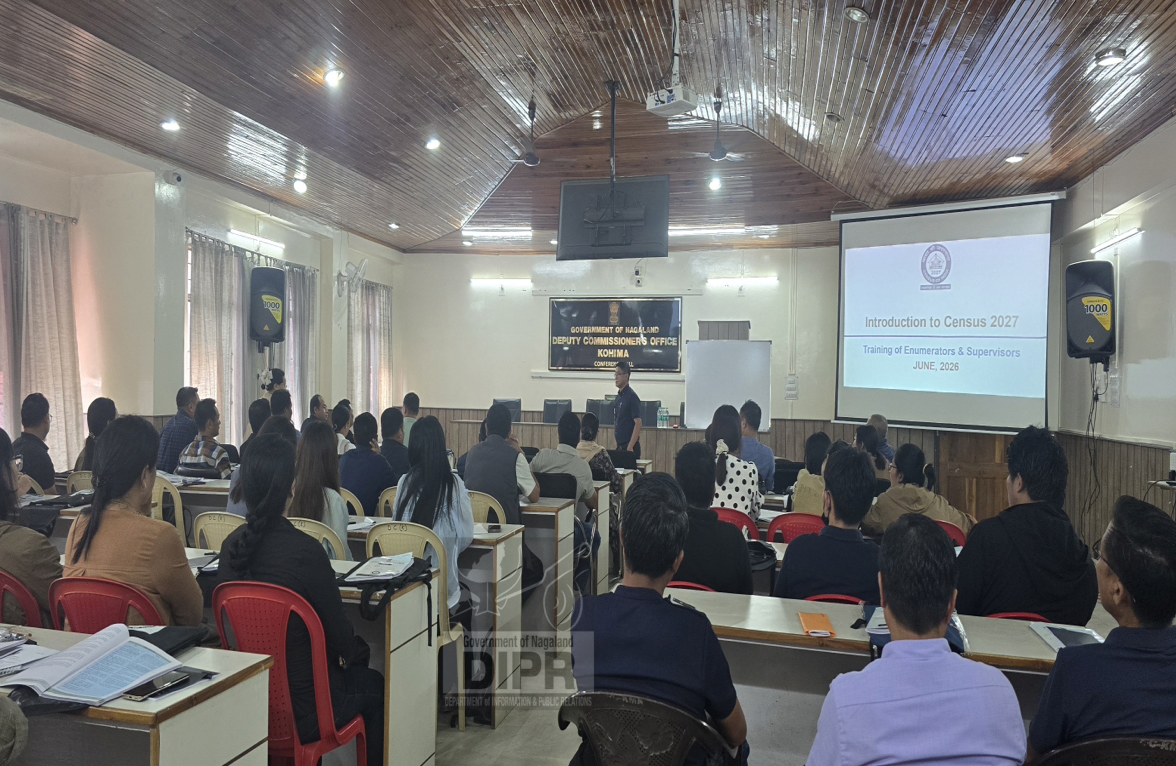
At the DC’s Conference Hall, 49 trainees from Kohima Sadar (Rural) and Kohima Sadar (Statutory Town) are being trained by Dr. Keduolhoulie Belho, and Dr. Medongulie Tsiekhanuo.
Addressing the participants, EAC Kohima, Khriethozo Pfükri, described the census as a constitutional exercise of national importance conducted under the Census Act, 1948. He noted that the census, originally scheduled for 2021, was postponed due to the COVID-19 pandemic and will now be conducted in two phases.
Pfükri informed that House Listing Operations will take place from July 1 to 31, 2026, while Population Enumeration is scheduled for February 2027. He also highlighted that the 2027 Census will be India’s first fully digital census.
Acknowledging that census duties would be carried out alongside regular official responsibilities, he urged participants to cooperate and actively engage in the training programme. He further reminded enumerators and supervisors of their legal responsibilities under the Census Act and called for accuracy, dedication and teamwork to ensure the successful conduct of the exercise.
Involving 50 trainees from Kohima Sadar (Statutory Town), is being conducted at the DRDA Hall under field trainers, Thejakielie Meyase and Savilie Yhor.
Alemyapang Longchar, CEO, KMC and City Census Officer, stressed the importance of the three-day training programme and urged the participants to make full use of it. He said supervisors would play a key role in guiding enumerators and ensuring that the Census is conducted effectively.
Referring to the Census schedule, he informed that during the first two days of the exercise, enumerators would identify and demarcate their respective blocks, prepare layout maps and verify field details. He urged supervisors to maintain close coordination with the enumerators and provide necessary support throughout the process.
Noting that the Census would be conducted through a paperless and digital platform, he said technical and operational challenges may arise and called upon the participants to be prepared to address them. He stressed that no person should be left out of the Census and urged supervisors to closely monitor the work and progress of the enumerators.