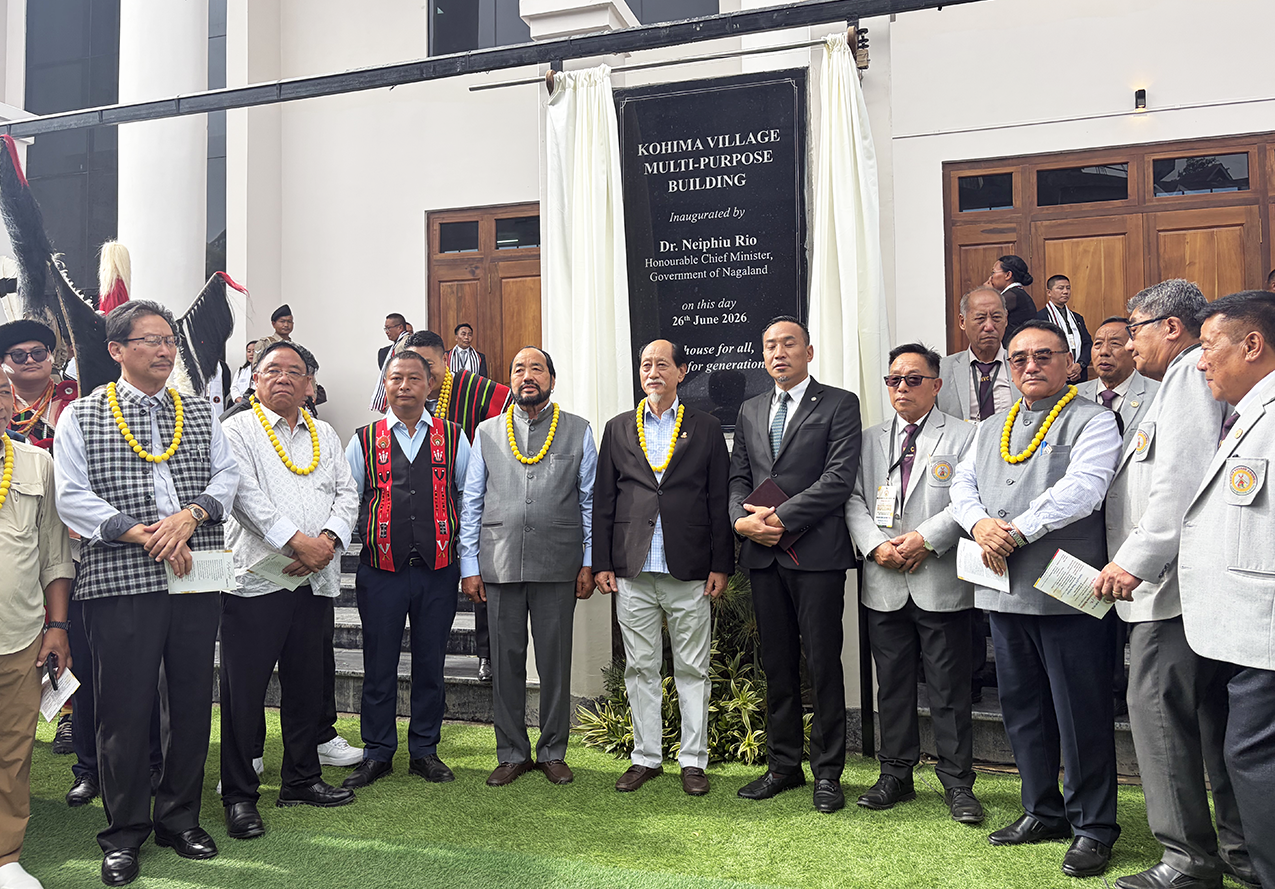
Nagaland Chief Minister, Neiphiu Rio on Friday called for collective efforts to safeguard indigenous rights through effective implementation of the Inner Line Permit (ILP) and the Register of Indigenous Inhabitants of Nagaland (RIIN), while inaugurating the Kohima Village Multipurpose Building at Ziekezou, Kohima Village.
Stating that the building is not merely a community hall but a symbol of Naga unity, identity and shared heritage, Rio described the building as a common space for all Nagas and reaffirmed the government’s commitment to preserving the state’s unique cultural, constitutional and customary institutions while promoting inclusive development.
Rio said the project was made possible through substantial financial assistance from the Ministry of Tribal Affairs, Government of India, which sanctioned Rs 5 crore for the construction during the tenure of then Union Tribal Affairs Minister, Arjun Munda. He also assured that the state government would provide additional funds to complete the remaining works.
Congratulating the Kohima Village Council, led by Chairman, Helievi-o Solo, Rio credited the successful completion of the project to the unity and collective efforts of the village community. He emphasised that the building belongs not only to Kohima Village but to all Naga communities and organisations that may require a common venue for social, cultural and community events, fostering unity and goodwill.
The Chief Minister also reflected on Kohima Village’s historical significance, describing it as one of the largest indigenous villages in Asia and attributing its growth to its welcoming spirit and inclusive nature. He noted that the village has long served as a centre for preserving and nurturing Naga identity and traditions.
Highlighting the constitutional and legal safeguards protecting the rights of the Nagas, Rio referred to the Bengal Eastern Frontier Regulation (BEFR), 1873, which introduced the Inner Line Permit system, and Article 371A of the Constitution of India, which safeguards the religious and social practices, customary laws, and traditional institutions of the Nagas. He urged tribal bodies, hohos and community organisations to continue protecting and promoting the unique identity and cultural heritage of the Naga people.
Expressing confidence that the new facility would serve generations to come, Rio said the multipurpose building would stand as a symbol of brotherhood, unity and shared progress, while providing a common platform for all communities to host events in the state capital.
Speaking on the protection of Naga identity and customary institutions, Rio said three petitions had questioned the legality of extending the ILP to the three districts, but the state government successfully defended its position in court. He asserted that the judgment reaffirmed Nagaland’s authority to implement the ILP, which traces its origins to the Bengal Eastern Frontier Regulation (BEFR), 1873, and continues to be protected under Article 371A of the Constitution.
Emphasising that legal protection alone is insufficient, Rio called for collective responsibility in ensuring effective implementation of the ILP system. He urged house owners to register and certify tenants, village councils to maintain records of non-Naga residents working within their jurisdictions, and institutions, contractors and employers to ensure that all non-local workers are properly documented. “Everybody who comes to Nagaland should have a registration,” he stressed.
The Chief Minister also acknowledged the concerns raised by students’ organisations regarding the influx of non-local workers. However, he maintained that long-term protection of Naga interests would require developing a skilled local workforce capable of taking over jobs currently performed by migrant workers, rather than relying solely on government action.
Rio further highlighted Nagaland’s exemption from the 73rd Constitutional Amendment, which introduced the Panchayati Raj system across India. He said this exemption has enabled the state to preserve its traditional village council system based on consensus and selection rather than electoral politics.
Explaining the importance of the customary governance model, Rio said village councils are institutions rooted in Naga tradition where leaders are selected through consensus instead of elections. Introducing electoral contests within village councils, he cautioned, could create ruling and opposition factions, dividing villages and weakening the unity that has long characterised Naga society.
Download Nagaland Tribune app on Google Play


Speaking on the Register of Indigenous Inhabitants of Nagaland (RIIN), the Chief Minister said the initiative was introduced to clearly identify and protect the indigenous inhabitants of the state after instances where indigenous certificates had allegedly been issued to non-Nagas over the years.
Rio said the RIIN exercise is intended to distinguish indigenous inhabitants from permanent or temporary residents. While non-Naga communities and business families residing in the state are welcome to live and work in Nagaland, he maintained that they cannot be classified as indigenous inhabitants.
He explained that native Naga villages remain the primary authority in certifying who is indigenous, noting that Nagas do not require fresh enumeration as their indigenous status is rooted in their ancestral villages. According to him, those who migrated within Nagaland would continue to retain their indigenous identity based on their native village of origin.
The Chief Minister further stated that Indian citizens who settled in Nagaland before the prescribed cut-off year could be recognised as permanent residents, while those arriving after the cut-off would be treated as temporary residents but would not qualify as indigenous inhabitants.
Referring to communities such as Kukis, Garos and Karbis (Mikirs), Rio said legal challenges had been made seeking indigenous status. However, he maintained that these communities are migrants to Nagaland and therefore cannot be recognised as indigenous inhabitants of the state under the RIIN framework.
Rio also clarified that the RIIN exercise specifically concerns the indigenous inhabitants of Nagaland and should not be confused with the status of Nagas residing in neighbouring states. He said Nagas living in Manipur, Arunachal Pradesh and Assam are indigenous to their respective ancestral areas, while the RIIN is designed solely to identify indigenous inhabitants within Nagaland.
Rio underscored that unity, cooperation and brotherhood are essential for the survival and progress of both Nagaland and the Naga people. He described the newly inaugurated Kohima Village Multipurpose Building as a symbol of oneness, saying that while the facility would be managed by the Kohima Village Council, it is intended to serve all communities for social, cultural and public events upon payment of a nominal user fee.
Highlighting the government’s focus on public welfare, Rio spoke about the Chief Minister Health Insurance Scheme (CMHIS), stating that government employees contribute approximately Rs 400–500 annually based on their salary scale, while beneficiaries are entitled to health coverage of up to Rs 20 lakh per year for medical treatment. He said the scheme reflects the state’s commitment to ensuring better healthcare access for its citizens.
On employment and entrepreneurship, the Chief Minister acknowledged the growing competition in recruitment through the Nagaland Public Service Commission (NPSC) and the Nagaland Staff Selection Board (NSSB), noting that government jobs alone cannot sustain the state’s economy. He encouraged young people to explore entrepreneurship, adding that under the state’s micro-financing initiatives, eligible entrepreneurs can avail loans with minimal financial burden, where beneficiaries contribute only 10 per cent, the state government provides 30 per cent support, and banks finance the remaining 60 per cent.
Rio also stressed the importance of the upcoming 2027 Census, expressing concern that the 2001 Census in Nagaland was “horribly wrong” and urging citizens to ensure accurate enumeration. He said reliable census data is vital for effective planning, equitable allocation of resources and the state’s future development, calling on the people to cooperate in producing truthful demographic figures.
Advisor for School Education and MLA, Dr Kekhrielhoulie Yhome, reflected on the historical and cultural significance of Kohima Village, describing it as the birthplace of Nagaland’s capital and a place that has long welcomed people from across the state and beyond.
Yhome noted that Kohima’s position as the capital has brought development and opportunities but has also placed immense social and economic pressure on the indigenous community. He said the village has generously contributed much of its ancestral land for public infrastructure and urban expansion, yet many indigenous families now face land constraints despite being natives of the area.
Yhome said, the capital comprises 19 municipal wards and continues to attract people from different communities seeking better opportunities.
Highlighting the significance of the newly inaugurated Kohima Village Multipurpose Building, Yhome said the facility was constructed with government support and is intended to serve not only Kohima Village but all Nagas. He expressed hope that the building would become a common platform for community gatherings, cultural events and discussions on issues concerning the future of the Naga people.
Inviting the public to make use of the facility, he said the multipurpose building would be available for community functions at a nominal fee and would serve as a symbol of unity, cooperation and shared progress for generations to come.
The inaugural programme was compered by Kikruneinuo Liezietsu and Vilakuolie Mere, while the invocation was offered by Rev Dr Ruokuovilie Sachü, Senior Pastor, Kohima Baptist Church (KBK). The inaugural monolith of the Kohima Village Multipurpose Building was unveiled by the Chief Guest, Chief Minister, Neiphiu Rio.
The programme featured a welcome address by Helievi-o Solo, Chairman of the Kohima Village Council (KVC), a special presentation of “Kewhizou” by Medophrenuo Yiese, and a report on the construction of the Kohima Village Multipurpose Building was also played . A traditional folk song was presented by Lidi Kro-u, while the programme concluded with a vote of thanks delivered by K. Neibou Sekhose, Convenor of the Organising Committee.