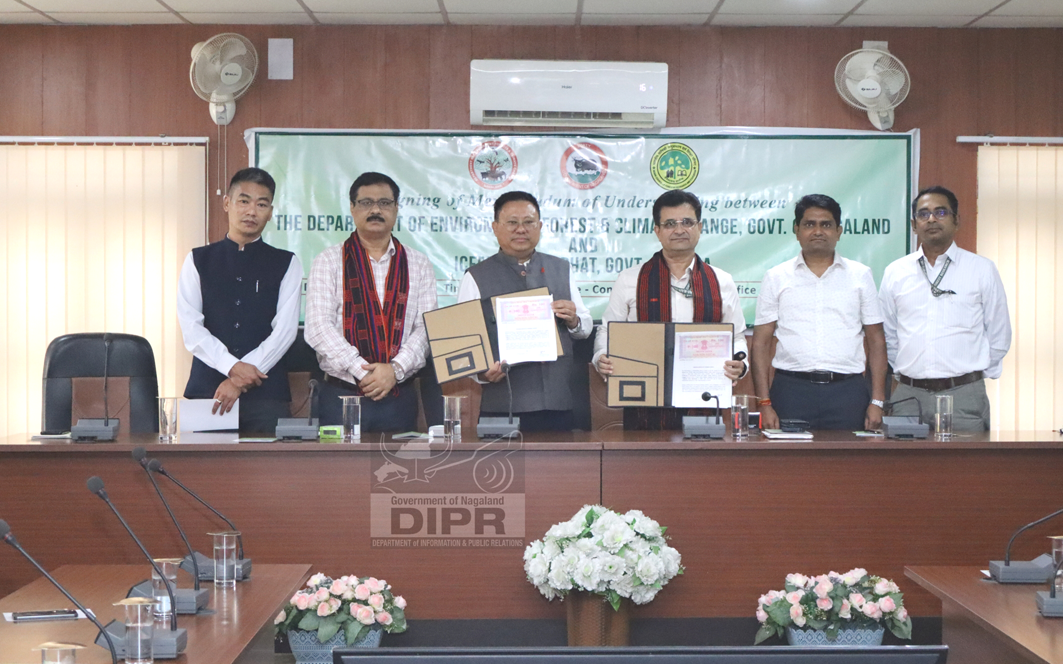
In a significant step towards promoting scientific forestry and sustainable livelihoods, the Department of Environment, Forest & Climate Change (DEFCC), Government of Nagaland, on Saturday signed a Memorandum of Understanding (MoU) with the Indian Council of Forestry Research and Education–Rain Forest Research Institute (ICFRE-RFRI), Jorhat, to strengthen research, technology transfer and sustainable management of the State’s forest resources.
The MoU was signed at the Forest Office Complex, Dimapur, and is expected to enhance collaboration in areas such as agroforestry, bamboo, agarwood, plantation development, capacity building and scientific forest management, according to DIPR update.
Speaking on the occasion, Dr Nitin Kulkarni, Director of ICFRE-RFRI, described the agreement as the beginning of a stronger partnership between the institute and the Government of Nagaland for the sustainable management of forest resources.
He said the Rain Forest Research Institute (RFRI), functioning under the Indian Council of Forestry Research and Education (ICFRE), has been carrying out extensive research on agroforestry, bamboo, agarwood and other forest resources across the Northeast. Emphasising that research should directly benefit communities, he stressed the importance of technology transfer, extension services and capacity-building programmes for farmers and stakeholders.
Kulkarni noted that the Northeast is one of India’s richest biodiversity hotspots and called for the sustainable utilisation of natural resources while ensuring their conservation for future generations. He expressed confidence that the collaboration would promote scientific research, value addition and sustainable livelihoods linked to Nagaland’s forest and plantation resources.
Addressing the gathering, Principal Secretary, Environment, Forest & Climate Change and Development Commissioner, Y Kikheto Sema, IAS said Nagaland is entering a new phase of sustainable development after nearly two decades of peace, with plantation-based livelihoods such as agarwood and coffee emerging as promising drivers of economic growth while safeguarding the environment.
Download Nagaland Tribune app on Google Play


He pointed out that nearly 70 per cent of Nagaland’s population resides in rural areas and depends on agriculture and allied sectors. In the absence of large and medium-scale industries, he said plantation crops offer significant opportunities for employment generation and livelihood enhancement.
Highlighting the State’s recently approved Nagaland Agarwood (Conservation and Promotion) Policy, 2026, Sema said the policy was framed to ensure fair returns for farmers engaged in agarwood cultivation. Approved by the State Cabinet on May 6, the policy paved the way for collaboration with RFRI to facilitate scientific research, quality planting materials, technology transfer and technical support.
He observed that Nagaland’s foothill areas bordering Assam possess favourable agro-climatic conditions for agarwood cultivation, where natural agarwood infection is already prevalent. The partnership with RFRI, he said, would help improve cultivation practices, strengthen market linkages and enhance farmers’ incomes.
Sema also stressed the need for greater collaboration with research institutions across the Northeast to accelerate innovation and technology exchange. Referring to advances in plantation science, he noted that improved technologies could significantly reduce the maturity period of plantation species, enabling farmers to realise better returns in a shorter time.
Expressing concern over the decline in forest cover, he cited the India State of Forest Report and urged communities and landowners to conserve natural forests while promoting sustainable plantation crops such as agarwood and coffee to improve rural livelihoods and strengthen climate resilience.
Describing the MoU as the foundation of a long-term partnership, Sema called for close cooperation between the department and RFRI in research, farmer training, technology dissemination and market development. He said sustained collaboration among government agencies, research institutions and local communities would be key to achieving sustainable development and improving the socio-economic condition of farmers across the State.
The programme was chaired by Supongnukshi Ao, IFS, Additional Principal Chief Conservator of Forests (Territorial). The keynote address was delivered by Sidramappa Chalkapure, IFS, Chief Conservator of Forests (Planning & Development) and Member Secretary, Nagaland State Biodiversity Board, while T. Aochuba, IFS, Conservator of Forests, proposed the vote of thanks.